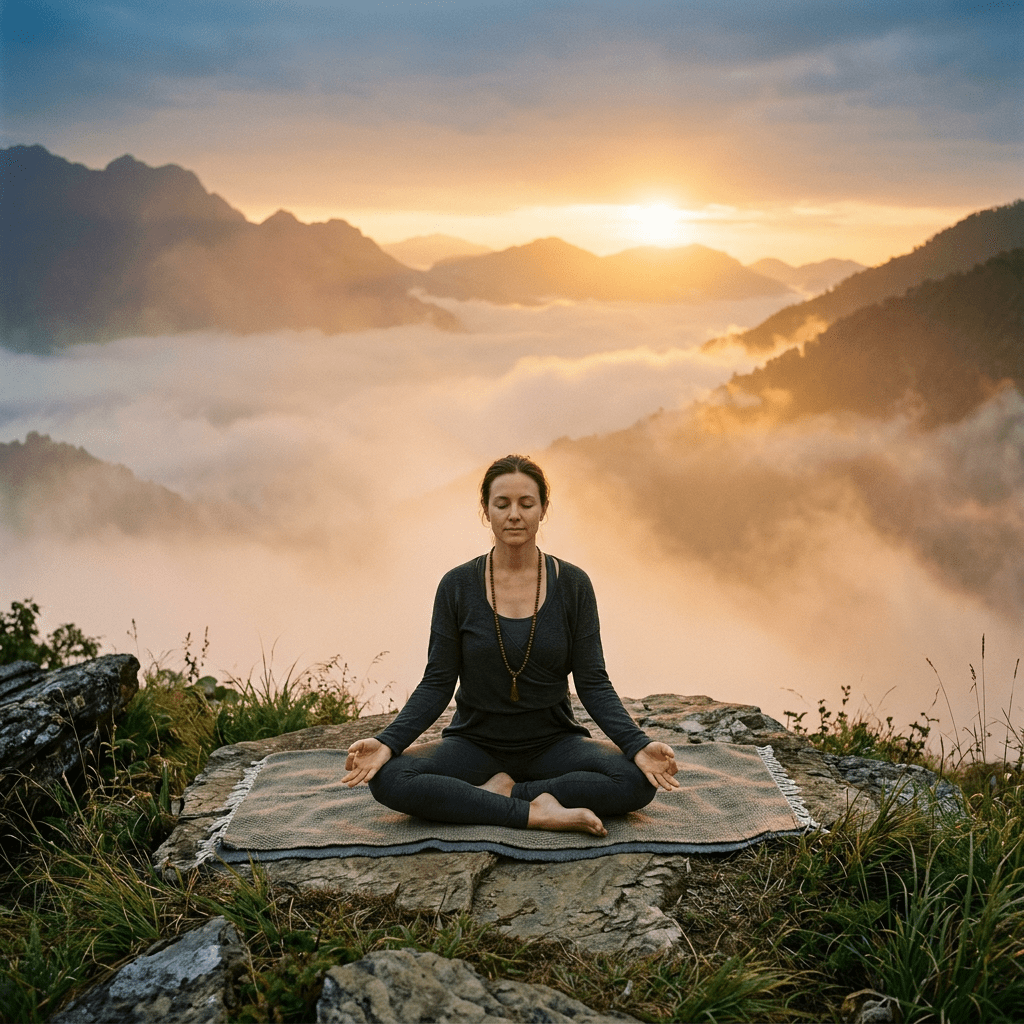
There is in the tradition that emerges from the Rig Veda a practice whose origins are so ancient that archaeologists have found them engraved on the seals of Mohenjo-daro, depicting figures seated in postures that indicate a particular attention to the torso and the breath: prânayama. This practice, generally translated as breath control or breathing exercises, is far more precisely described by its root: prâna, vital force, and yama, control, deployment. Prânayamais therefore literally the extension of vital force through the mastery of breath, and this definition already says something essential about the difference between what the Vedic tradition understood by this practice and what contemporary preventive medicine seeks to produce.
Contemporary preventive medicine is an idea whose legitimacy everyone recognises and that health systems struggle to put into practice. Its principle is simple: it is better to maintain health than to treat illness, not only for the wellbeing of individuals but for the economic effectiveness of health systems that devote the greater part of their resources to curative care rather than preventive interventions. Despite this consensus in principle, preventive medicine remains marginal in most Western health systems, which are structurally organised around illness rather than health, around urgency rather than anticipation, around treatment rather than prevention.
Pranayama, in the Vedic tradition and in the traditions that derive from it, is precisely a practice of health maintenance in the most profound sense of the word. Not health as the absence of illness, which Western medicine has long considered its reference definition. But health as vitality, as the free circulation of vital energy throughout the entire body-consciousness system, as a dynamic equilibrium that allows the being to function with the fullness of its capacities. This vision of health as positive vitality rather than as the absence of pathology is precisely what the World Health Organisation attempted to capture in its 1948 definition, which remains to this day largely theoretical in concrete medical practices.
What does Prânayamado, concretely, in the body and in consciousness? The Vedic answer and the contemporary answer of physiology and neuroscience converge in a way that is one of the most striking in the entire field of research on contemplative practices. The autonomic nervous system, which regulates the involuntary functions of the body, is divided into two branches: the sympathetic system, said to govern fight or flight, which mobilises the organism in the face of threats, and the parasympathetic system, said to govern rest and digestion, which allows recovery, regeneration and maintenance functions. In modern life, dominated by chronic stress, permanent stimulation and perpetual urgency, the sympathetic system is chronically overactivated at the expense of the parasympathetic. The result is a physiology in a state of permanent alert, that consumes its resources without being able to regenerate them, that produces chronic inflammation, hormonal imbalances, weakened immunity, and ultimately the chronic diseases that dominate morbidity and mortality in developed countries.
Prânayamaacts directly and powerfully on this balance. Breathing is the only autonomous process of the body that we can consciously control, and it is precisely for this reason that it is the most direct interface between the conscious nervous system and the autonomic nervous system. By modifying the rhythm, the depth, the ratio between inhalation and exhalation, by introducing retentions at full or empty lungs, Prânayamadirectly modifies the balance between the sympathetic and parasympathetic systems. A prolonged exhalation, for example, activates the vagus nerve, the principal conductor of the parasympathetic system, and produces a state of calm and recovery that the body cannot otherwise reach in a few breaths. Breathing rhythmed at a frequency of approximately six cycles per minute, which the yogic tradition calls coherent breathing, produces what physiologists call cardiac coherence, a state in which heart rate variability is maximised, indicating optimal flexibility and resilience of the autonomic nervous system.
Heart rate variability is one of the most robust physiological markers of overall health and stress resilience. Studies show that high heart rate variability is associated with better cardiovascular health, stronger immunity, better emotional regulation, superior cognitive functions and a longer life expectancy. And Prânayamapractices, in their different forms, are among the most effective interventions for durably increasing this variability. This is not a coincidence: it is the neurophysiological confirmation of what the Vedic rishis knew from the inside, that mastery of the breath is the most direct and most powerful means of access to the regulation of the entire vital system.
But the Vedic vision of Prânayamagoes further than what contemporary physiology can measure. In the hymns and in the tradition that derives from them, prâna is not simply the oxygen that the lungs extract from the air. It is a cosmic force that circulates in the universe and whose vehicle in the human body is the breath. To practise Prânayamais therefore not only to optimise the physiology of the autonomic nervous system, it is also, and above all, to enter into conscious relationship with this cosmic force, to let it circulate freely throughout the entire body and consciousness, to dissolve the obstructions that prevent this circulation and that are, in the Vedic vision, the deep source of all illness.
This vision of illness as obstruction of the circulation of prâna is shared, in various forms, by all the traditional medicines of Eurasia: Chinese medicine with its qi circulating in the meridians, Ayurvedic medicine with its doshas and nadis, Tibetan medicine with its winds and channels. All describe health as the free circulation of a vital force and illness as the obstruction of this circulation. And all propose breathing practices as one of the fundamental tools for maintaining or restoring this circulation.
Contemporary preventive medicine that takes Prânayamaseriously is beginning to document effects that go well beyond simple relaxation. Studies on the regular practice of Prânayamashow significant reductions in blood pressure, inflammatory markers, chronic cortisol, anxious and depressive symptoms. They show improvements in pulmonary function, glycaemic regulation, sleep quality, recovery after effort. Certain studies are beginning to document effects on the expression of genes linked to inflammation and oxidative stress, suggesting that Prânayamaacts at a biological level deeper than classical physiology had anticipated.
These results are promising, but they encounter a structural obstacle in the contemporary health system: Prânayamacannot be patented. It generates no revenue for the pharmaceutical industry. It requires no medical visits or costly examinations. It can be learned in a few sessions and practised alone, free of charge, for life. These characteristics, which make it the ideal preventive medicine tool from the perspective of the patient and public health, make it economically unattractive for the dominant actors in the health system, who are structurally oriented toward costly and repeated interventions rather than toward empowering and free practices.
This is where the Vedic vision of Prânayamameets the most profound critique that can be addressed to contemporary preventive medicine: it cannot be truly preventive as long as it remains prisoner of an economic system that has more interest in treating illnesses than in preventing them. Pranayama, like dakshina, like the yajña, like all the Vedic practices we have examined in these articles, belongs to a vision of the world in which wellbeing is a common good that is cultivated collectively and freely, not a commodity that one purchases from specialised providers. This vision is neither nostalgic nor utopian. It is functional: it kept entire populations in good health for millennia, with resources infinitely more limited than those our health systems deploy today. And it waits, in every breath we have not yet learned to master, to be rediscovered.


Votre commentaire