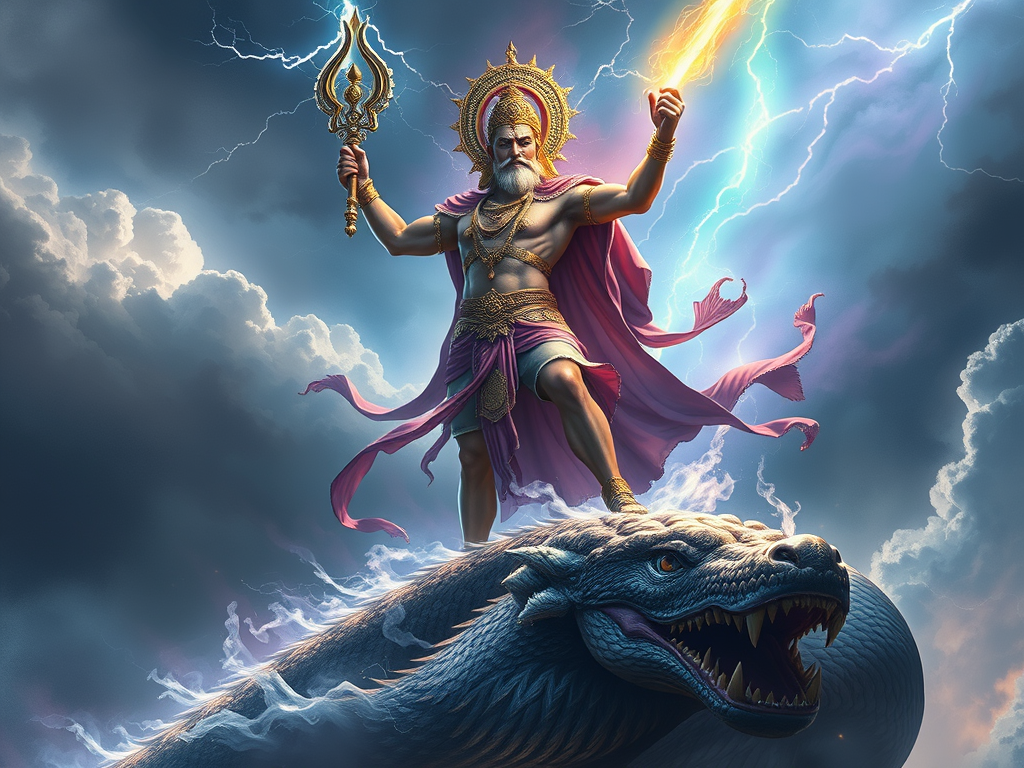
There is in the Rig Veda an image of Indra that stands in contrast to his usual representation as a warrior god armed with the thunderbolt: that of the chief chosen by his community. A passage in the tenth mandala says simply: « They chose him as a people chooses its king. » This sentence, brief and almost unremarkable in the flow of the hymns, is in reality one of the most important in the entire Vedic corpus for understanding the nature of political power in the civilisation of the 7 Rivers. It says that the chief is not a monarch of divine right, not a conqueror who imposes himself by force, not an heir who receives power as a family inheritance. He is someone the community has chosen, and this election defines him as much as his own qualities.
Indra is the warrior god, certainly, but he is also the god of collective energy, of the force that emerges when a community unites around a common goal. His weapon, the Vajra, is made from the bones of the rishi Dadhîca, that is to say from the very substance of transmitted and shared wisdom. His power is not solitary: he fights with the Maruts, he is supported by the rishis who recite the hymns, he is sustained by the soma that the community prepares and offers. Indra without his community is not Indra. He is a force without direction, an energy without purpose. It is the community that makes him what he is by choosing and supporting him.
This vision of the chief as an emanation of the community rather than an authority imposed from outside is fundamentally democratic in the most profound sense of the word. Not democratic in the modern procedural sense, with its ballots, its parties, its constitutional rules. Democratic in the substantive sense: power comes from the people, not as a legal fiction but as a lived reality, in which those who lead are genuinely chosen, genuinely supported, genuinely accountable to those who chose them.
Contemporary direct democracy, in its various forms, seeks to recover something of this spirit. It opposes classical representative democracy, in which citizens delegate their power to elected representatives who then exercise this power relatively autonomously for several years. It proposes instead mechanisms of more continuous and more direct participation: popular initiative referendums that allow citizens themselves to propose laws, randomly selected citizens’ assemblies that deliberate on complex questions, participatory budgets that give citizens direct power over the use of public resources, digital platforms that allow permanent consultation of citizens on political decisions.
These mechanisms respond to a real and legitimate frustration. Contemporary representative democracy presents serious dysfunctions that its most honest advocates acknowledge: the capture of elected representatives by the economic interests that finance electoral campaigns, the progressive distancing between decision-makers and ordinary citizens, the transformation of political parties into electoral machines disconnected from ground-level realities, the professionalisation of politics that makes it a separate trade from ordinary life. Faced with these dysfunctions, direct democracy proposes to shorten the distance between power and the people, to recreate something of the immediacy of the relationship that the tenth mandala passage describes when it says that the people chose their king.
But the Vedic vision of Indra invites us to go further in reflecting on what direct democracy can and cannot do. In the hymns, the choice of Indra by the community is not an administrative act, not a formal procedure in which each expresses an individual preference and the arithmetic majority determines the result. It is an act of recognition: the community identifies in Indra the one who best embodies the force and the vision it needs to accomplish what it must accomplish. It is not the will of the majority that creates Indra. It is the collective vision of a community that knows what it is and what it wants to become.
This distinction between the will of the majority and collective vision is fundamental and often neglected in debates on direct democracy. The will of the majority is what one measures in a vote: it is the aggregation of individual preferences, each carrying the same weight, the result being determined by the greatest number. Collective vision is something different and more difficult to produce: it is what emerges when a community truly deliberates, when its members listen to each other, inform each other, confront their perspectives, and arrive at a shared understanding that surpasses the simple sum of initial preferences.
Contemporary direct democracy, in its best expressions, seeks precisely to produce this collective vision rather than simply to aggregate individual wills. Randomly selected citizens’ assemblies, which have been used with remarkable success in Ireland to address questions such as abortion and same-sex marriage, are the most accomplished example. These assemblies bring together ordinary citizens, representative of the diversity of society, who spend several weeks or months informing themselves on a complex question, hearing experts, deliberating among themselves, and finally formulating recommendations that are often more nuanced and more sagacious than what professional politicians would have produced. This resembles, in its structure, what the rishis did in the deliberation circles of Vedic civilisation.
What is missing, however, from contemporary direct democracy, even in its most elaborated forms, is what the Vedic vision of Indra reminds us: the inner condition of authentic democracy. In the civilisation of the 7 Rivers, the choice of Indra by the community was possible because those who chose had themselves a particular quality of consciousness, forged by the regular practice of soma and the sacrifice. They were not atomised individuals, each enclosed in their egotistic preferences and immediate personal interests. They were members of a community who had regularly experienced the dissolution of the ego into something greater, who knew from the inside what the common good meant because they had lived it in the ecstasy of the sacrifice.
This inner condition is precisely what is missing from our contemporary democracies, direct or representative. One can multiply participatory procedures, deliberation platforms, referendums and citizens’ assemblies: if the participants arrive at these processes with unworked egos, intact tribal identities, fears and desires that short-circuit the capacity to see beyond immediate interest, the results will be disappointing. Direct democracy is not a technical solution to the problem of democracy. It is an aspiration that can only be fully realised if it is accompanied by a transformation of the quality of consciousness of the participants.
What the Vedic vision of Indra offers us is therefore not an institutional model to reproduce. It is an understanding of what makes democracy possible in its most profound dimension: not procedures, but people. People who have developed the capacity to see beyond their immediate ego, to truly hear others, to recognise in someone else the quality and the vision that deserve to be followed. People who know, because they have lived it, that the common good is real and that it is worth sacrificing a part of one’s personal preferences for it. This is what Indra represents: not democracy as procedure, but democracy as collective quality of consciousness. And this is what our contemporary democracies, direct or representative, most need to recover.


Votre commentaire