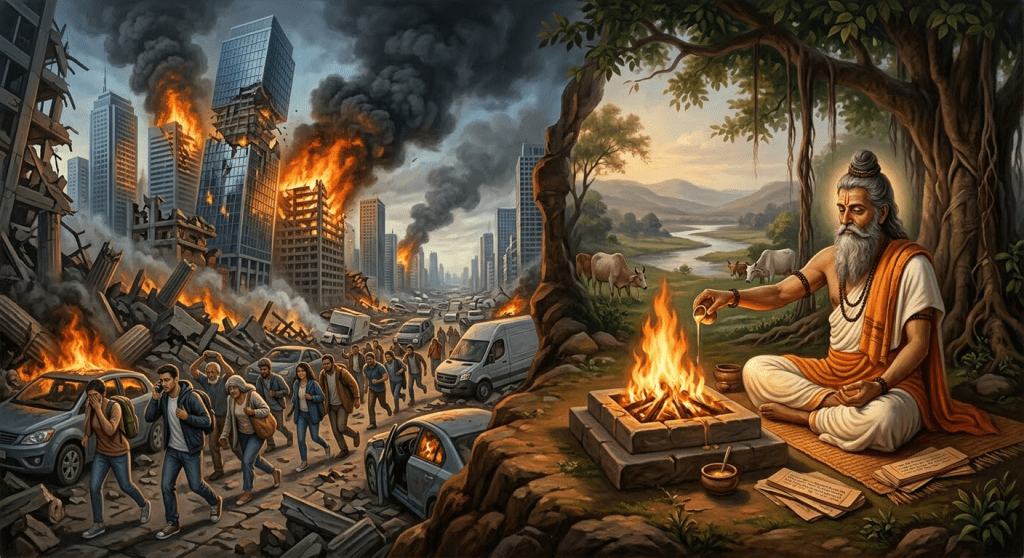
There is something vertiginous in realising that the first word of the Rig Veda, Agni, is also the name of the force that structures the deepest crisis of our era. Agnim île purohitam: I invoke Agni, the priest placed in front. This first word, spoken by thousands of mouths for six thousand years at sunrise, designates a reality that we have reduced to an engineering problem, to a question of transition between energy sources, to a technological challenge that markets and governments struggle to meet. The Vedic rishis would not have understood this reduction. For them, Agni was not a resource. He was a presence.
We devoted several articles to Agni in his spiritual and cosmological dimensions. But it is time to look directly at what the contemporary energy crisis says about our relationship with fire, and what the Vedic vision can offer us for understanding it differently from the way we usually do.
The contemporary energy crisis is generally presented as a problem of supply and transition. We have built an entire civilisation on fossil fuels — coal, oil, gas — which are forms of Agni stored over hundreds of millions of years in the depths of the earth. We burn them in a few centuries, releasing into the atmosphere the carbon that the planet took aeons to sequester, disrupting the climatic balances on which all life has developed. The proposed solution is technical: replace these fossil fuels with renewable energy sources — solar, wind, hydraulic — that use the natural flows of energy without exhausting stocks or polluting the atmosphere.
This solution is necessary. But it is insufficient if it is not accompanied by a more profound transformation of our relationship with fire, with energy, with the force that sets the world in motion. And this is where the Vedic vision of Agni can offer us something that engineering alone cannot give.
In the Vedic vision, Agni is a cosmic force that manifests at all levels of reality simultaneously. He is the fire of the hearth, the fire of the sacrifice, the fire of the sun, the fire of digestion in the body, the fire of awakening consciousness. This vision is not a poetic metaphor. It is a description of a functional reality: the same transformative force that burns wood in the hearth burns food in the body, burns the resistances of the ego in meditation, burns the cosmic obstacles in Indra’s battle against Vritra. Agni is the principle of transformation as such, at all its levels and in all its forms.
What this vision tells us about our energy crisis is of striking clarity. We have developed a relationship with fire that is no longer a relationship of transformation but a relationship of extraction. We do not ask what Agni can transform in us and around us. We ask how to extract the maximum energy from available sources to feed an economic machine whose growth is the only criterion of success. We treat Agni as a resource to be consumed rather than as a force to be honoured, understood, used with the wisdom of someone who knows that this force is constitutive of reality itself and cannot be treated with impunity as a simple fuel.
The Vedic rishis knew something that our energy engineers have not yet fully integrated: energy is not neutral. The way one produces it, uses it, regards it has effects that go well beyond technical efficiency. A fire lit with intention, in a ritual framework, with appropriate materials, at the right moment, produces something qualitatively different from a fire lit in any way for any end. This is not superstition. It is the recognition that energy and intention are linked, that the quality of the use determines the quality of the effect, that burning wood to warm a community gathered in an act of celebration is not the same thing as burning coal in a power station to feed servers that store advertising data.
This recognition has practical implications that certain pioneers of the energy transition are beginning to articulate, often without Vedic vocabulary but with intuitions that correspond to it. The idea that local energy, produced and consumed in the same territory, in a relationship of proximity between producers and users, is preferable to energy transported thousands of kilometres between anonymous producers and indifferent consumers: this is a Vedic intuition. The idea that energy sobriety is not a deprivation but a way of living more intensely with less: this is a Vedic intuition. The idea that the energy transition must be accompanied by a transformation of consciousness, by a new relationship with fire, warmth and light: this is a Vedic intuition.
But there is something even more fundamental that the Vedic vision of Agni offers us for thinking about the energy crisis. It is the question of the inner fire. In the Vedic vision, the most important fire is not the fire of the hearth nor the fire of the power station. It is the fire of consciousness, that ardour of presence and attention that transforms ordinary experience into understanding, that consumes the veils of illusion to allow the Truth to appear. This inner fire is the source of all creative energy, of all authentic innovation, of all real transformation.
Our civilisation has developed an extraordinary capacity to produce and consume external energy, and an increasingly weak capacity to tend the inner fire. We have become consumers of passive energy: we watch screens, we move in motorised vehicles, we inhabit heated and air-conditioned spaces, we eat foods transformed by industries that have externalised for us every stage of the transformation. The result is a civilisation extraordinarily hungry for external energy and extraordinarily poor in internal energy, in that capacity to transform one’s own experience, to generate one’s own spiritual warmth, to tend the fire of a fully lived life.The real energy transition will not only be the replacement of fossil fuels by renewable energies. It will be the rediscovery of Agni in all his dimensions: the fire of the hearth that gathers and warms the community, the fire of transformation that means available resources are used with the wisdom of someone who knows they are not infinite, the fire of consciousness that gives human action a direction and a depth that technical efficiency alone cannot produce. This is not a mystical proposition. It is the most urgent practical lesson that the first word of the Rig Veda addresses to us, six thousand years after being pronounced for the first time at sunrise, before a fire lit with intention, by someone who knew what fire meant.


Laisser un commentaire