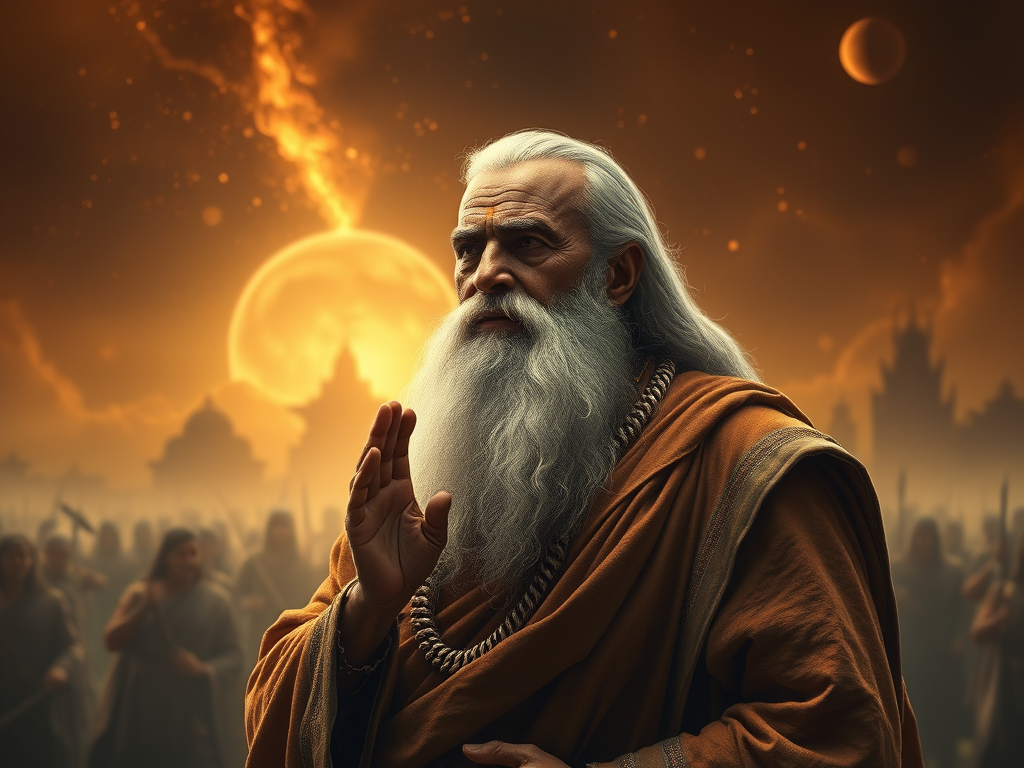
There is a practice that has almost entirely disappeared from our modern lives, and whose disappearance is so gradual and so thoroughly integrated into what we call progress that we no longer even notice it: recitation. Not recitation in the scholastic sense of the word, that chore imposed on children before modern pedagogies decided it was better to understand than to memorise. Recitation in the Vedic sense: an act of total memory, a way of carrying within oneself a heritage of thought and experience accumulated over generations, of keeping it alive through regular repetition, of offering it as a fire one tends so that the light does not go out.
In Vedic civilisation, reciting the hymns was not a cultural act in the sense we understand today, a way of maintaining contact with a heritage one values but which remains external to oneself. It was an act of memory in the most profound sense: a way of making exist what would otherwise disappear, of maintaining in the present a reality that belongs to a past of which one is the living continuation. The rishi who recited the hymn of Vishvamitra was not reciting someone else’s text. He was reciting something that had become his own through transmission, something that was now as constitutive of his identity as his own breath.
This conception of recitation as incorporation rather than performance is what fundamentally distinguishes the Vedic oral memory from all the forms of cultural conservation we practise today. We have libraries, museums, archives, databases, digital storage servers of a capacity that would have seemed miraculous to any previous generation. We can preserve quantities of information that exceed by several orders of magnitude what any past civilisation has ever been able to store. And yet we are losing something that these civilisations had and that we no longer have: long memory, that capacity to carry collectively, in living bodies and voices, an understanding of the world accumulated over generations and transmitted not as information but as experience.
The difference between stored information and carried memory is fundamental and deserves attention. Stored information is accessible. It can be retrieved, consulted, used. But it is external: it exists outside the one who accesses it, and accessing it does not transform them. Carried memory is constitutive. It is part of the inner structure of the one who carries it, it orients their perception, it informs their choices, it is present in the way they think and live, whether they think about it consciously or not. The Vedic rishis who had memorised the hymns in all their recitation modes did not consult the Rig Veda. They were formed by the Rig Veda, at every moment, in every aspect of their existence.
This distinction explains why the loss of recitation as a cultural practice is far more than a loss of habit or style. It is a loss of substance. When societies cease to carry their long memory collectively, they do not lose it immediately: they store it, archive it, digitise it. But they lose the living relationship to this memory, the way it orients the present and gives temporal depth to decisions and values. A society without a carried long memory is a society that lives in a permanent present, incapable of situating its moment within a larger arc, incapable of truly learning from what preceded it because what preceded it is no longer constitutive of what it is but merely consultable in what it stores.
The philosopher Paul Ricoeur said that the identity of a person is narrative, that it is constructed in the story that person tells of themselves through time. What is true for individuals is true for civilisations. A civilisation that has a carried long memory has a strong narrative identity: it knows where it comes from, it can situate its present in the continuity of a past it carries within itself, it can anticipate its future in light of the accumulated wisdom of its ancestors. A civilisation that has lost this carried long memory, even if it possesses exhaustive archives, has a fragile narrative identity: it is more vulnerable to ruptures, more likely to repeat the errors of the past that it knows intellectually but does not feel in its flesh, more susceptible to manipulation by those who offer simplified narratives to fill the void left by the absence of living memory.
There is in the Vedic tradition a notion that says precisely this: sruti, that which is heard. The Rig Veda and the other sacred texts are called sruti because they were heard, received in a particular state of consciousness, and transmitted from voice to ear from their origins. This designation says something essential about the nature of the knowledge they carry: it is an auditory knowledge, a knowledge that passes through sound, that lives in sound, that can only exist if it is heard by someone who truly hears it, not only with the ears but with the totality of their presence. The sruti cannot be read. It can only be heard. And to be heard, there must be someone prepared to hear, prepared through years of training in the quality of listening that allows one to receive what the text carries.
This dimension of preparation for listening is another thing we have lost. Our relationship to information is fundamentally different from the Vedic relationship to sruti. We are consumers of information, not receivers of transmission. We choose what we listen to, we interrupt what we listen to if it no longer interests us, we go and find another source if this one does not satisfy us. This way of treating information as a commodity of which one is the client and judge is exactly the opposite of the posture of the Vedic shishya, the student who has prepared for years to receive what their master has to give, who knows that what they do not yet understand is not the sign of a defect in the teaching but of an insufficiency in their own preparation.
Contemporary societies are losing their long memory in several simultaneous ways. The first is the acceleration of social time: when cycles of technological, economic and cultural innovation are measured in years or decades, it becomes difficult to keep alive a memory measured in centuries or millennia. The second is the fragmentation of bearing communities: oral traditions survive when they are carried by coherent communities that maintain them collectively. The fragmentation of traditional communities through urbanisation, mobility and individualisation deprives these traditions of their natural bearers. The third is the competition of short memories: in an environment saturated with information, short and immediate memories tend to displace long memories, because they are more accessible, more adapted to the rhythm of contemporary attention.
What the Vedic recitation tells us about all of this is not a nostalgia for the past. It is a question about the present and the future. What long memory do we carry collectively? What are the texts, the narratives, the wisdoms that we keep alive not in archives but in bodies and voices, in regular practices that make them part of what we are? And if the answer to these questions is insufficient, if our collective living memory is too short, too fragile, too superficial to orient us in the crises we are traversing, what must be done to lengthen it, strengthen it, make it once again constitutive of what we are rather than merely consultable in what we store?


Laisser un commentaire