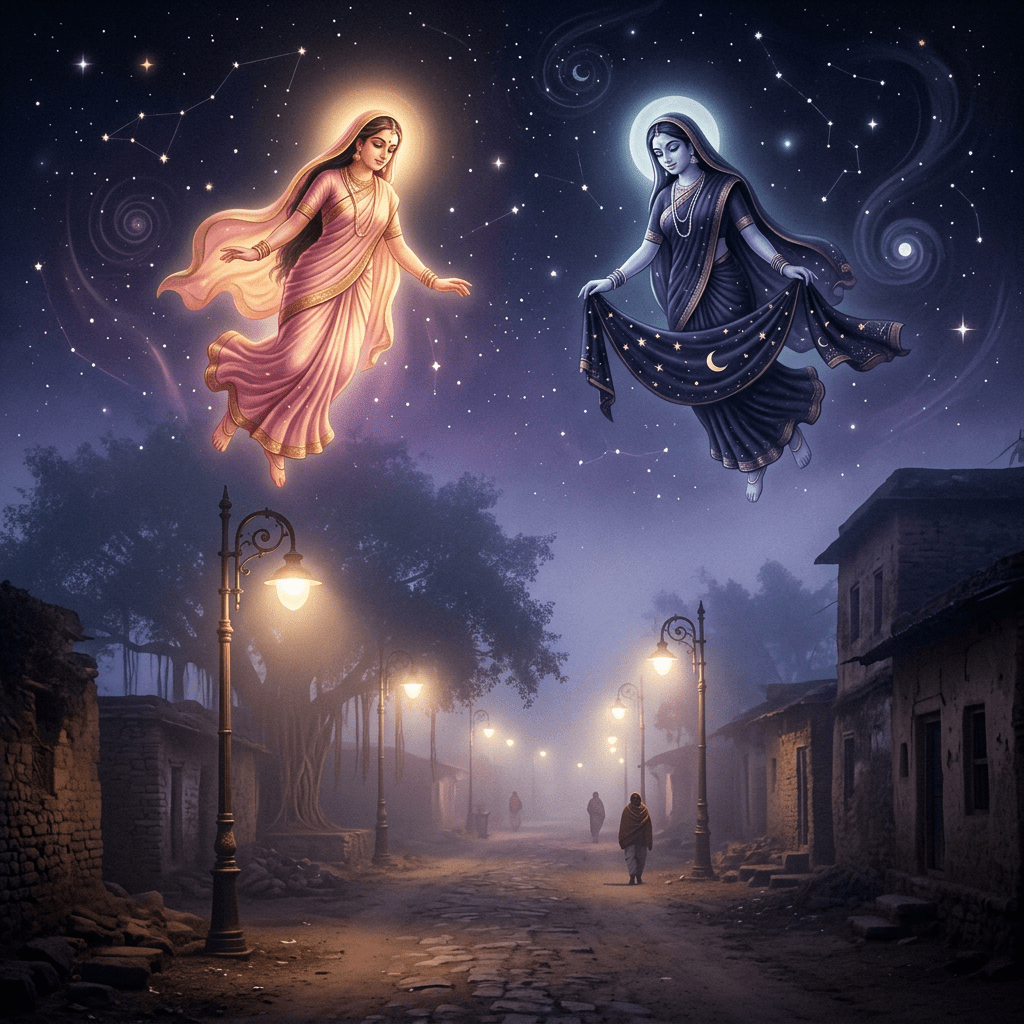
There is in the Rig Veda a divine pair that embodies one of the most fundamental principles of Vedic cosmology: Ushas and Nakta, the Dawn and the Night. Sisters, complementary, inseparable, they succeed one another in an order that never falters, that cannot falter, that is the most visible and most daily expression of the Truth, the fundamental reality of the world. One arrives when the other departs. One prepares what the other accomplishes. One opens what the other closes. Together they weave the basic rhythm of all life on the planet, that cosmic heartbeat that living beings have integrated into their biology over hundreds of millions of years of evolution, and that our era is in the process of breaking with an insouciance that has not yet measured all of its consequences.
We devoted an entire article to Ushas, the Dawn, and to her beauty and spiritual significance. Nakta, the Night, is less celebrated in the hymns, but she is equally present, equally necessary. Hymn 10.127 is devoted to her, and it is of a sober and particular beauty that says something about the way the rishis perceived darkness: not as the enemy, not as the domain of Vritra and malevolent forces, but as the great protector, the one who covers the world with her mantle and permits rest, recovery, dream, the digestion of what the day has brought. Nakta is not the absence of light. She is a presence in her own right, with her own gifts, her own functions, her own indispensable contribution to the balance of the world.
The relationship between Ushas and Nakta in the hymns is described as a frictionless alternation, a regular and benevolent handover of powers. They do not dispute the sky. One yields place to the other with a grace that is the very image of what the Truth produces when it is not obstructed: natural circulation, without resistance, without accumulation, without rupture. This image of two sisters who take turns in the governance of the world says something essential about the Vedic vision of time and rhythm: opposites are not at war. They succeed one another in a dance whose rhythm is the condition of all life.
This rhythm, which modern biology calls the circadian rhythm, is inscribed in every cell of every living being. Chronobiology, the science that studies biological rhythms, has shown that the regular alternation of light and darkness regulates thousands of physiological processes: the production of hormones, body temperature, metabolism, cellular repair, the consolidation of memory during sleep, the regulation of the immune system. These processes only function correctly if the signal of the light-darkness alternation is received with the regularity and quality that evolution has programmed. When this signal is disturbed, the entire system suffers.
Artificial lighting, and in particular the blue-spectrum LED lighting that dominates contemporary illumination, is the most powerful and most ubiquitous disruptor of this signal. It does not simply extend the day. It sends to the brain and the entire hormonal system a signal contradictory to what the body would expect at that hour according to millions of years of evolution. Melatonin, that hormone of the night which prepares the organism for sleep and plays a protective role in many biological processes, cannot be correctly produced in the presence of blue light. Cortisol, the hormone of waking and activity, remains elevated when it should be declining. The rhythms of cellular repair, which preferentially unfold at night, are disturbed. Nakta is being prevented from doing her work.
The health consequences of this disruption are beginning to be documented with growing precision and concern. Shift workers, those whose circadian rhythm is chronically disrupted, present significantly higher risks of cancers, cardiovascular diseases, diabetes, depression and cognitive disorders. The World Health Organisation has classified night work as a probable carcinogen. Urban populations exposed to nocturnal light pollution present sleep disturbances and biological rhythm disruptions that translate into measurable effects on health. And studies on children and adolescents exposed to luminous screens in the evening show disturbances of brain development and circadian rhythms whose long-term effects have not yet been fully measured.
But the consequences do not stop at human health. Light pollution disrupts ecosystems in a dramatic and largely underestimated way. Nocturnal insects, a large proportion of which are essential pollinators, are attracted and killed by artificial light in their billions. Migratory birds, which use the stars to orient themselves, are disoriented by the brightness of cities and die in their millions against illuminated buildings. Sea turtle hatchlings that follow the moonlight to reach the sea find themselves attracted inland by hotel lights. The cycles of reproduction, hunting and rest of thousands of species are disrupted by a night that is no longer truly night. Nakta is no longer disturbed only for human beings. She is disturbed for all living things.
There is something particularly revealing in the way our civilisation has approached this problem. It first ignored it, because artificial light was perceived as pure and simple progress, a victory of civilisation over the constraints of nature. It is only now beginning to recognise it, under the pressure of the accumulating health and ecological data. And even in this recognition, the dominant response is technological: LEDs with a less disruptive spectrum, timers, glass filtering blue light, applications that reduce the blue emission of screens in the evening. These are useful responses. But they miss the essential, because the essential is not technical. It is the re-establishment of a relationship with Nakta, with the night as a reality to be welcomed rather than an obstacle to be overcome.
The Vedic rishis had no need of chronobiology to know that the night was sacred. They knew it because they lived in the night, truly, without screens, without electric lighting, under a starlit sky of a density and beauty that most contemporary city dwellers have never seen. And they had developed a relationship with Nakta that recognised her gifts: deep rest, the dream that processes and integrates what the day has brought, the silence in which visions arrive, the permeability of the intermediate world that opens in the darkness. The hymn to Nakta is not a hymn of resignation to the inevitable. It is a hymn of recognition for something that gives, that protects, that nourishes in a way that light cannot nourish.
What Ushas and Nakta together teach us is that rhythm is not a constraint. It is a resource. The regular alternation of opening and closing, of activity and rest, of light and darkness, is the condition in which life can renew itself, regenerate itself, produce with a power that continuous activity and permanent illumination cannot sustain. A candle burned at both ends consumes itself twice as fast without producing twice as much light. A civilisation that refuses the night, that refuses Nakta, that imposes on its members and its ecosystems a permanent lighting and a permanent activity, is a candle burned at both ends.
Healing perhaps passes through a gesture as simple as the one the rishis accomplished every evening: to let the night come. To turn off the lights. To welcome Nakta with the same attention and the same recognition with which they welcomed Ushas at the break of day. To let the natural rhythm reclaim its rights, in the body, in the house, in the neighbourhood, in the city. This is not a regression. It is an alignment with the Truth, with the fundamental reality of the world, which has always said that life cannot be only light. It must also be night.


Laisser un commentaire