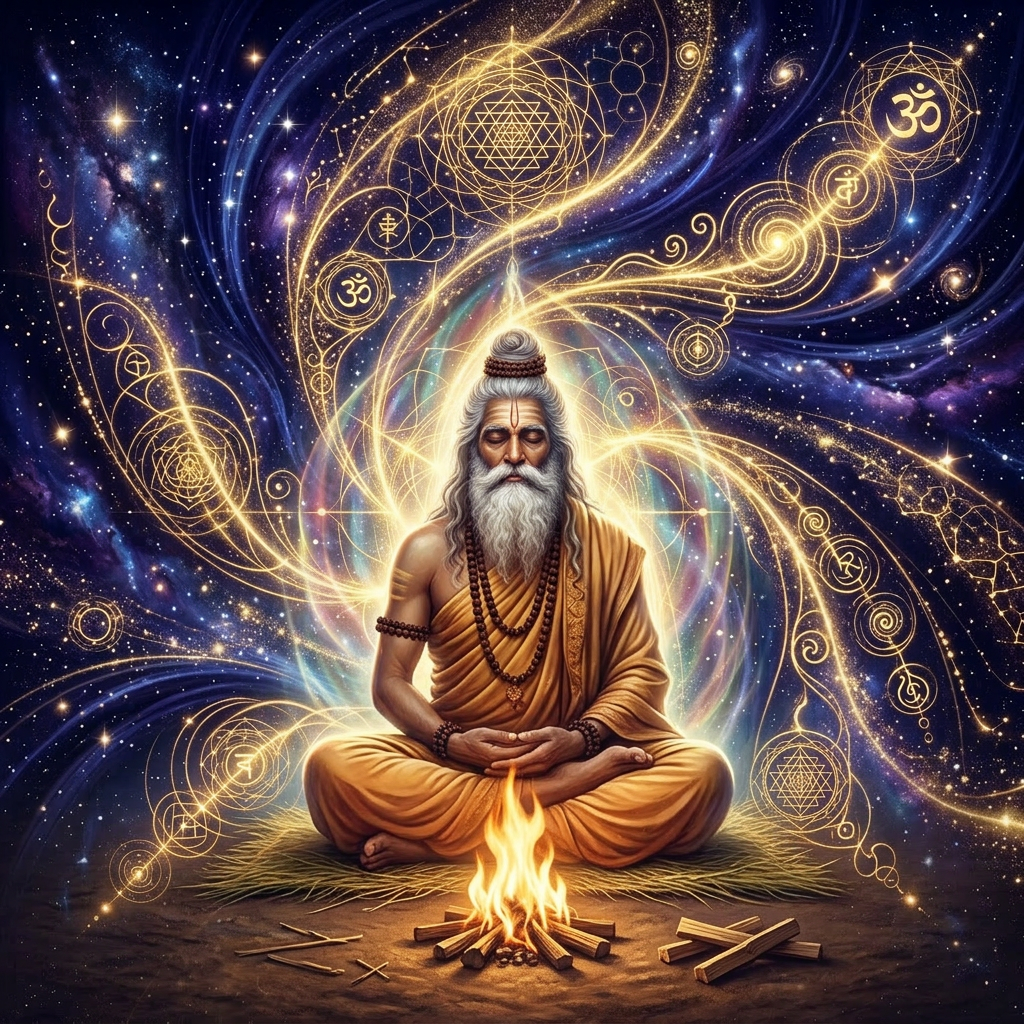
There is in the Rig Veda a triad that structures the entire spiritual and cosmological vision of the text, even if it is never presented as such in an explicit and systematic way: fire, breath and consciousness. These three realities are linked in the hymns in a way that is not an arbitrary symbolic association, not a convenient poetic metaphor, but the description of a real and functional relationship that the rishis had discovered through direct experience and that they described with the precision of someone speaking of what they have lived.
Let us begin with fire, Agni. We have devoted several articles to him, but in the context of this triad, it is worth emphasising a dimension we have not yet fully developed: fire as process rather than as thing. Agni is not an object. It is an event, an ongoing transformation, a process of combustion that consumes a material in order to release its energy and light. This processual character of fire is fundamental in Vedic thought. Fire does not simply exist. It does something, continuously, at every instant of its existence: it transforms. And this transformation is the condition of its nature: a fire that no longer burns is no longer a fire.
This vision of fire as an ongoing transformation has its direct counterpart in the Vedic vision of life. A living being is not a static object that can be defined by its fixed properties. It is a process, a slow and continuous combustion whose engine is the breath. Agni is the vital heat of the body, that inner fire that the Ayurvedic medical traditions would later call jatharagni, the fire of digestion, which transforms food into vital energy. But Agni is also the heat of awakening consciousness, that ardour of attention which transforms ordinary experience into understanding, which consumes the veils of Maya to allow the Light of ṛta to appear.
Breath, prâna, is the link between fire and consciousness. In Vedic physiology, which precedes and prefigures later Ayurvedic physiology, breath is not simply air entering and leaving the lungs. It is vital force itself, the energy that animates everything that lives, from the breath of wind in the trees to the breath of human respiration. Vâyu, the god of wind, is the master of cosmic breath, and it is no accident that the hymns describe him as the master of the intermediate world, that space between Earth and Sky where the essential of Vedic spiritual life unfolds. Breath is the natural inhabitant of the intermediate world: it is between matter and spirit, between body and consciousness, between the visible and the invisible.
The connection between breath and fire is both physical and spiritual. Physically, fire needs air to burn. Without breath, without oxygen, the flame goes out. This dependence of fire on breath is the image of the dependence of awakened consciousness on prâna: without the vital force that breath brings, consciousness cannot awaken, cannot maintain that state of presence and attention that constitutes awakening. And conversely, breath well directed, pranayama, enlivens the inner fire of consciousness exactly as bellows enliven the flame of a hearth. This is not a metaphor. It is a functional description of what happens in body and consciousness when pranayama is correctly practised.
The practice of pranayama, which is probably as old as Vedism itself — since the seals of Mohenjo-daro depict figures in meditation posture with manifest attention to the posture of the torso and the breath — rests precisely on this relationship between breath and consciousness. By regulating the breath, by giving it a particular rhythm, depth and quality, one directly modifies the state of consciousness. A slow and deep breath produces a state of calm and presence. A rapid and intense breath produces an activation of consciousness. A breath retained at certain key moments of its cycle produces particular states of consciousness that resemble, in their effects, what soma produced in a more direct and more intense way.
This is where the link between the three terms of the triad becomes clearest and most important. Soma acted on consciousness by dissolving the egotistic constructions that veiled it. Pranayama acts on consciousness through the same mechanism, but more slowly and more gradually, using breath to modify the brain’s biochemistry and reduce the activity of the default mode network, that network of permanent egotistic narration. In both cases, what one seeks to produce is the same: the temporary dissolution of the ego’s obstruction, the liberation of the flow of consciousness toward Brahman, the entry into the Light.
Stanislav Grof, whom we mentioned in the article on the effects of soma, developed holotropic breathwork precisely on this basis: by using breath in a particularly intensive and sustained way, he obtained results comparable to those of psychedelics in the treatment of deep psychological disorders and in the induction of mystical experiences. This is not surprising for someone who has read the Rig Veda carefully. The rishis knew six thousand years ago that breath was the most direct and most universally available means of access to the states of consciousness that soma allowed one to reach. Holotropic breathwork is not a modern invention. It is a rediscovery.
In the Vedic hymns, Agni and Vâyu are often invoked together, and this association is not fortuitous. Agni is the fire of transformation. Vâyu is the breath that enlivens it. And their collaboration produces awakened consciousness, that Light which all the hymns invoke, seek and celebrate. The image is perfect in its precision: without breath, the fire goes out and the light disappears. Without fire, breath produces nothing particular. But when the right breath meets the right fire, light unfolds, and this light is consciousness seeing itself, perceiving ṛta, entering Brahman.
There is a contemporary practice that illustrates this triad with striking clarity: seated meditation before a lit candle. This practice, which exists in many spiritual traditions and is offered today as a mindfulness exercise, spontaneously reproduces the Vedic configuration: the fire of Agni is there, visible, living; the breath is conscious, regulated by concentration; and consciousness, attracted and stabilised by the flame and the respiratory rhythm, begins to calm itself, to deepen, to open toward something vaster than itself. It is not a coincidence that this practice works. It is because it reproduces a configuration that the Vedic Indians had identified as functional six thousand years ago: fire, breath, consciousness — three realities that condition each other mutually and that, brought together in the right context, open a door toward what the Rig Veda calls the Light.
What this triad tells us about the nature of consciousness is perhaps its most important contribution to contemporary thought. Consciousness is not a thing. It is a process, a combustion, an ongoing transformation, exactly like fire. And like fire, it needs to be fed, maintained, enlivened. Breath is its most immediate and most universally available fuel. And the sacred fire, Agni, is its cosmic model, the visible and daily demonstration of what consciousness can be when it burns with the full intensity of its nature: luminous, transformative, consuming the obscurities and resistances to allow the Truth to appear that was always there, waiting simply for the breath to be right and the fire to be nourished.


Votre commentaire