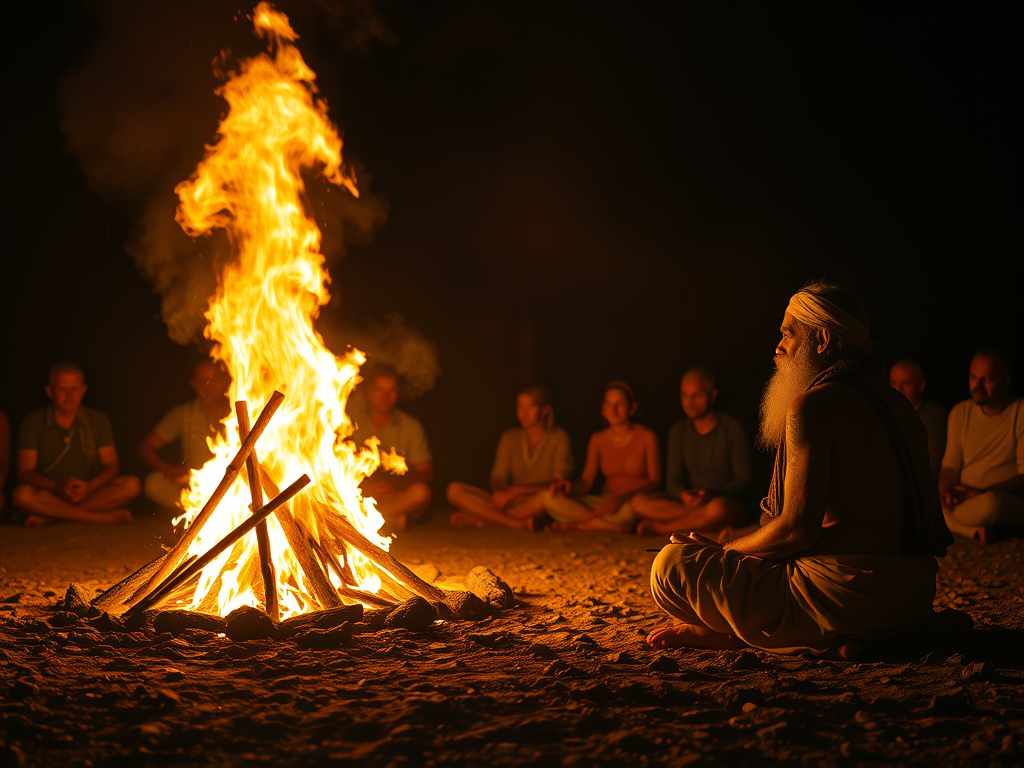
There are in the Rig Veda more hymns devoted to Agni than to any other god, with the exception of Indra. This omnipresence is not accidental. Agni is the first word of the Rig Veda. The corpus opens with him: Agnim île purohitam, I invoke Agni, the purohita, the priest who is placed in front. This inaugural position is not a chance of compilation. It is a deliberate choice that says something essential about the structure of all Vedic spirituality: before the gods of the sky, before Indra and his cosmic battles, before Varuna and his omniscient vision, there is fire. There is Agni. There is transformation.
Agni is probably the oldest divine figure in the Rig Veda, the one whose roots plunge most deeply into the prehistoric shamanism from which Vedism emerged. Fire is humanity’s first sacred technology. Long before soma, long before hymns and mantras, there was fire lit in the darkness, fire that kept predators at bay, fire that made it possible to cook food and thus render digestible resources that were otherwise inaccessible, fire around which the community gathered and whose warmth created a space of safety and sharing. This primordial fire, this fire of human prehistory, became Agni. It was sacralised, deified, recognised as a cosmic force that manifests in the flame of the hearth exactly as it manifests in lightning, in the sun, in the warmth of the living body, in the fire of digestion, in the ardour of awakening consciousness.
The hymns to Agni have a particular quality that distinguishes them from the hymns to the other great gods. They have a warmth, a familiarity, an intimacy that one does not find with the same intensity in the hymns to Indra or Varuna. One speaks to Agni as to someone who is there, present, visible, tangible. Not as to a distant power that one seeks to draw down from the heights of the sky. Agni is already there, in the hearth, in the sacrificial fire, in the flame that was lit this morning as it was lit yesterday and as it will be lit tomorrow. This constant and concrete presence creates a relationship of a different nature from that which one maintains with the gods of the sky.
In the hymns, Agni is the messenger par excellence. He is the one who receives the offerings poured into the fire and transmits them to the gods. He is the one who makes the link between the human world and the divine world, between the material and the spiritual, between what burns and what receives the light of that combustion. His function as messenger says something fundamental about the nature of the relationship between human beings and the gods in the Vedic vision: it is not a direct relationship, like a telephone call in which one dials a god and he answers immediately. It is a relationship mediated by transformation. What one offers must first be changed, transmuted, by fire, in order to reach its destination. Transformation is the condition of the gift, and fire is the agent of that transformation.
Agni is also the Light in its most immediate and most accessible manifestation. Unlike the Light of Brahman, which is an inner experience requiring particular preparation and context, the light of Agni is there, within reach, visible, warming. It drives away physical darkness and it drives away Vritra, the inner darkness. This parallel between the light of fire and the Light of awakening is one of the most constant images in the Rig Veda, and it works in both directions: the fire that burns in the hearth is a metaphor for inner awakening, and inner awakening is an amplification of what fire does in the hearth. To light the sacrificial fire is symbolically to light the fire of consciousness. And to let the fire go out is to let consciousness grow dark.
There is in certain hymns to Agni a therapeutic dimension that directly prefigures what we call today light therapy and the therapeutic effects of fire on the human psyche. Darkness is associated in the hymns with illness, fear, obstruction, everything that prevents life from circulating freely. And the light of Agni drives all of this away, not through a magical mechanism but through a real mechanism that contemporary neurology is beginning to document: exposure to light, and in particular to firelight, produces measurable effects on the brain and on emotional state. The daily practice of the domestic fire, in Vedic civilisation, was not only a spiritual practice in the sense of a belief. It was a psychosomatic practice whose effects were real and verifiable, even if the conceptual framework within which they were interpreted was different from our own.
Which brings us to the question that the title of this article poses: what happens when the sacred fire goes out in modern hearths? And it has gone out. Not metaphorically: literally. The great majority of contemporary homes have no fire. They have electric radiators, induction hobs, LED bulbs. Warmth is present, light is present, but they are produced by mechanisms that do not burn, that do not transform, that do not consume a material in order to release its energy. It is not the same thing. It is not the same thing at all.
Fire has properties that are irreducible to its thermal and luminous functions. It is alive in the sense that it is born, grows, feeds and dies. It is unpredictable in the sense that it never does exactly the same thing twice. It is present in the sense that it requires continuous attention: one cannot light a fire and forget about it the way one forgets a radiator. It creates a relationship, an obligation of presence and attention, that is in itself a spiritual practice. And it has a particular quality of light, a warm, fluctuating, living light, that produces an effect on consciousness that full-spectrum bulbs do not achieve.
The disappearance of the domestic fire from modern homes is a loss whose full consequences we have probably not yet measured. It is not merely a loss of charm or tradition. It is the loss of a daily anchor in something living and transformative, the loss of a spontaneous ritual that organised the time of the day around a concrete and luminous centre, the loss of a daily relationship with the cosmic force that the Vedic rishis recognised in the flame and invoked with words of a beauty and a precision that have not aged in six thousand years.
Agnim île purohitam. I invoke Agni, the priest placed in front. These four words, which open the Rig Veda and have opened it for at least six thousand years, are still recited today by Indian brahmins at sunrise, before a fire lit according to the rules of the tradition. This continuity is at once a consolation and a challenge. A consolation, because it says that the chain is not entirely broken, that something essential has been preserved despite the millennia and the catastrophes. A challenge, because it poses a question to which our era has not yet truly responded: in a world without hearth fires, without sacrificial fires, without that daily presence of the flame that organised Vedic spirituality, how does one light within oneself the fire that Agni represented? How does one keep alive, in the cold darkness of our neon-lit apartments, the awareness that transformation is possible, that the Light is accessible, and that something can burn in us that is not wood but presence?
 Le Rig Veda
Laisser un commentaire