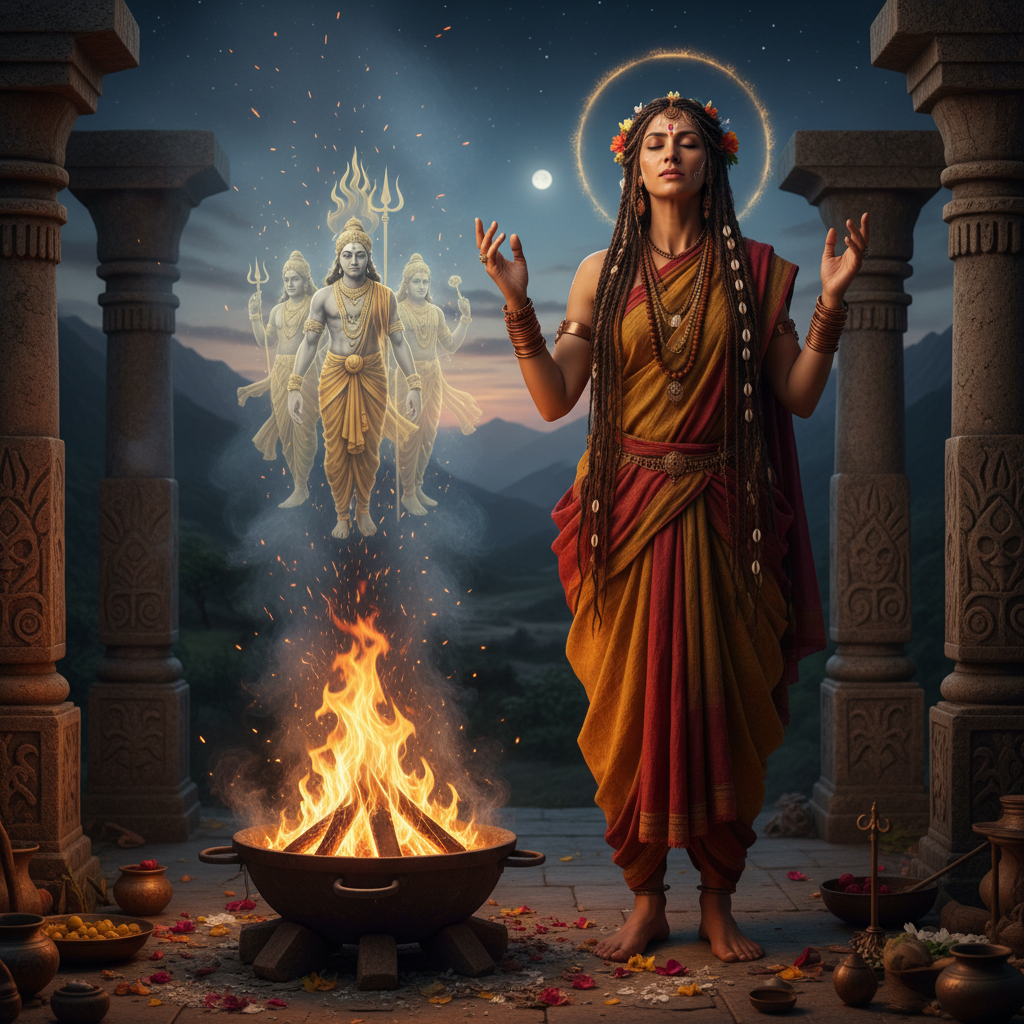
There is a persistent misconception about the place of women in the ancient Indian tradition. Because contemporary Hinduism, in certain of its manifestations, has reduced the role of women to domestic and subordinate functions, because the caste system in its late and rigid form has often marginalised women, this marginalisation is retrospectively projected onto original Vedism. This is a historical error that the text of the Rig Veda itself contradicts with a clarity and a consistency that leave little room for doubt. The Vedic society of the first nine mandalas, the one that precedes the disappearance of soma and the appearance of castes, was a society in which women participated fully in the spiritual, intellectual and social life of the community.
Let us begin with the fact that is most difficult to contest: there were women rishis. Not marginal figures tolerated at the periphery of a tradition dominated by men, but rishis in the full sense, whose hymns are included in the sacred corpus of the Rig Veda on exactly the same footing as those of their male counterparts. Lopamudra, Ghosha, Apala, Vishvavara, Sikata Nivavari, Surya Savitri: these names are in the text, identified as authors of their respective hymns, with the same precision with which other hymns are attributed to their male rishis. Their existence is not an anecdotal curiosity. It is proof that in Vedic civilisation, the capacity to receive revelation, to enter into contact with Brahman, to compose hymns worthy of the sacred corpus, was not considered a masculine prerogative.
Lopamudra is perhaps the most celebrated among them, and her hymn 1.179 is one of the most astonishing in the entire corpus. In it she holds a dialogue with her husband, the rishi Agastya, in an exchange about desire and the relationship between man and woman of a frankness and a modernity that stand in striking contrast to the image one often has of ancient sacred texts. Lopamudra does not speak from a position of submission or inferiority. She speaks as an equal, with an assurance and a clarity that say something essential about the status she occupied in her society. She had her own desires, her own spiritual vision, and she expressed them within the most sacred framework imaginable, that of the Vedic hymns, without anyone apparently finding this inconvenient.
Ghosha is another remarkable figure. She composed several hymns to the Ashvins, the healer gods, in which she speaks of her own life with an unusual personal precision for a sacred text. She describes her illness, her recovery, her ageing, her human relationships with an intimacy that speaks of a woman fully present to her own experience and capable of transforming it into a hymn. Her relationship with the Ashvins is not that of a supplicant before distant powers. It is a relationship of mutual trust and affection, like that of any rishi with his gods.
Women drank soma. This fact, which the Rig Veda mentions without making it a remarkable event, says everything about their place in Vedic spiritual life. Soma was not reserved for men. Access to the experience of Brahman was not a masculine prerogative. Women participated in the sacrifices as drinkers of soma, not merely as assistants or spectators. And the wife of the sacrificer was an active participant in the sacrifice, not a decorative presence. The hymns mention on several occasions that leaders came to the sacrifice with their wife, with a care in the formulation that says the woman was there as a co-celebrant, not as a companion.
Archaeology confirms this image of full and complete feminine participation in the life of Vedic civilisation. Feminine representations in the art of the Indus-Sarasvati civilisation are numerous and diverse. Women appear there unveiled, often adorned with elaborate jewellery, in postures that evoke nothing of submission or self-effacement. The feminine figurines found at numerous sites are sometimes interpreted as representations of the mother goddess, which suggests that the feminine occupied a central place in the ritual and spiritual life of this civilisation, not only in the texts but in concrete practices.
In the neighbouring regions that shared the same spirituality as Vedic civilisation, notably in Turkmenistan and Afghanistan, where excavations have uncovered civilisations that were contemporary and culturally close, women manifestly occupied leadership roles. The burials of women at these sites are accompanied by objects that signal high status and recognised authority. These archaeological data are consistent with what the Rig Veda suggests for Vedic civilisation itself: a society in which leadership was not exclusively masculine.
One must also speak of what the Rig Veda does not contain, because this absence is as telling as the presences. In the first nine mandalas, there are no moral lessons about the place of women, no instructions about their submission, no rules about their behaviour or their dress, no restrictions on their access to spiritual practices. These absences are not gaps in the text. They reflect a society in which these restrictions did not yet exist, in which the relationship between men and women had not yet been codified in the terms of domination and subordination that would progressively appear in later texts.
Sexuality was not a taboo in Vedic society, and this absence of taboo concerned women as much as men. The text of the Rig Veda is sometimes explicitly erotic, without this explicitness being presented as problematic or as a concession to human weakness. Archaeology confirms this impression of relative freedom: the representations of feminine nudity in the art of the Indus are not pornographic in a degrading sense, but they show a relationship to the body and to sensuality that is very different from that which would characterise the societies that followed.
The change would come with the disappearance of soma and the appearance of castes in the tenth mandala. This is not a coincidence. We have seen in other articles that the disappearance of soma brought about a progressive return of egotistic structures in social organisation. And one of the most consistent manifestations of these egotistic structures, in all human civilisations, is the subordination of the feminine to the masculine. When the collective ego reclaims power, when hierarchy replaces horizontality, when institutional religion replaces lived spirituality, women are invariably the first to lose the status they occupied in the preceding period. This is what happened in Vedic civilisation between the ninth and the tenth mandala, and the centuries that followed only accentuated this movement.
What the Rig Veda tells us about women in Vedic society is therefore at once a historical description and an invitation to reflect on what we have lost. A civilisation in which women composed sacred hymns, drank soma, participated in the sacrifices, occupied leadership roles, and were subject to no codified restrictions on their freedom: this civilisation existed, it lasted two thousand years, and it produced one of the most remarkable texts in human history. This reality deserves to be known, not as a romantic utopia projected onto an idealised past, but as a concrete and archaeologically documented demonstration of what a society can be when it has not yet allowed the collective ego to dictate the place of each person.
 Le Rig Veda
Laisser un commentaire