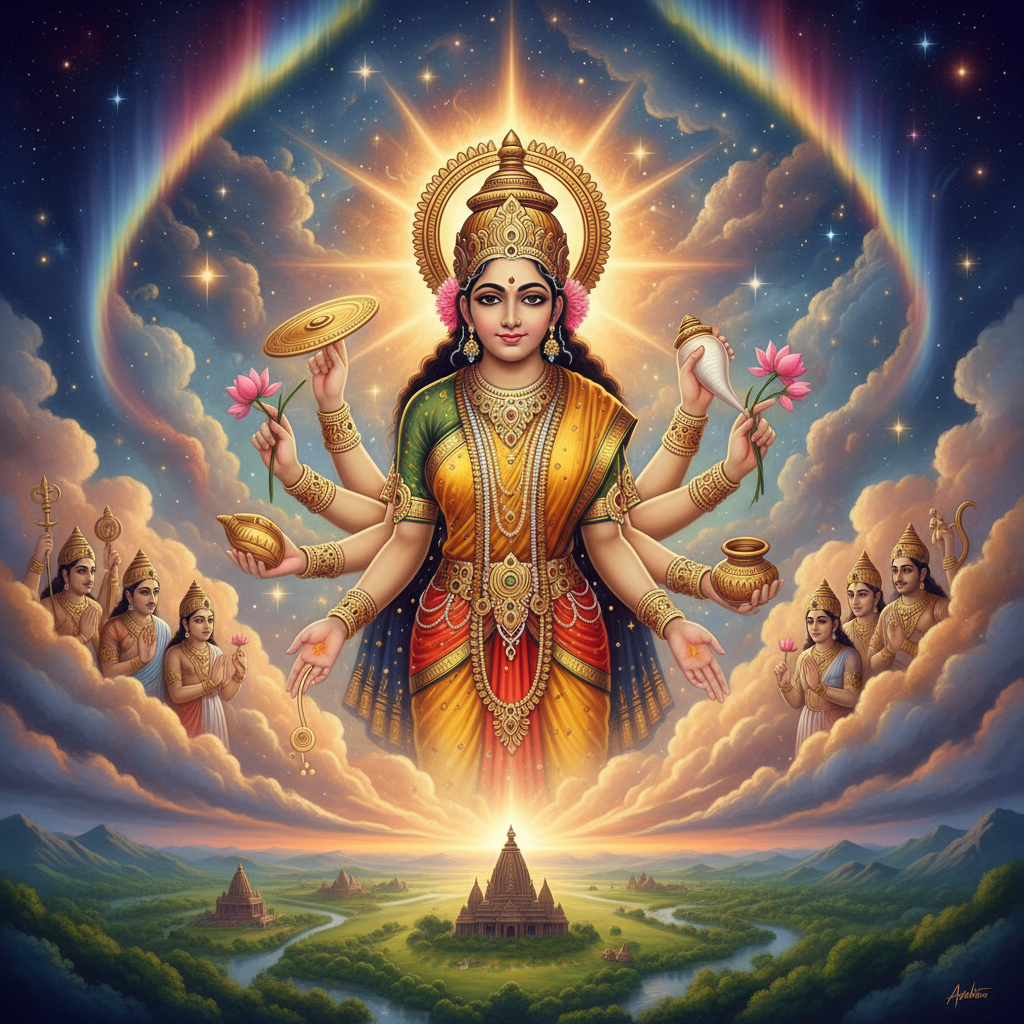
There is in the Rig Veda a divine figure that occupies a unique position in the entire Vedic pantheon, and without doubt in the entire history of spiritualities: Aditi. Unique, because she is at once omnipresent and elusive, fundamental and almost indefinable, the mother of all the gods and yet without a developed mythological narrative, without precise attributes, without a fixed iconographic representation. She is there, in the hymns, everywhere and nowhere at once, constantly invoked but never truly described, as if the text itself recognised that certain realities resist description and can only be named, again and again, in the hope that the repetition of the name will eventually evoke what words cannot directly grasp.
Her name says everything, and it says the unsayable. Aditi: a, the negation, and diti, which comes from the root da, to bind, to limit. Aditi is therefore literally that which is not bound, that which is not limited, that which is free of all boundary and all constraint. In a Vedic cosmos where everything that exists has a form, a function, a name, attributes, relationships with other beings, Aditi is what precedes all of that, what contains all of that without being contained by anything. She is the infinite space in which everything else exists. She is the condition of possibility of existence itself.
The Adityas, the great solar gods of the Rig Veda, are her sons: Varuna, Mitra, Aryaman, Bhaga, Daksha, Ansa, and others depending on the lists. This detail is fundamental. The gods who maintain cosmic order, who guarantee ṛta, who watch over the relations between beings and over the circulation of Truth in the world, are all sons of Aditi. They emerged from her, they carry her nature within them, and it is from this nature that they draw their power. To understand Aditi is to understand the source of everything in the Vedic cosmos that is light, truth and order.
In the hymns, the requests addressed to Aditi are of a particular nature. One does not ask her for rain, cattle, horses, victories in battle. One asks her for protection, liberation, space. One asks her to keep at a distance what hurts, what imprisons, what diminishes. One asks her for what only a mother can give: fundamental security, not the kind that comes from force or wealth, but the kind that comes from the sense of belonging to something greater than oneself, of resting in a space that contains us without suffocating us, that allows us to be what we are without judgement or condition. It is the protection of the infinite itself, and it is of a radically different nature from all the other protections the hymns invoke.
There is in the Rig Veda a remarkable formulation that says something essential about Aditi: she is the sky, she is the atmosphere, she is the mother, she is the father, she is the son, she is all the gods, she is the five peoples, she is what has been born and what will be born. This vertiginous list is not poetic exaggeration. It is a serious attempt to say something unsayable: Aditi is not one deity among others with her particular sphere of influence. She is the totality. She is that in which everything exists, that of which everything is made, that to which everything returns. In the philosophical vocabulary that would develop centuries later in the Upanishads, one would say that Aditi is Brahman in a maternal and feminine aspect. But in the Rig Veda, she precedes these philosophical categories. She is simply named, again and again, in a recognition that is closer to wonder than to theology.
The maternal dimension of Aditi is not incidental. It is foundational. In almost all the religious traditions that followed Vedism, the ultimate principle, the Absolute, was conceptualised as masculine, paternal, transcendent, separated from the world it created and to which it is superior. Aditi proposes something radically different: a maternal Absolute, immanent, that contains the world within herself as a mother contains her child, without separation, without hierarchy, without the distance that the paternal model introduces almost inevitably. This is not a marginal detail. It is a vision of the relationship between the finite and the infinite, between the creature and the creative principle, that is of striking depth and modernity.
What contemporary physicists call the quantum vacuum — that apparently empty space which is in reality the ground of all physical reality, saturated with potential energy, virtually containing everything that can exist — is perhaps the closest scientific description of what the rishis named Aditi. Not because the rishis anticipated quantum physics, but because the direct experience of Brahman that soma facilitated gave access to a layer of reality that resembles, in its fundamental properties, what modern physics is beginning to glimpse by other means. The space that contains everything without itself being contained, that is the condition of everything without itself being conditioned: that is Aditi, and it is also, in a very different language, what contemporary cosmology seeks to describe when it speaks of the fundamental states of the cosmos.
The relationship between Aditi and her sons the Adityas says something important about the way the Vedic Indians conceived of the relationship between the infinite and the finite. The Adityas are not separate from Aditi. They were born from her, they carry her within them, their power is her power manifested in particular and defined forms. Varuna who sees everything, Mitra who binds friends, Aryaman who presides over unions: each of them is an aspect of the maternal infinite of Aditi, made operational in a precise domain of existence. The infinite manifests in the finite without ceasing to be infinite. This is one of the most profound metaphysical intuitions of the Rig Veda, and it is carried by this figure of Aditi whom one rarely cites when speaking of the philosophical greatness of the Vedic text.
Something must also be said about what Aditi represents for the question of the feminine in spirituality. In Western monotheistic traditions, the ultimate principle is masculine and the feminine is subordinate, derivative, sometimes even associated with the fall and with temptation. In original Vedism, before the disappearance of soma and the rise of patriarchal structures linked to the disappearance of ṛta as lived experience, the most fundamental principle — the one that contains all the gods and all the cosmos — is feminine. Aditi precedes the gods. She comes before them, she contains them, they were born from her. This vision does not marginalise the feminine. It makes it the source of everything.
Aditi is singular in the sense that she performs no miracles, fights no demons, intervenes in no cosmic battles. She has no need to do anything, because she is that in which everything is done. Her presence in the hymns is a background presence, constant, silent, like space is present in every room without one thinking of it, like air is present at every breath without one seeing it. The rishis named her in order to remember that she was there, to keep alive in their consciousness the reality of that maternal infinite in which they lived and moved, as all beings do, at every moment, whether they are aware of it or not.
 Le Rig Veda
Laisser un commentaire