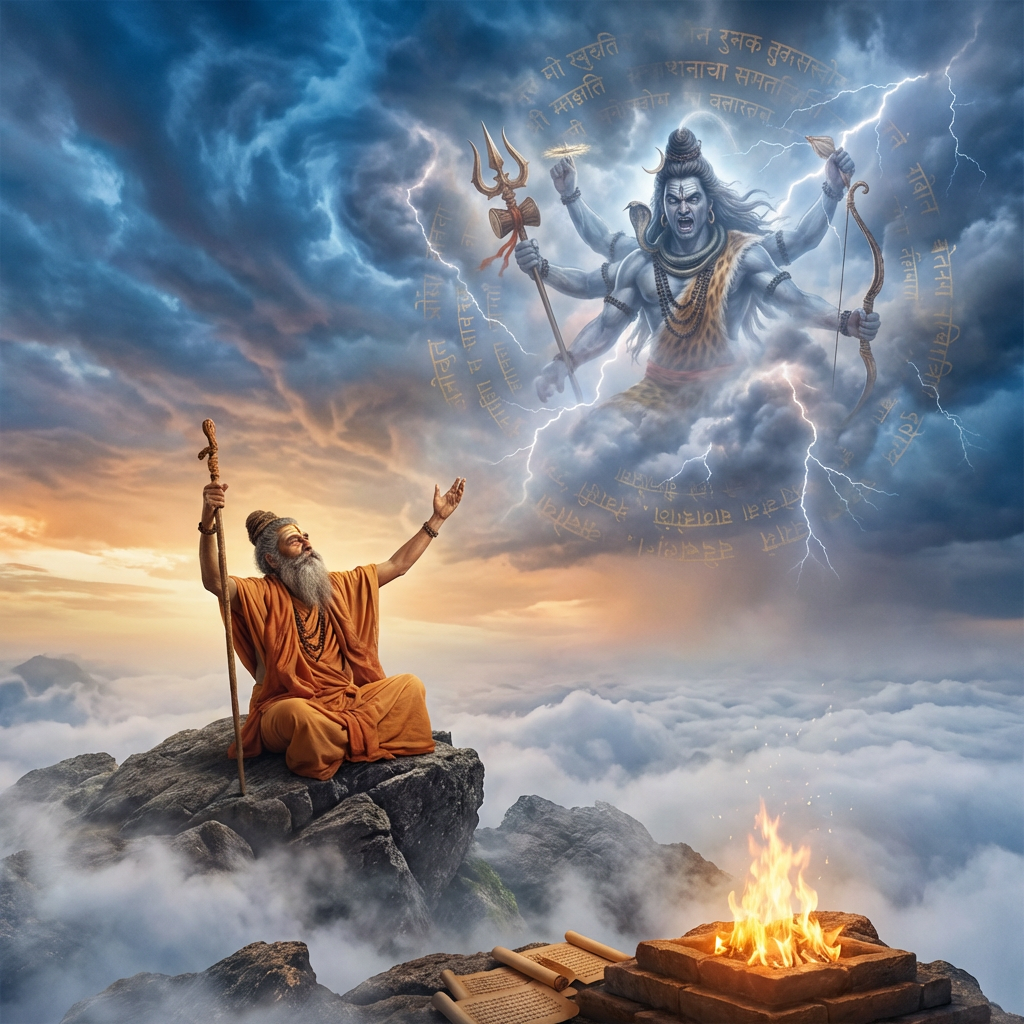
There is in the Rig Veda a figure that stands in singular contrast to the rest of the Vedic pantheon. The other great gods — Indra, Agni, Varuna, Mitra, the Ashvins — are invoked with a familiarity, a warmth, sometimes even a tenderness that says something about the nature of the relationship the rishis maintained with them. Rudra is different. One approaches him with caution. One speaks to him with respect, but also with an apprehension that the hymns make no attempt to conceal. He is powerful in a way that is not quite like the others, containing something unpredictable, potentially devastating, that the rishis recognised and honoured without ever quite taming. His name says everything: Rudra, the one who makes weep, the one who wrings out cries, the one whose power is great enough to break whatever resists.
And yet this same Rudra is also the most powerful healer in the Rig Veda. The one whose hands carry the remedies, whose pharmacopoeia is the richest, whose compassion for suffering beings is the deepest. This coexistence of terrifying power and curative compassion is not a contradiction in Vedic thought. It is on the contrary a profound unity, one of the most striking intuitions in the text about the nature of reality: the same force that can destroy is the only one that can truly heal.
The paradox resolves itself when one understands what the rishis meant by healing. In the Vedic vision, healing is not simply suppressing a symptom, restoring a disturbed balance, returning an organism to its previous state. Healing is transformation. It is the elimination of what obstructs, what blocks, what prevents vital force from circulating freely. And this elimination sometimes requires a power that from the outside resembles destruction. Rudra destroys in order to liberate. He tears out darkness as one tears out a weed: with a force that has nothing delicate about it, but whose result is the freeing of space for what can grow.
The second mandala of the Rig Veda contains several hymns to Rudra of particular intensity and beauty. One finds in them this characteristic request: that Rudra remain benevolent, that he direct his power toward enemies and forces of darkness rather than toward the sacrificer and his family. There is in these hymns an implicit admission: Rudra is a force that does not always distinguish between what deserves to be destroyed and what deserves to be spared. His power is total, without nuance, absolute in its effectiveness. This is why one does not approach him with the same casualness with which one approaches Indra or Agni. One asks him to be gentle, mriduhridaya in Sanskrit, gentle of heart, and this request itself says how much gentleness is not his natural state.
His sons, the Maruts, the gods of storms and winds, carry the same ambivalence. They are Indra’s companions in his cosmic battles, the unleashed forces of natural energy, as destructive as a storm and as necessary. They cleanse the atmosphere, they renew the air, they break through resistances. They are sons in the image of the father: raw power in the service of an order they maintain by their very existence. The storm is terrifying, but without the storm, the air stagnates, the water grows still, life suffocates. The Maruts do for the cosmos what Rudra does for consciousness: they maintain movement by preventing stagnation.
The pharmacopoeia of Rudra is one of the least known dimensions of his figure, and one of the most fascinating. The hymns attribute to him a knowledge of medicinal plants and remedies that surpasses that of all other gods. He is the physician of physicians, the one who knows the herbs that grow in the mountains, the roots that heal wounds, the substances that dissolve poisons. This dimension of herbal healer is consistent with his nature as god of wild spaces, of forests, of mountains, of places that civilisation has not yet domesticated. Rudra is not a god of cities and hearths. He is the god of nature in its most powerful and most untouched state, and it is in these spaces that the most effective remedies grow, including soma itself.
There is a deep connection, which the Rig Veda establishes without fully spelling it out, between Rudra and soma. Both are associated with mountains, with wild spaces, with a power that surpasses ordinary understanding. Both are agents of radical transformation. Both require a ritualised context and serious preparation for their effects to be beneficial rather than devastating. The same substance or the same force that heals in the right conditions can destroy in the wrong ones. Rudra embodies this principle in its purest and most direct form: there is no diluted version of his power, no pocket-sized Rudra that one can invoke without consequences. When he is called, it is the totality of his nature that responds.
What makes Rudra particularly important for understanding Vedic thought as a whole is what he says about the relationship between destruction and growth, between death and life, between pain and healing. In the Vedic vision, these oppositions are not absolute antagonisms. They are complementary aspects of the same process of transformation. The destruction of what is obsolete, rigid, apparently dead, is the necessary condition for something new to emerge. Rudra is the divine figure of this fundamental truth. He is terrifying because transformation is terrifying when one is attached to what must be destroyed. He is a healer because, once the destruction is accomplished, what remains can at last live fully.
Centuries after the Rig Veda, Rudra would become Shiva, whose name means the benevolent one, in a paradox that is not one: the same power that makes one weep is, when one understands it and surrenders to it rather than resisting it, the most benevolent power there is. Shiva in later Hinduism would be the god of meditation, the great ascetic, the master of yoga, but also the destroyer of the cosmos at the end of the cycle. Both aspects are already present in the Rudra of the Rig Veda, in embryonic form, awaiting the centuries that would give them their full development. The god who makes one weep and the benevolent god are the same god, seen from two different levels of understanding. Before the transformation, one weeps. Afterwards, one understands that it was a grace.
 Le Rig Veda
Laisser un commentaire