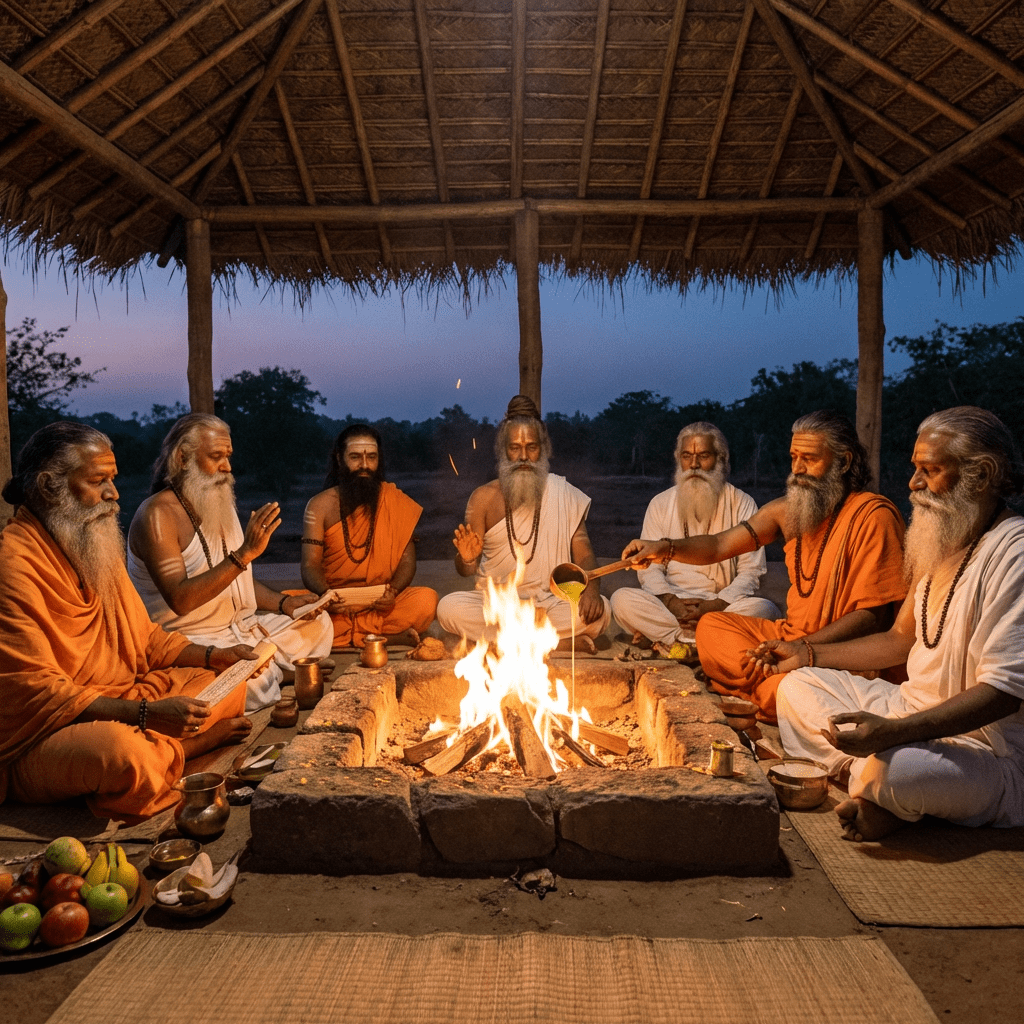
There is a dimension of the Rig Veda that tends to be overlooked when it is read as a religious or philosophical text: its human dimension, its familial, almost intimate quality. The hymns do not fall from the sky. They have authors, or rather receivers — men and women who received them in particular states of consciousness and transmitted them to their descendants. These authors are the rishis, and they are not isolated individuals. They belong to clans, to lineages, to families whose names run through the text from beginning to end and who constitute the human fabric on which the Rig Veda is woven. To understand these families is to understand something essential about the way Vedic civilisation functioned, about the way spiritual knowledge was transmitted, and about the way concrete human beings, with their histories, their rivalries and their friendships, produced one of the most remarkable texts humanity has ever composed.
The principle of the family mandalas rests on a simple and effective organisation. Mandalas two through seven, the oldest in the Rig Veda, are each associated with a particular lineage of rishis. These are not anonymous compilations. They are family collections, assembled and transmitted by clans whose identity is inseparable from the hymns they produced. Each mandala bears the stylistic, thematic and spiritual mark of the family that composed it, and these marks are distinctive enough that specialists can often identify the origin of a hymn simply from the way it treats certain themes or certain gods.
The Angiras are probably the oldest and most fundamental lineage in the Rig Veda. The name itself is one of the most meaning-laden in the entire Vedic corpus: the Angiras are the forces of Light, beings of fire, those who inhabit the intermediate world and serve as messengers between human beings and the gods. In the hymns, the word angiras is used both as the proper name of a family of rishis and as a generic designation for these luminous forces of the intermediate world. This ambiguity is not a defect. It says something essential: the family of the Angiras defines itself by its very nature, by the fact that it is a bearer of Light, and its human members are the earthly representatives of this cosmic force. Agni himself is sometimes called Angiras, the first and greatest of them. Indra is an Angiras. This family is therefore not simply a human lineage. It is a category of beings who participate in the nature of fire and Light.
The Bharadvaja constitute one of the most prolific families in the Rig Veda. The sixth mandala, one of the oldest, belongs to them. Bharadvaja himself is described as a great priest, a Purohita, the spiritual counsellor of a king. The hymns of his family have a particular quality: they combine great technical mastery with a human warmth that distinguishes them from certain other more abstract mandalas. The Bharadvaja seem to have had a particularly strong relationship with Indra, whom they invoke with remarkable familiarity and intensity, and with Agni, the domestic and sacrificial fire that is at the heart of their practice. Vedic legend has it that Bharadvaja lived three successive lifetimes studying the Vedas without having time to complete his knowledge of them, which says something about the way the Vedic people conceived of the extent of their own tradition.
The Atri are the authors of the fifth mandala, and it is in this mandala that one finds the hymn containing the description of the eclipse that allows us to date the oldest parts of the Rig Veda to around 3929 or 3928 BCE. This single contribution would be enough to make the Atri family precious to anyone seeking to understand the chronology of the text. But the Atri are much more than that. Their name literally means the one who eats, which may seem strange for a family of rishis, but which in the Vedic context designates the one who consumes, who transforms, who digests reality to extract its essence. It is a metaphor for spiritual practice itself. The hymns of the Atri have a particular contemplative quality, a way of pausing on the beauty of the visible world, on the rising of the sun, on the light of the dawn, that contrasts with the martial energy of certain hymns to Indra from other families.
The Vishvamitra, authors of the third mandala, are perhaps the family whose legend is the most famous in the entire Indian tradition. Vishvamitra, whose name means friend of all, is one of the most complex and fascinating figures in all of Vedic and post-Vedic literature. In the Rig Veda, he appears as the priest of King Sudas, the one who composed the hymns of the war of the ten kings, that founding conflict in which the Bharatas prevailed over a coalition of ten peoples. The hymns of Vishvamitra have a particular dramatic tension, an awareness of human and political stakes that gives them a different colour from the more purely contemplative hymns of other families. It is also to Vishvamitra that the Gayatri is attributed, that hymn 3.62.10 which is still today the most recited mantra in the Hindu world.
The Vasishtha, authors of the seventh mandala, are the great rivals of the Vishvamitra in the Vedic tradition, and this rivalry is one of the most celebrated in all of Indian literature. Vasishtha is the priest of the gods, the Brahmarshi par excellence, the one whose spiritual knowledge is the deepest and most firmly established. Where Vishvamitra is the warrior turned sage, the man of action who conquered knowledge through effort and will, Vasishtha is the born sage, the one for whom knowledge of Brahman is a nature rather than a conquest. The hymns of the seventh mandala have a quality of serenity and assurance that sets them apart. These are hymns from someone who knows, not from someone who is seeking. The relationship of Vasishtha with Varuna is particularly remarkable: several hymns describe an intimate dialogue between the rishi and the god, in which Vasishtha questions Varuna about his own errors and asks for his purification, with a frankness and a humility that are genuinely moving.
The Kanva are one of the most represented families in the eighth mandala, though that mandala is shared between several lineages. Their hymns have a particular lyrical quality, a musicality and a fluidity that distinguish them. The Kanva family seems to have had a predilection for hymns to the Ashvins, those twin healer gods, and for hymns to soma, which they describe with a precision and a sensitivity that suggest direct and deep personal experience of its effects.
What is remarkable about all these families is that they did not function in isolation. The hymns show interactions, borrowings, dialogues between lineages. The war of the ten kings, which directly involved the Vishvamitra and the Vasishtha on opposing sides, did not prevent their hymns from coexisting in the same corpus and being transmitted with the same care. The Vedic tradition was broad enough and mature enough to contain its own internal tensions without allowing them to fragment the whole.
These families of rishis are also the testimony of a conception of spiritual transmission that deserves attention. Vedic knowledge was not transmitted through institutions, through public schools, through central authorities. It was transmitted within the family, from master to student certainly, but in a context where the family lineage was the guarantor of authenticity and continuity. To be a Bharadvaja or a Vasishtha was not merely to carry a name. It was to carry a way of being, a way of entering into relationship with the divine, a way of receiving and transmitting the hymns that had been forged over generations and that carried within it the accumulated experience of all those who had walked that path before you. It is a form of transmission that we have largely lost, and whose loss is not without consequences for the way we situate ourselves in time and in knowledge.
 Le Rig Veda
Laisser un commentaire