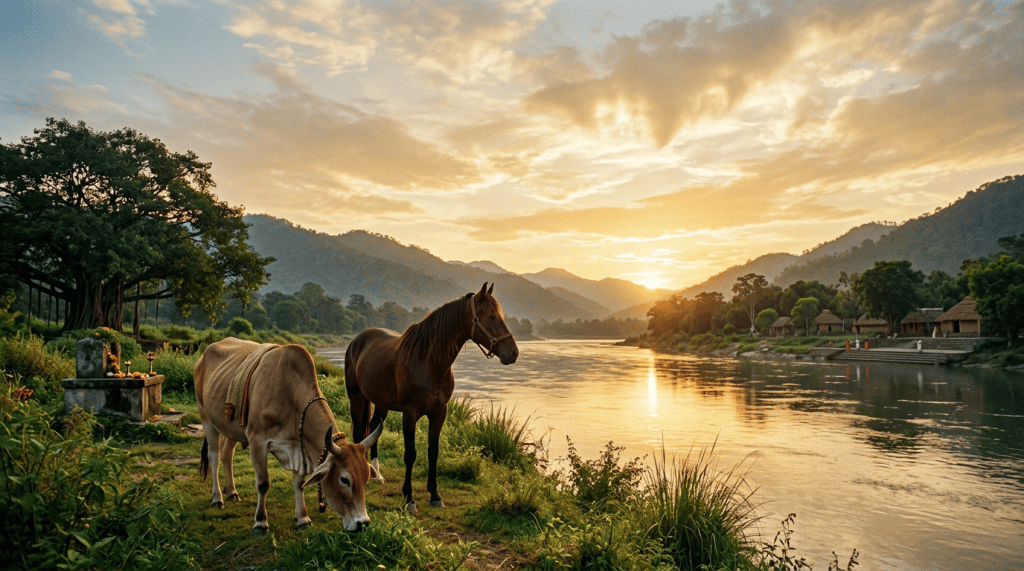
The nourishing cow. The steady mare. The base that sustains everything without ever failing. This is how the Rig Veda names Pṛthivī, the Earth, to whom the ṛṣis dedicated some of the oldest and most tender hymns in the whole corpus.
In the Vedic tradition, the world is organized around three planes: the Sky (Dyaus), the Intermediate World (Antarikṣa), and the Earth (Pṛthivī). This is not abstract cosmology. It is a map of human experience. The Sky is the domain of luminous consciousness, the Truth — what Sri Aurobindo calls ṛta. The Earth is the plane of concrete manifestation, where that Truth must become incarnate.
The couple Dyaus-Pṛthivī returns constantly through the hymns: the Father-Sky and the Mother-Earth, the two pillars between which all existence unfolds. “Who will restore us to Earth-Aditi, so that we may see the Father and the Mother” (1.136). This prayer says it all: the Earth is not simply soil, she is Aditi — the infinite in its nurturing form, the Great Mother-Goddess in her fullness.
What strikes me in these hymns is the complete absence of fear or domination. No desire to master the Earth, exploit her, possess her. Only a prayer of gratitude, addressed as to a mother. She is the one who “sustains what is moving and what is still” — the formula returns like a mantra. She carries the forests, the mountains, the waters, the people, without distinction or preference.
To my mind, this is one of the most urgent lessons of the Rig Veda for our time: the Earth is not a resource. She is a living being, a presence, a mother. The ṛṣis knew this five or six thousand years ago. We have forgotten it.
And in the symbolic reading I follow, drawing on Sri Aurobindo, Pṛthivī also names the plane of ordinary consciousness — this world, as we ordinarily perceive it. The prayer to the Earth becomes then a prayer for Truth to become incarnate here, in our concrete life, in our society, in our daily existence.
What I take from this: before being a goddess, before being a symbol, Pṛthivī is an immediate reality. The ground beneath our feet. The air we breathe. The body we inhabit. The Vedic hymn does not ask us to believe in something. It asks us to look at what is here — and to give thanks.


Votre commentaire