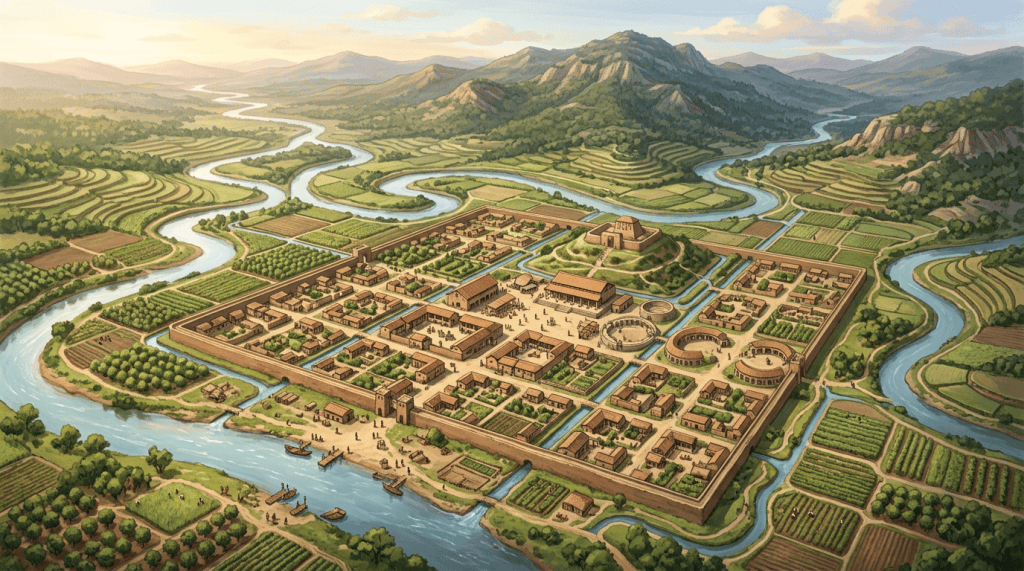
The Puruṣa Sūkta, hymn 10.90 of the Rig Veda, is a cosmogony text — a description of how the world was born from the sacrifice of a thousand-headed primordial being. But it is also, to my mind, the most accurate description of a certain vision of human society. And this vision I find again in the archaeological remains of the Seven Rivers civilisation with a precision that strikes me every time I return to it.
The social body according to the Puruṣa Sūkta
The hymn describes four functions arising from the four limbs of Puruṣa’s body: the mouth (knowledge and speech), the arms (governance and protection), the thighs (production and exchange), the feet (foundational work). These four varṇas — brahmaṇa, rājanya, vaiśya, śūdra — are not a hierarchy of value. They are the functions of a living organism. And like any organism, it works only if all its parts play their role and receive what they need.
What I take from the Puruṣa Sūkta is precisely the image of the body: a system where each part is irreplaceable, where the mouth cannot eat if the feet do not carry it to food. It is a functional and interdependent vision of society — the opposite of any fixed hierarchy. The hymn itself, I explore it verse by verse in my article on the Puruṣa Sūkta (rigveda.blog).
The Sapta Sindhu: a society without absolute kings
What strikes one in the excavations of Mohenjo-daro, Harappā, Dholavira, is precisely the absence of what archaeology finds almost everywhere else: no dominant palaces, no monumental temples dedicated to a god-king, no representations of triumphant sovereigns crushing their enemies, no royal tombs overflowing with accumulated wealth.
The cities of the Sapta Sindhu are planned, rational, comfortable for everyone. The houses in working-class neighbourhoods have the same access to wells and sewers as those in more prosperous districts. There are no fortifications turned inward — the walls, where they exist, protect against mud and floods, not against the lower classes.
This is exactly how a healthy body functions: each part receives what it needs. This horizontal organisation I also described in my article on weights and measures (saptasindhuveda.com) — the same standardised measures across the entire civilisation suggest coordination without a dominant centre.
Sacrifice at the heart of social life
The whole life of Vedic civilisation revolved around sacrifices. But in the Puruṣa Sūkta, sacrifice is not a loss — it is a circular gift: one offers to the gods, and the gods return in kind. Soma is drunk to diminish the ego, so that the one who governs governs less for himself and more for the whole.
In this logic, the rājanya — the leaders — were required to drink soma at the great sacrifices. Not the śūdras, because they held no collective power to exercise. But as soon as a śūdra became wealthy and powerful, he too had to drink soma and change varṇa. Power called for responsibility, and responsibility called for the humility of sacrifice.
This is a vision radically different from modern Western power — where wealth exempts from responsibility rather than creating it. And the seals of the Sapta Sindhu, with their figures in deep meditative posture, suggest that this practice of internalisation was already present long before the Rig Veda codified it. Those meditating figures I explore in my article on the engraved bestiary (saptasindhuveda.com).
A model for after
What moves me most in this rapprochement between the Puruṣa Sūkta and the Seven Rivers civilisation is that both converge toward the same idea: a viable society is one that functions like a living body, where each function is honoured, where power is tempered by responsibility, and where wealth circulates rather than accumulates.
We are far from this model today. And perhaps that is why I return ceaselessly to these texts and these remains — not to flee the present, but to find in them resources we have forgotten.


Votre commentaire