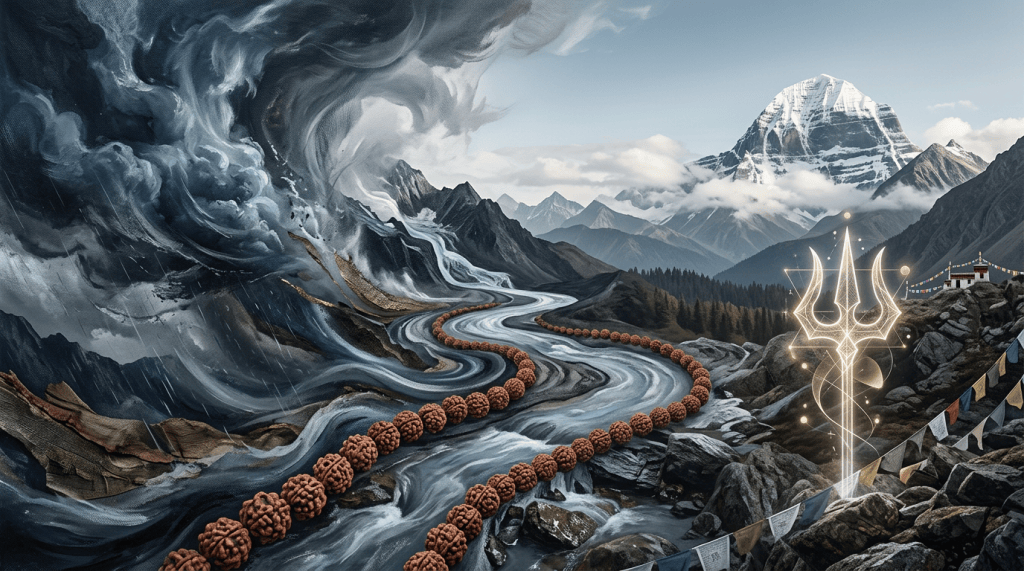
There is a god in the Rig Veda whom one does not invoke like the others. You do not say to him: “Come, drink the soma, rejoice with us.” You say: do not be angry. Do not strike us. Turn your arrows away from us. That god is Rudra.
His root is rud — to weep, to make weep. He is the one who causes tears to flow. And this is the ancient name of Shiva, the Benevolent, a name given to him precisely because Rudra is frightening.
The prayer that pleads
Hymn 1.114, addressed To Rudra (ṛṣi: kutsa āṅgirasa), opens: “To the mighty Rudra we bring our hymn, to the lord of men, to him who wears his hair in a coil. May he be the cause of relief from suffering for all bipeds and quadrupeds.” And immediately: “Be favourable to us, O Rudra, and bring us Happiness… Whatever health and Happiness our father Manu obtained by his sacrifices, may we, through you, O Rudra, win them.”
Hymn 2.33 is still more explicit: “O Rudra, with the safest remedies you can give, may I reach a hundred winters, and drive far from us hatred, anguish, and disease in every form. O Rudra, the most beautiful of the living, in your glory you are the most powerful of the powerful, Bearer of the Thunderbolt. Carry us across the anguishes, toward well-being, repel the attacks of all aggressors.”
Beauty, power, generosity are acknowledged — and still he is begged not to strike.
Father of the Maruts
Rudra is the father of the Maruts, the storm gods whom the Rig Veda describes as “terrible as wild beasts in full Force, brilliant as fires” (2.34). The sons follow the nature of the father: raw energy, wind, tempest, destruction of whatever obstructs. They are also Indra’s companions. Rudra’s violence is therefore not blind violence — it is the force that cleanses, that shatters darkness to let the Light through.
In my own work on the Rig Veda, my definition is this: Rudra symbolises destruction. He is violent and terrible, while at the same time compassionate toward all that suffers. He destroys the shadows to make room for the Light.
The healer in spite of himself
This paradox is at the heart of Rudra: the most feared god is also the one asked for healing. One asks him for remedies for men, cows and horses. One asks him to drive disease away. The same god who carries the thunderbolt carries the medicinal herbs as well.
There is no contradiction here. In Vedic logic, whoever masters destruction also masters healing. Fire burns and purifies. The storm devastates and irrigates.
The secret of the Long-Haired: bhang and soma
Shiva is, in Indian tradition, a great devotee of bhang — a cannabis preparation used by sādhus as a substance of awakening. This tradition does not come from nowhere: it surfaces in Rig Veda hymn 10.136, To the Long-Haired (ṛṣis: the Vātaraśana brothers), which I place in the direct lineage of Rudra/Shiva.
The hymn describes the ascetics, the munis, girt with wind, clothed in ash: “Driven into a state of ecstasy, we ride upon the winds. You mortals, you see only our bodies.” The long-haired one carries fire, carries Heaven and Earth, carries the Sun that all behold. He flies through the intermediate world, friend of every god.
What the hymn describes is an altered state of consciousness — the ascetic’s ecstasy. When I was in India in 1973, on the small market above the ghats of Varanasi, a ball of bhang sold for 0.10 rupees. The sādhus are very fond of it. The preparation differs from soma in one essential point: for bhang, you keep the crushed plant and discard the juice; for soma, you do the opposite. Both paths lead to ecstasy — but they are not the same gods who walk them. Rudra/Shiva, god of destruction and regeneration, chose bhang. The Vedic sacrificants chose soma.
From Rudra to Shiva
When the Seven Rivers civilisation declined, when soma became scarce, when the ṛṣis migrated toward the Ganges, Rudra survived. He grew, absorbed other local deities, changed his name. Shiva — the Benevolent — is the tamed Rudra: the one whose healing power was kept in the hope of tempering the wrath. The Rig Veda traced him at the origins. As I explore in my companion article on saptasindhuveda.com about the Great Bath of Mohenjo-daro, ritual purification was at the heart of that civilisation — and Rudra, master of remedies, held his place within it.


Votre commentaire