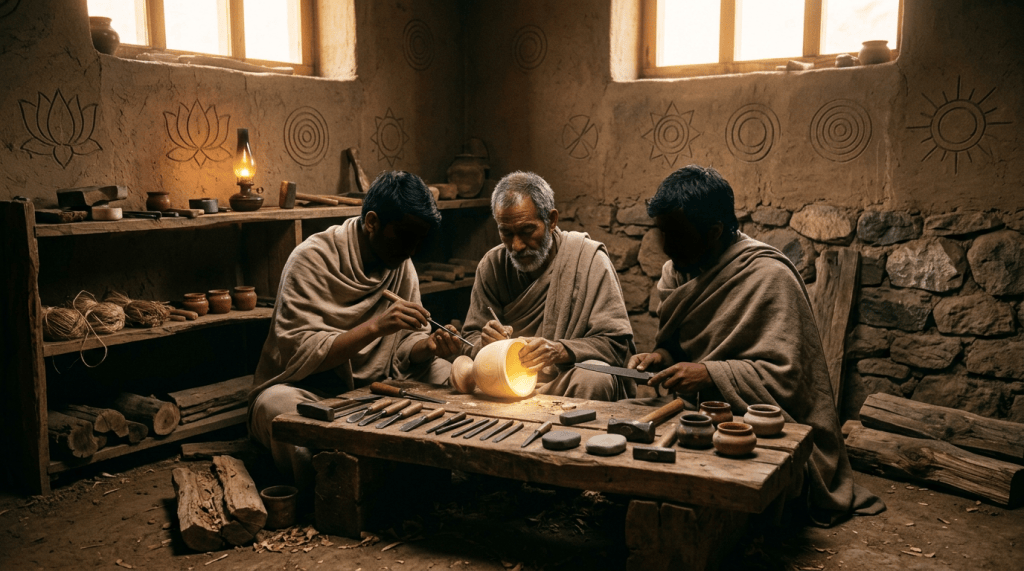
Among the most singular figures of the Rig Veda, the Ribhus hold a place apart: three mortals who became gods through the excellence of their work. Hymn 1.20 invites us to understand what the Vedic tradition truly means by immortality — not a birthright, but the reward of inner mastery.
In what I read as a foundational teaching of the Rig Veda, the Ribhus represent the possibility offered to every human being of reaching the divine through the perfection of the act. They are not gods in the ordinary sense — they became gods, and it is precisely this trajectory that makes them so essential to our understanding of Vedic spirituality.
The hymn opens with a luminous statement: « For these gods, this hymn is born from the mouth of sages. It achieves Illumination. » From the very first verse, the tone is set — this is not about celebrating distant powers, but about an illumination that happens here, in the mouth of the sages, at the heart of ritual and inner practice.
The Ribhus are the sons of Sudhanvan, a wise craftsman. This lineage is not accidental: it roots their myth firmly in the domain of making, creating, building with excellence. What I see here is the extraordinary Vedic valorization of work done well as a path toward the sacred. In many spiritual traditions, the material world is suspect, something to transcend or flee. Here, it is exactly the opposite: artisanal mastery is a path of deification.
Hymn 1.20 describes their works with precision. They built « for the Nâsatyas a quiet chariot that penetrates everywhere » — the Nâsatyas, or Ashvins, being the gods of journeying and healing. They « created the Cow that produces milk ». And perhaps their most remarkable achievement: « You have restored youth to your parents, through honest mantras of truth. » They rejuvenated their own parents. I read this image as the renewal of vital energy through right practice — the mastery of sacred sound, the mantra, enabling a regeneration that transcends ordinary biology. This is not magic; it is realization. For a deeper understanding of the sacred dimension of soma in the Rig Veda, I invite you to read my article on the ritual preparation of Soma.
The soma cup holds a central place in the myth of the Ribhus, developed more fully in other hymns. Agni presents them with a divine challenge: from the single cup, make four cups. This gesture — multiplying the one into four — is a transparent metaphor for the expansion of consciousness. One reality becomes four dimensions of itself. In my view, this type of ordeal symbolizes the capacity to see what is One in its multiplicity, while maintaining the coherence of the whole. It is a spiritual skill as much as a technical one.
Hymn 1.110, also dedicated to the Ribhus, specifies their reward: « This Sun has given you Immortality, for you have come to proclaim what nothing can hide. » Immortality granted by the Sun — Sûrya — is in the Rig Veda an image of boundless consciousness, the consciousness that never sets, that endures. What I read here: total transparency, the absence of concealment, is what opens the door to the immortal state. Nothing to hide because one has become what one is, with no gap between inner and outer.
This motif moves me particularly because it says something radically human: it is not static perfection that leads to the divine, but dynamic, honest, transparent work. The Ribhus labored, were tested, produced verifiable works — and through this they were admitted into the circle of the immortals. Indra himself acknowledges them, inviting them to the soma banquet: « The intoxications of soma come to you all together with Indra and the Maruts, with the sons of Aditi and the kings. »
What I take from hymn 1.20 as practical teaching: the Vedic path is not a path of renunciation from the world. It is a path of excellence within the world. To work with full presence, full awareness, in alignment with ṛta — the Truth of what is — this is what transforms the craftsman into a sage, and the sage into an immortal.
The Ribhus remind us that the divine does not descend upon us through arbitrary grace. It is conquered through the quality of the act, the rightness of the mantra, the capacity to rejuvenate what is exhausted, to multiply what is unique, to build what serves gods and human beings alike. The boundary between human and divine is not a boundary of nature, but of realization. On how this Vedic wisdom speaks to our contemporary world, you will find fascinating perspectives in my article on Sarasvatî and artificial intelligence on my other site.
In the tradition that sees the Nâsatyas, the Maruts, the Ädityas as forces acting within the human psyche, the Ribhus represent something precise: the artisan energy of consciousness, this capacity to fashion perfect forms from given materials. Every human being carries their inner Ribhus — those forces of making, creating, perfecting. Hymn 1.20 calls them to participate in the sacrifice, that is to say, to unite with something greater than themselves.
It is in this sense that I read this text as an encouragement: immortality is not reserved for the gods. It is the ripe fruit of honest work, conducted in Truth, offered to something greater than oneself. And to deepen this journey into the civilization of the 7 Rivers, discover how the craftsmen of that fascinating civilization expressed their genius in service of the common good.


Laisser un commentaire