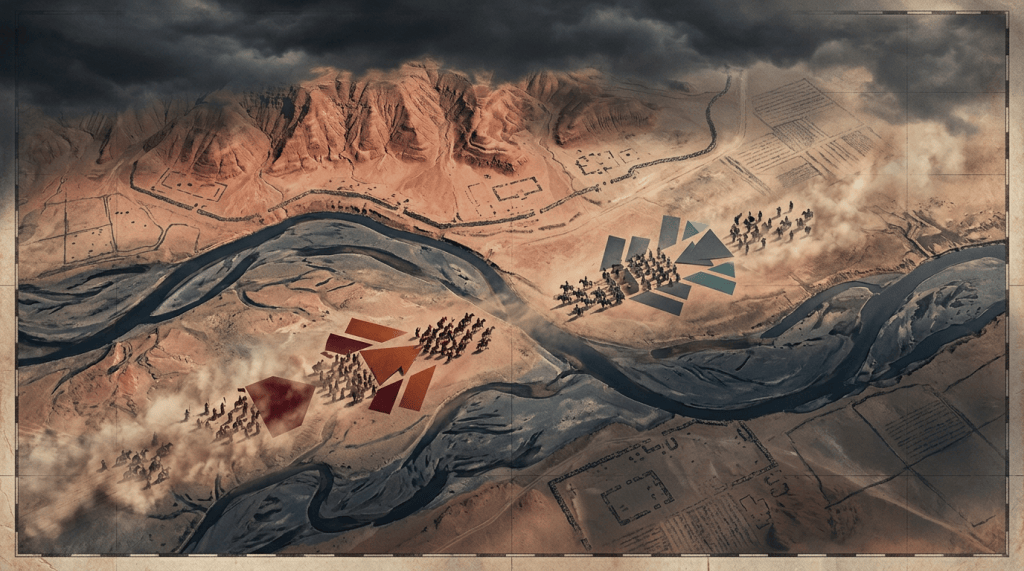
In the Rig Veda, there is History. Not only spirituality, not only hymns to rain and fire — there are names of kings, names of battles, rivers that can be located on a map. And among all these historical accounts, there is one that fascinates me more than the others: the war of the ten kings. It is, to my knowledge, the first conflict of which humanity has retained a precise memory. We know the protagonists, the places, and even some of the names of the dead.
At the heart of this war is a rivalry between two rishis: Vasiṣṭha and Viśvāmitra. It is this rivalry that, according to the more recent texts, would have sparked the conflict. King Sudâs — grandson of Divodâsa, king of the Bharatas — had as his chaplain, his purohita, Viśvāmitra. He replaced him with Vasiṣṭha. Viśvāmitra, it is said, did not appreciate this. He then rallied five Vedic peoples — the Pūru, the Yadu, the Turvaśas, the Anu, and the Druhyu — and allied them with five non-Ārya peoples to fight the Bharatas, who themselves came from the same federation of Pūrus.
What strikes me about this story is that it is not a religious war, nor a war of conquest. It is an internal war, a family quarrel, a wound to the pride of two priestly lineages. And yet it left a lasting mark on the collective memory of this people.
There were two battles. The first on the banks of the Paruṣṇī — today’s Rāvī river in the Punjab —, the second on the Yamunā. In hymn VII.19, I read: « They came to the Paruṣṇī with an evil intention, certainly not approaching quickly. Indra subdued the enemies, who, though in society, spoke badly and ran fast before Sudâsa. » Sudâs’s victory is celebrated several times in mandala VII, notably in hymn VII.33, addressed to Vasiṣṭha and his sons: « Now surely it is by your mantras that Indra has favoured Sudâsa against the ten kings, O Vasiṣṭhas. »
What I take from this war is its outcome. Sudâs conquered — and he united. After the victory, the five defeated peoples were integrated into the federation to form what would become the Ārya people. This is not the logic of the victor who crushes: it is the logic of gathering. The Laws of Manu, later but faithful to this spirit, say it explicitly: « After conquering a country, let the king honour the gods worshipped there and the virtuous Brahmins; let him distribute largesse to the people and make proclamations that will remove all fear. » Humiliating a defeated person is always a bad idea — this people already knew it.
For me, the war of the ten kings is not merely a historical event. It is a lesson in politics. And the rivalry between Vasiṣṭha and Viśvāmitra — two great rishis, two great spiritual lineages — reminds me that even in the wisest of civilizations, egos can come into conflict. The difference lies in what one does afterwards.
On the small pacifist civilizations that surrounded the Sapta Sindhu at the same time, I invite you to read my article on saptasindhuveda.com: Small Civilizations Led by Women: Matriarchy and Prehistoric Pacifism


Laisser un commentaire