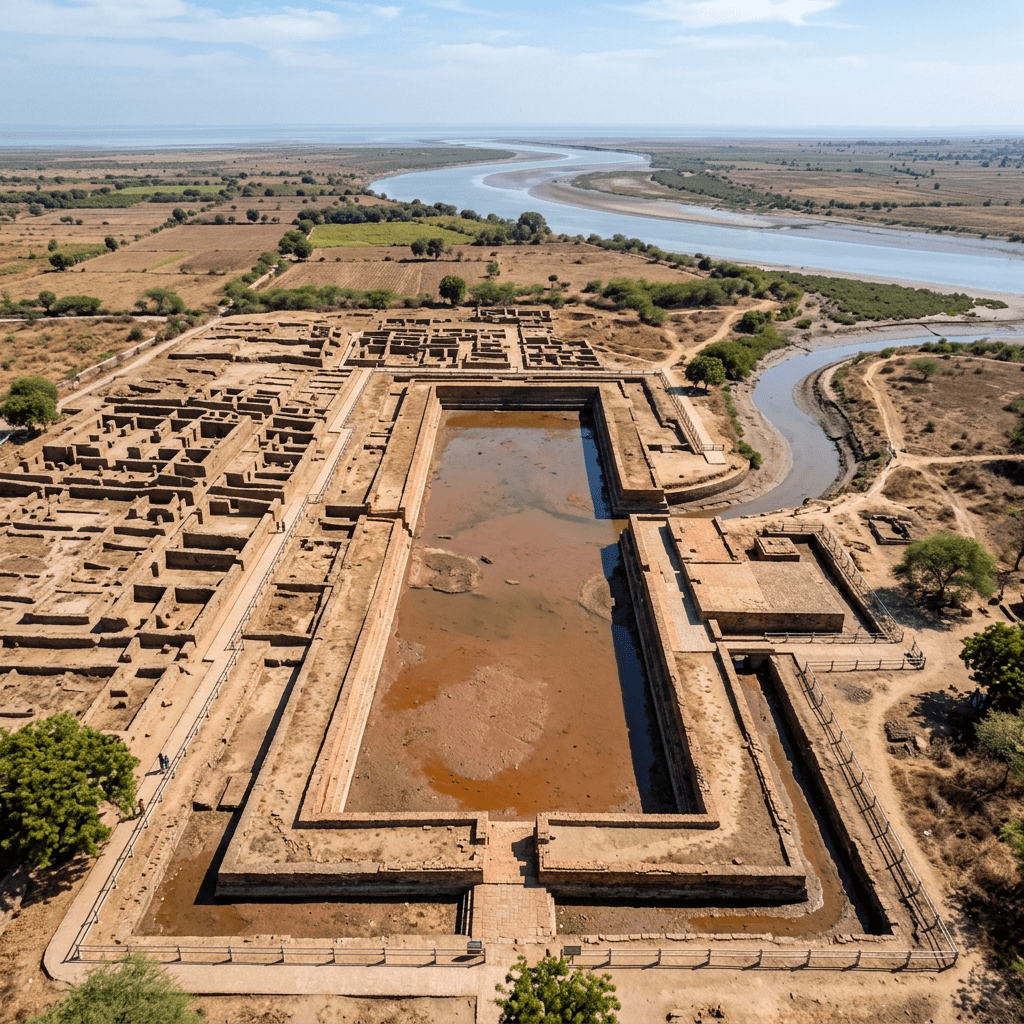
Lothal. The name means « the mound of the dead » in Gujarati — like Mohenjo-Daro in Sindhi. A linguistic coincidence that says something about how modern peoples named these sites without knowing what they were. For Lothal is not a mound of the dead. It is one of the most living, most active, most outward-looking sites in the entire civilization of the 7 Rivers.
It is at Lothal — in Gujarat, at the mouth of the rivers that join the Gulf of Khambhat — that the most tangible evidence was found that this civilization was also a maritime civilization.
What archaeologists called « the port »
Since the first systematic excavations of Lothal conducted by S. R. Rao from 1954 onwards, archaeologists uncovered a massive structure without parallel in all the archaeology of this civilization: a large rectangular brick basin measuring approximately 218 metres long by 37 metres wide and 4.15 metres deep, with carefully arranged water inlets and outlets.
S. R. Rao interpreted it as a docking basin — the oldest artificial port in human history. This interpretation was widely taken up in archaeological literature and popular accounts. Lothal was presented as the port of the 7 Rivers civilization, the maritime bridgehead that enabled exchanges with Bahrain, Oman and Mesopotamia.
But this interpretation has always posed problems for people who know the sea.
What Breton sailors told the author
Having presented the plans and photographs of this structure to Breton sailors — professionals of the sea, people whose relationship with water and boats is inscribed in their cultural DNA — I collected two alternative interpretations, more convincing than that of the commercial port.
The first: a fish trap. A retention basin for fish. The structure is ideal for keeping fish alive close at hand, easily accessible, without needing to fish every day. The water inlets and outlets allow natural renewal of the basin. It is a technique still used in certain coastal areas of Brittany for keeping seafood alive.
The second, put forward by other Breton sailors: a shipyard. A closed basin, fed with controlled water, in which boats can be built or repaired sheltered from currents and tides. The depth — more than four metres — allows work on hulls of significant size. The brick walls offer protection and stability that no natural shoreline could provide. And the structure is ideal for launching a boat gradually into the water, controlling the level precisely.
This second interpretation, put forward by sailors whose profession it is, seemed to me the most coherent with what I knew of the 7 Rivers civilization — a civilization that exported by sea to destinations thousands of kilometres away. Building and maintaining boats capable of crossing the Persian Gulf and the Indian Ocean to Mesopotamia is not an operation carried out on a beach. It requires infrastructure.
The recent archaeological confirmation
And here is the news: archaeology has settled the matter. One or two years ago, a thorough archaeological study of the Lothal site concluded that the structure was indeed a shipyard — not an ordinary commercial port.
The analyses showed that the hydraulic arrangements were designed to control the water level with precision — a characteristic useless for a port receiving merchant vessels, but essential for a yard where hulls are progressively and carefully floated. Traces of woodworking tools were found in the vicinity. The geographical location — set back from the sea, connected by a canal — corresponds far more to a construction and maintenance site than to a commercial entry port.
The Breton sailors were right. Their practical knowledge of the sea and of boats had allowed them to read the structure of Lothal with a precision that conventional archaeology had not reached.
What Lothal reveals about the maritime civilization of the 7 Rivers
In The Civilization of the 7 Rivers, I underline that long-distance trade was at the heart of this civilization. Sumerian cuneiform tablets mention Meluhha — the name given to this civilization — in the context of regular commercial exchanges. Indus trading posts were found in Iran and Mesopotamia. Steatite seals typical of the 7 Rivers civilization were found in Bahrain. Carnelian beads were discovered in Sumerian royal tombs.
These exchanges were not made only by land caravans. A significant part of trade was carried by sea — across the Gulf of Oman, along the Arabian coasts, to the Shatt al-Arab and the cities of Sumer. This maritime trade required boats capable of navigating the open sea, sturdy, large enough to carry bulky merchandise.
Underwater archaeology has also discovered a wall beneath the waters at Bet-Dwarka, still in Gujarat — which could be the remains of a quay submerged by rising sea levels since Antiquity. Here too, deeper excavations are needed — and promise important revelations.
And B. B. Lal, later director of the Archaeological Survey of India, discovered at Lothal and Kalibangan fire sacrifice altars — confirming that the inhabitants of Lothal practised the same Vedic rituals as the rest of the civilization. This was not a colony of sailors without cultural roots. It was a city fully integrated into the 7 Rivers civilization, with its spiritual practices, its social structures — and its shipyard.
A lesson in epistemology
The story of Lothal is also a lesson about how knowledge is constructed — and about the limits of academic knowledge when it is cut off from practical experience.
Archaeologists trained in excavation methods, stratigraphic analysis, and the study of artefacts looked at this basin and said: it is a port. Breton sailors, whose knowledge is not bookish but embodied in generations of maritime practice, looked at the same plans and said: it is a shipyard. Recent archaeology has vindicated the sailors.
This is not an argument against archaeology. It is an argument for the diversity of knowledge — for the idea that understanding an ancient civilization requires not only rigorous academic methods, but also the practical wisdom of those whose lives resemble, however partially, those of the men and women who were building boats five thousand years ago on the shores of the Gulf of Khambhat.


Votre commentaire