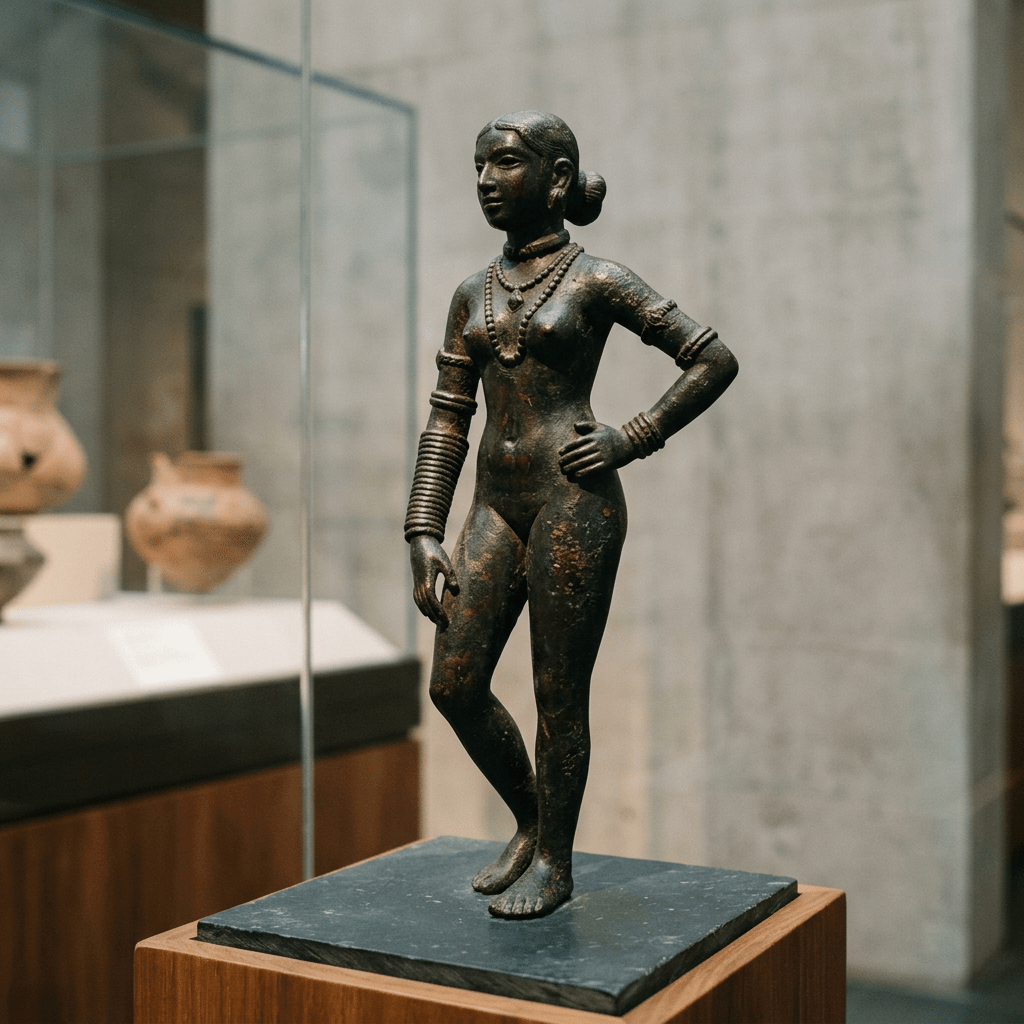
She is ten centimetres tall. Cast in bronze using the lost-wax technique, dated to around 2500 BCE. She stands upright, her left hand resting on her hip, her right arm hanging along her body, her head turned slightly. She is naked, adorned with bracelets that cover almost her entire left arm, and a necklace. She is looking at something we cannot see — with a quiet confidence, without the slightest trace of submission or modesty.
This is the Dancing Girl of Mohenjo-Daro. Discovered in 1926, now housed in the National Museum of New Delhi. She is the only statuette of relatively large size found in the entire civilization of the 7 Rivers — and she says, by herself, essential things about that civilization.
What a statuette can reveal
In The Civilization of the 7 Rivers, I note that among the thousands of artefacts discovered on the sites of this civilization, the statuettes show men and women going bare-chested, like sub-Saharan African women a few decades ago — without this troubling anyone. Men and women alike wore many necklaces and bracelets, often in lapis lazuli, carnelian and gold. Hairstyles were very elaborate, probably distinctive according to linguistic or regional communities.
The Dancing Girl embodies all of this — and something more. Her nudity is not that of the slave or the object. It is that of a free woman, at home in her body, at ease in the space she occupies. The position of her hand on her hip is not a submissive pose. It is a pose of confidence — almost of quiet defiance.
John Marshall, who directed the first excavations at Mohenjo-Daro, described her as a « dancing girl » — and the name stuck. But no inscription tells us exactly what she was. A dancer at public sacrifices? A representation of a goddess? A portrait of a community woman? We do not know. What we do know is that she was carefully made, by an artisan who mastered the difficult lost-wax casting technique, to represent a woman in her full bodily dignity.
The body without shame in Vedic civilization
In The Civilization of the 7 Rivers, I cite Possehl: female figurines often wear long pleated skirts, while male figurines are depicted with loincloths. But torsos are bare, for both sexes, without this apparently raising any moral question.
This absence of bodily shame is not an anecdotal detail. It says something fundamental about how this civilization understood the human body — not as something to hide, cover or control, but as a natural reality, to adorn, to honour, to allow to express itself in movement.
The Rig Veda itself points in the same direction. The marriage hymn 10.85 — the longest hymn in the Rig Veda — describes with remarkable frankness and sensuality the body of the bride, the desire of the spouses, the physical union. There is no guilt around the body or sexuality in the ancient mandalas. These dimensions of human life are presented as natural, to be honoured on the same level as the sacrifice or meditation.
Art as a trace of society
The Dancing Girl is unique in all the civilization of the 7 Rivers — no other statuette of this size and quality has been found. But she is not isolated in spirit. Thousands of small female figurines in terracotta have been discovered on all sites — in houses, not in temples. Figures of women with wide hips, elaborate ornaments, often standing, often carrying something. These figurines were not objects of institutional worship. They were in homes, in courtyards, in domestic spaces.
In The Civilization of the 7 Rivers, I underline that jewellery — lapis lazuli necklaces, carved shell bracelets, gold and carnelian ornaments — was exported to Mesopotamia, Bahrain and Iran. Craftsmanship was a major export industry, and women’s jewellery was an essential part of it. This was not a society that hid its women. It was a society that exported their beauty.
Musical instruments and collective celebration
The Dancing Girl did not dance in silence. In The Civilization of the 7 Rivers, I note that excavations uncovered a seven-hole flute — allowing more harmonious melodies than a six-hole flute — a nine-string instrument resembling a harp, a kind of metal kettledrum, and several bowed and plucked string instruments, ancestors of the sarod and the sitar.
Public sacrifices — the Agnistoma and its variants — were occasions for great collective celebrations overflowing with colour, music and rejoicing, with snake charmers, musicians and dancers. Vedic spirituality, I affirm in this book, is absolutely not sad. The Dancing Girl is not an ascetic figure. She is a figure of joy.
What the Dancer says about the place of women
A civilization that represents its women standing, naked, confident, adorned and free in their bodies — and that represents no warrior, no king, no sovereign — says something precise about its values.
In the Rig Veda, thirteen women composed hymns. Women drank soma like men. They were not relegated to the domestic space. Hymn 5.61.6 says it without ambiguity in my translation: « A woman is more trustworthy than a man, if he does not follow the gods and is selfish. »
The Dancing Girl is the metal confirmation of what the text says in Sanskrit. In the civilization of the 7 Rivers, the woman was not an object of control, possession or shame. She was a full presence — in the body, in art, in spirituality, in social life.
Ten centimetres of bronze. Four thousand five hundred years. And an evidence that crosses time: there has already existed, on this Earth, a civilization that knew how to look at women without reducing them.
https://www.rigveda.blog/dancing-girl-mohenjo-daro-femininity-art


Votre commentaire