There is a received idea about yoga that the globalization of this practice has firmly installed in the Western public mind. The idea that yoga is essentially a physical practice — a series of postures, stretches, and breathing exercises — codified by Patañjali in his Yoga Sūtras, somewhere around the second century BCE.
This idea is both true and profoundly misleading. Patañjali certainly codified a form of yoga. But he did not invent yoga. He systematized a tradition that had existed for millennia before him — a tradition whose roots plunge directly into the Rig Veda, into the civilization of the 7 Rivers, into practices that predate by several millennia everything the West knows under the name of yoga.
The Seals of Mohenjo-Daro — The Archaeological Evidence
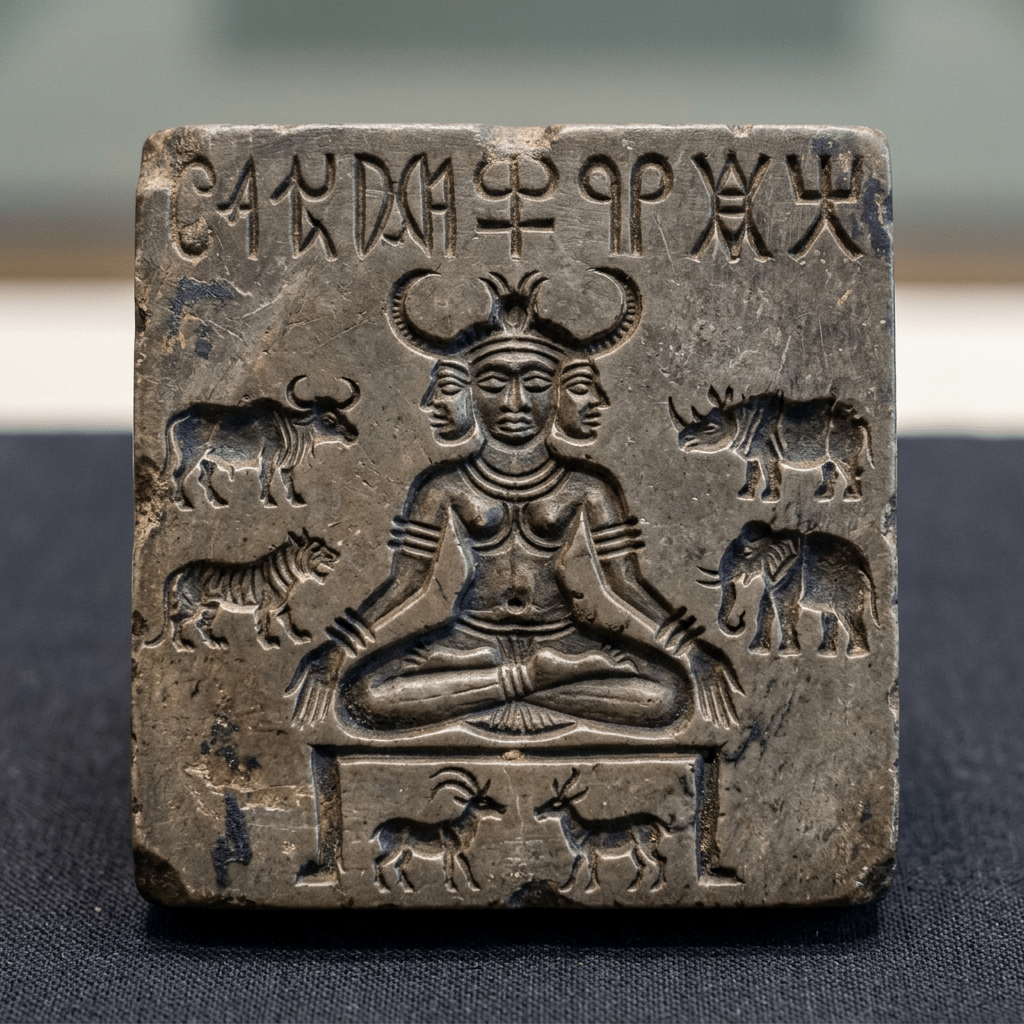
In my work on the civilization of the 7 Rivers, I emphasize the importance of an archaeological fact that is often mentioned but rarely fully measured in its implications. Among the thousands of seals and figurines found at Indus civilization sites — at Mohenjo-Daro, Harappa, Rakhigarhi — several depict figures seated in postures that leave no doubt about their nature.
The most famous is the seal known as « Proto-Shiva » or « Pashupati » — a figure seated in perfect meditation posture, legs crossed, feet joined, hands resting on knees, gaze directed downward or inward. Around him, animals. Above his head, what appears to be horns or a ritual headdress.
This figure is seated in what we would today call a meditation posture — a posture that millions of people around the world practice daily in their yoga classes. And it was engraved more than four thousand years ago, at a time when Patañjali had not yet been born, when the Yoga Sūtras did not exist, when even the Upanishads had not yet been composed.
Yoga — in the sense of seated meditative practice, interior concentration, control of breath and attention — existed before Patañjali by at least two thousand years.
Yoga in the Rig Veda — What the Text Says
In the Rig Veda itself — that text which I have translated in its entirety and whose introduction I have studied at length — the word « yoga » does not appear in its later technical sense. But the reality it designates is omnipresent.
The rishis who composed the hymns were not mere poets. They were practitioners — beings who had accessed, through their interior practices and through Soma, expanded states of consciousness that allowed them to « see » the truths that their hymns express. The word « rishi » itself — often translated as « seer » — says this visionary dimension, this capacity to perceive what escapes ordinary consciousness.
The Munis — those solitary ascetics whose existence the Rig Veda mentions in several hymns — are the direct ancestors of the yogis. Hymn 10.136 describes them as beings who have mastered the wind, the breath, who see beyond appearances, who fly through the air — all images of the interior mastery that meditative and breathing practices produce.
« The Munis, girt with wind, clad in yellow dust, follow the path of the wind, where the gods have gone before them. »
This is not magic or poetic fantasy. It is the description, in Vedic symbolic language, of what we would today call altered states of consciousness — states produced by interior practices that yoga, in its later forms, will codify and systematize.
Pranayama — Control of the Breath as Primordial Practice
One of the most fundamental practices of yoga — in all its forms, at all times — is pranayama, the control of breath. This practice did not appear with Patañjali. It is present from the Rig Veda.
Vāyu — the wind, the deified breath — is one of the major forces of the Vedic pantheon. Its relationship with life is direct and immediate — without breath, no life. But in the Vedic vision, breath is not merely a biological process. It is a link between the physical world and the subtle world, between ordinary consciousness and expanded consciousness.
Controlling the breath — slowing the respiration, deepening it, using it as a tool of attention and interior transformation — is to act on this link. It is to deepen the connection between the manifested world and what transcends it.
Stanislav Grof — whom I mention in my introduction to the Rig Veda — demonstrated experimentally that holotropic breathing, an intense form of pranayama, produces states of consciousness comparable to those that Soma produced. This is not a coincidence. It is the modern confirmation that the Vedic rishis had discovered, empirically, the deep link between control of breath and access to expanded states of consciousness.
Yoga as Dissolution of the Ego
What is fundamental in the yoga of origins — and that contemporary Westernized forms have often lost sight of — is its objective.
Vedic yoga is not a wellness practice. It is not a method for being more flexible, less stressed, better in one’s body — even if these effects can be consequences of it. It is a practice whose goal is the temporary dissolution of the ego — that direct access to Brahman, to ultimate reality, that I have described in my work.
In the Vedic vision, the ego — that psychological structure that experiences itself as separate from the rest — is the primary obstacle to the perception of reality as it is. Soma dissolved this obstacle chemically. The yoga of the Munis dissolved it through practice — through meditation, control of breath, concentration, prolonged immobility.
The two paths — chemical and meditative — had the same goal. And often, in Vedic practice, they combined — Soma facilitated entry into meditation, and meditation amplified and oriented the effects of Soma.
Patañjali — Codifier, Not Inventor
When Patañjali composed his Yoga Sūtras — probably around the second century BCE, though the exact date is debated — he did not create something new. He systematized a millennial oral tradition. He codified, organized, systematized what generations of practitioners had discovered and transmitted.
His celebrated « Yoga citta vritti nirodha » — « Yoga is the cessation of the fluctuations of the mind » — is not a conceptual innovation. It is the precise and concise formulation of a reality that the rishis of the Rig Veda knew and practiced for millennia.
What Patañjali contributes — and it is considerable — is a system. A clear progression, defined stages, a map of the interior territory that yoga allows one to explore. The eight limbs of yoga — yama, niyama, asana, pranayama, pratyahara, dharana, dhyana, samadhi — constitute a complete pedagogy of interior transformation.
But the destination toward which this pedagogy leads — the dissolution of the ego in universal consciousness, access to Brahman, the perception of Truth as it is — this destination was known and lived by the Vedic rishis long before Patañjali drew the map of the path.
What the Yoga of Origins Tells Us Today
In a world that has adopted yoga as a wellness and fitness practice — that has made it a global industry worth several billion dollars — rediscovering the Vedic roots of this practice is not an exercise in antiquarianism.
It is an invitation to remember what yoga was truly seeking — not improved physical performance, not stress management, not a more toned figure. The dissolution of the ego. Access to a reality that surpasses the ordinary self. The direct perception of that fundamental unity that Brahman designates.
In a world that is collapsing partly because the collective ego — the ego of corporations, states, civilizations — has taken precedence over all other considerations, this invitation is more urgent than ever.
The yoga of origins is not an individual wellness practice. It is a technology of consciousness transformation — individual and collective. And it is perhaps what our era most needs.


Laisser un commentaire