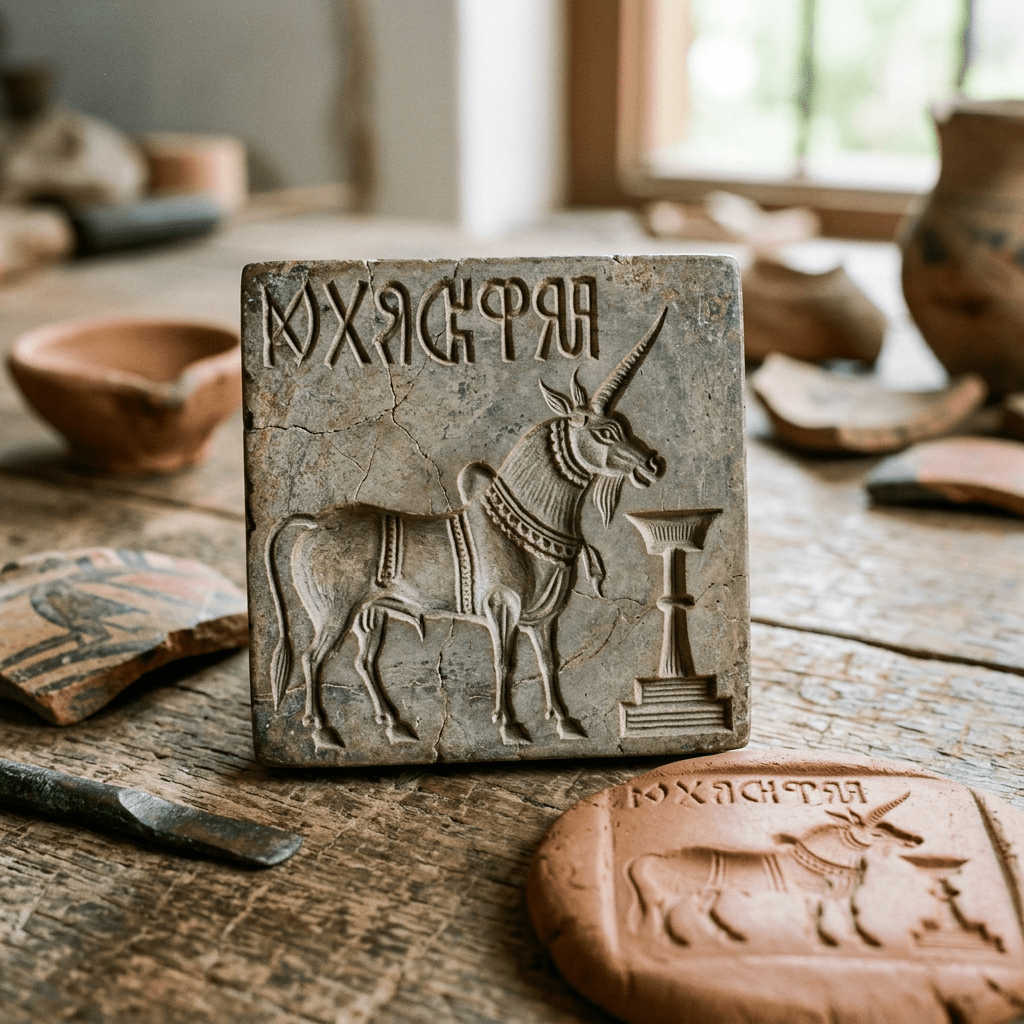
There is in the iconography of the Indus civilization an image that recurs with remarkable insistence. It is found engraved on hundreds of seals — those small steatite objects that bear inscriptions in the still undeciphered writing of the civilization. It is an animal that resembles a bull, but with a single horn projecting forward from its forehead. An animal that does not exist in nature. An animal that archaeologists, for lack of a better term, have called the Indus unicorn.
This unicorn — so omnipresent that it has become the iconic symbol of the entire Harappan civilization — is not a decorative fantasy. It is a cosmology engraved in stone.
What the Seals Tell Us
The seals of the Indus civilization are among the most fascinating and most mysterious objects that archaeology has unearthed. Small — rarely more than a few centimeters — they were used to mark goods, identify owners or functions, authenticate documents or transactions. Their presence on sites as distant from one another as Mohenjo-Daro, Harappa, Lothal and Rakhigarhi testifies to a commercial and administrative network of remarkable reach.
But what strikes in these seals is their iconography. Among the hundreds of images of animals that appear — bulls, elephants, rhinoceroses, tigers, crocodiles — the unicorn is by far the most frequent. It has been found on more than half of all discovered seals. In a civilization where nothing seems accidental — where bricks are standardized, where streets are laid out with precision, where systems of weights and measures are uniform over thousands of kilometers — this omnipresence is a signal.
The Indus unicorn is not a real animal awkwardly represented. It is an intentionally composite animal — a bull with a unique horn, placed in a way that exists in no natural animal. A deliberate symbolic construction.
The Composite Animal as Cosmological Language
In my work on the civilization of the 7 Rivers, I often emphasize something that archaeologists have taken time to fully recognize — this civilization communicated through symbols of remarkable sophistication. And the composite animal is one of its most powerful symbolic languages.
The idea of combining elements from different animals to create a being that does not exist in nature — but that exists in symbolic and cosmological space — is universal in the great civilizations. Ancient Egypt with its animal-headed gods. Mesopotamia with its winged bulls with human heads. China with its dragon combining serpent, eagle, deer and fish. Greece with its Minotaur, its Chimera, its Sphinx.
These composite animals are not monsters born of unbridled imagination. They are maps — visual representations of realities that surpass the ordinary world. They say — by their very combination — that cosmological reality cannot be grasped from a single angle, a single perspective, a single nature. It requires synthesis.
The Indus unicorn is precisely that — a synthesis. The body of the bull — that central animal in Vedic symbolism, representing strength, fertility, vital power — combined with the unique horn that lunges forward, upward, toward what surpasses.
The Single Horn — Symbol of Unity
In the Rig Veda and in the traditions that flow from it, the horn has a precise symbolic significance. It is concentrated power — the force that gathers at a point to pierce, to traverse, to reach.
But a single horn says something more — it says unity. Where two horns say duality, combat, opposition — a single horn says synthesis, the transcendence of duality, unity rediscovered beyond oppositions.
In the Vedic vision of Brahman that I explore in my work — that ultimate reality that precedes and surpasses all distinctions — the single horn of the Indus unicorn is a remarkably apt image. It says that behind the multiplicity of forms, forces, gods — there is a fundamental unity. A point that lunges toward the One.
The bull — plurality, strength, the manifested world. The single horn — unity, direction, transcendence. The composite animal says both at once. It is the manifested world and the point toward the absolute in the same being.
The Unicorn and the Soma
There is another reading of the Indus unicorn that I find particularly suggestive — its possible relationship with the Soma.
In the seals where the unicorn appears, one often finds before it an object that archaeologists have interpreted in different ways — a manger, a filter, a vessel. Some researchers have proposed that this object is linked to the preparation of Soma — that press or filter through which the sacred juice was prepared.
If this reading is correct — and it is consistent with everything we know about the central importance of Soma in the civilization of the 7 Rivers — then the unicorn would be the animal of Soma. The animal that presides over transformation — over that passage from the ordinary state of consciousness to the expanded state that Soma produced.
The single horn as the path toward illumination. The bull as anchoring in physical reality. The unicorn as the symbol of that being who remains in the world while pointing toward what transcends it.
This is precisely what the Vedic sacrifice sought to accomplish — not a flight from the world, but an anchoring in the world combined with an opening toward what transcends it. The Indus unicorn, in this reading, is the visual representation of this double belonging.
What the Unicorn Tells Us About the Civilization of the 7 Rivers
The omnipresence of the unicorn on the seals of the Indus civilization says something essential about the nature of this civilization.
It was a civilization that thought in symbols — that had developed a sophisticated visual language to express realities that surpass ordinary words. Its craftspeople engraved cosmologies in functional objects — the seals that served commerce carried messages about the nature of reality.
It was a civilization where the spiritual and the commercial, the sacred and the everyday, did not separate. The same image that said something profound about the nature of the cosmos also served to authenticate a commercial transaction. Ultimate reality and ordinary reality were not two separate worlds — they were two faces of the same world.
And it was a civilization that valued unity — symbolized by the single horn — in a world of multiplicity. This horn that lunges forward, upward, toward what surpasses — it is perhaps the key to understanding everything that makes this civilization unique. A civilization that pointed, in each of its gestures and objects, toward something greater than itself.
The unicorn of the Indus still awaits full understanding. Like the writing that accompanies it on the seals. Like the civilization that created it.
But it already tells us something essential — that this civilization saw the world differently from us. And that this different way of seeing deserves our attention.


Laisser un commentaire