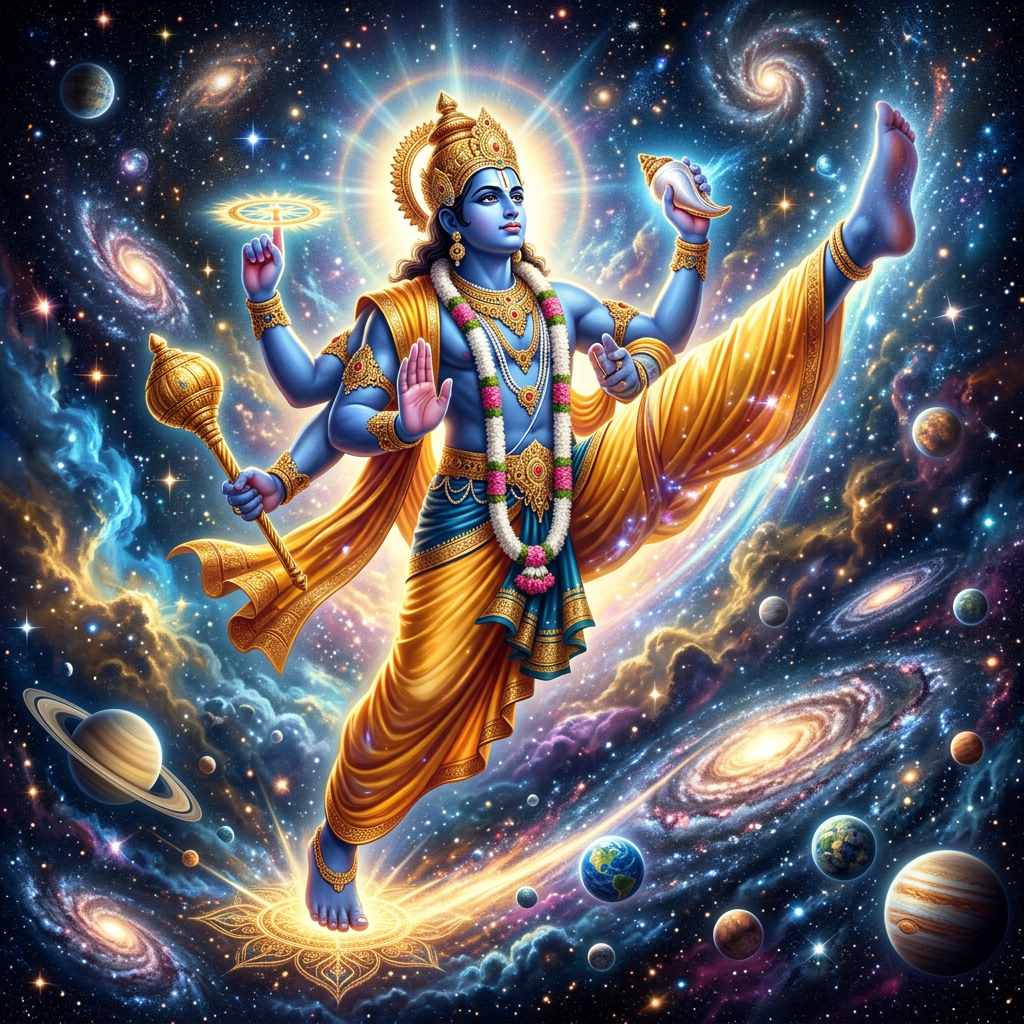
Vishnu is one of the least understood gods in the Rig Veda, precisely because we read him through the lens of later Hindu mythology — the four-armed, benevolent deity reclining on the serpent Ananta, the great preserver of cosmic order. But in the Rig Veda, Vishnu is not yet all of that. He is something at once simpler and more vertiginous: the being who has traversed the three levels of the universe, and returned to tell of it.
His three legendary strides — which without exaggeration constitute one of the richest mythemes in all of Vedic literature — are not a cosmogonic narrative in the usual sense. They are not the steps of a giant measuring physical space. They are the three movements of a consciousness traveling through, one after another, the three states of reality that the rishis had identified, described, and mapped with a precision that our modern categories still struggle to match.
The first step is Earth. Not the ground underfoot — ordinary consciousness. The state in which nearly all of us spend the greater part of our existence. What the Vedic people called maya, not to say that the world does not exist, but to say that we perceive only a fragment of it, distorted by the limits of our sensory organs and our intellect — which, in the Vedic view, is not the summit of being but one sense among others, more refined than the five primary ones, but just as limited. Earth is the world as it appears when one looks only through the narrow windows of what one is accustomed to seeing.
The second step is the Intermediate World. This is where everything actually happens. It is the space of all states of consciousness existing between the ordinary and complete fusion with the universe. This is where the Vedic gods live in the hymns — not in a distant heaven, but in this immediate and yet inaccessible space, unreachable by those who have not opened the right doors. This is where visions occur, where premonitions cross through the being, where perception expands beyond what the ordinary senses can capture. The rishis did not regard these experiences as extraordinary. They were part of the normal landscape for anyone progressing seriously on the path — with the help of soma, with ritual practice, with years of training in the brahmanic oral tradition.
The third step is Heaven. Fusion. What Vedic thought calls Brahman, the Absolute, and what the hymns designate by three inseparable words: sat-cit-ananda, Being, Consciousness and Bliss. The state in which the ego falls silent, where the boundary between self and the rest of the universe dissolves — not into emptiness, but into maximal consciousness, infinitely vaster than any other. Hymn 8.48 states it without elaboration, with the plain directness of a simple observation that requires no commentary: we have drunk the soma, we have become immortal, we have entered the Light, we have found the gods there.
What the myth of Vishnu tells us is that he accomplished these three steps. Not in imagination. Not in theory. He accomplished them and stands as witness to them — which is the exact definition of a god in the Vedic tradition: not an all-powerful creator foreign to his creation, but a being who has traversed the experience and who guides those who follow.
The text of hymn 1.154 adds something worth attention: mortals cannot see the third step. They see the first two, they can traverse them. But the highest Heaven remains beyond direct reach. The rishis know this, they say it openly, and yet they speak of it with a precision that does not belong to people who are speculating. It is the precision of people who have approached the frontier, who have felt the air from the other side, and who describe from that edge what they cannot see face to face. This knowledge of the limit, this understanding from the border, is perhaps one of the most honest forms of spiritual knowledge ever formulated.
There is a remarkable coherence in the fact that Vishnu traverses these three levels in great strides. This is not a cautious meandering. Nor is it a painful ascent. It is a stride — a wide, natural, almost effortless gesture for one who knows that these three spaces form a continuum and not three separate worlds. The error of modern societies — which the Vedic people would have called a gross error — is to inhabit only the first level, to mistake Earth for the entire universe, ordinary perception for the totality of possible experience, the analytical intellect for the supreme form of intelligence.
Vishnu strides widely because the separation between the three levels is not a barrier. It is a habit. A habit of inattention, of narrowing, of fear of what exceeds known categories. Breaking this habit is exactly what the Vedic sacrifice and the soma were designed to enable. And it is what Vishnu, crossing the three levels in one ample and unhesitating gesture, shows us is possible.
The map that the Rig Veda transmits to us is not an archaeological curiosity. It is a map of human states of consciousness that remains valid today — whether in contemporary research on modified states of mind, in the testimonies of deep meditation practitioners, or in the accounts of near-death experiences that describe, with disconcerting regularity, exactly what the rishis described: the Light, the dissolution of boundaries, the immediate and total knowledge that has nothing to do with ordinary intellect.
Vishnu strode across the three levels. He left his traces in the hymns. All we need to do is read them without reducing them to what we are already capable of understanding.
 Le Rig Veda
Laisser un commentaire