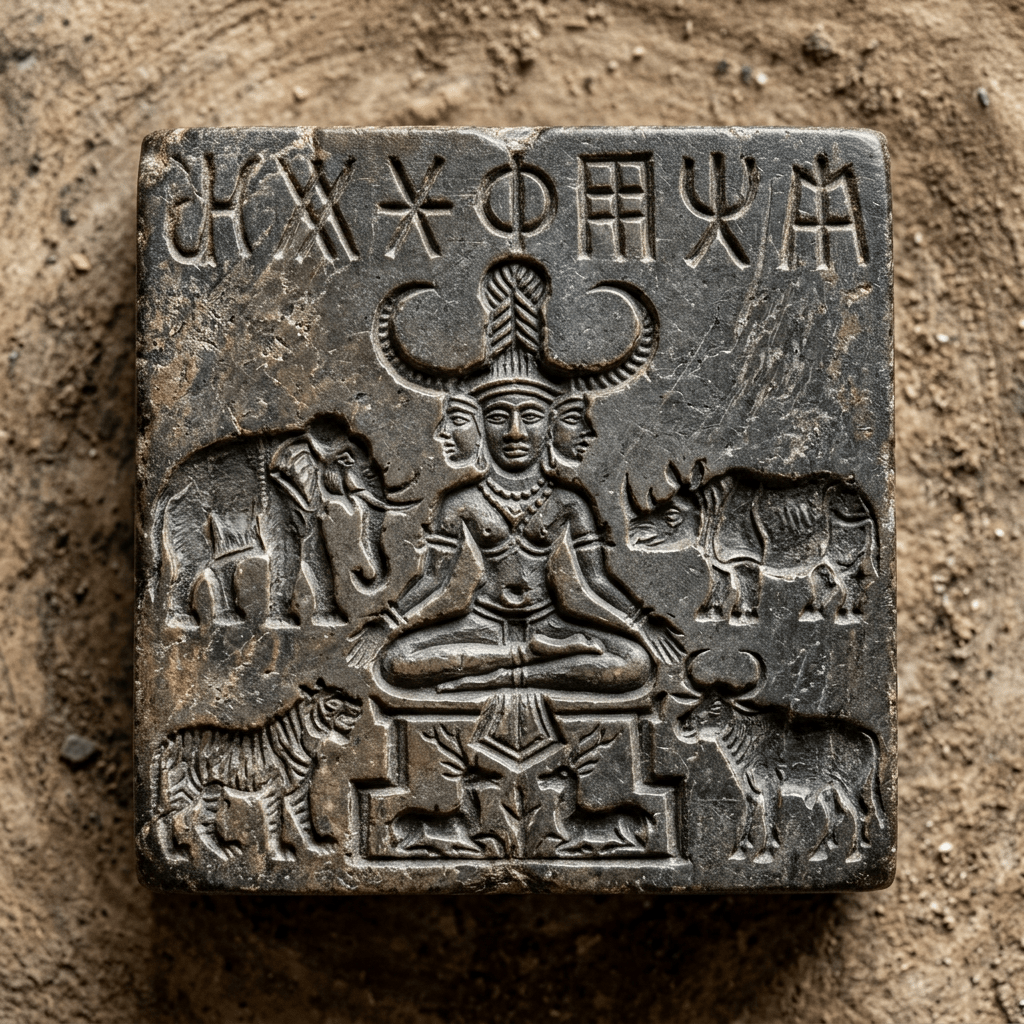
On a small steatite seal found at Mohenjo-Daro, a strange figure sits in meditation. It wears a horned headdress. Around it stand four animals — a rhinoceros, a buffalo, an elephant, a tiger. It seems to reign over them without constraint. This image is four to five thousand years old. And it resembles, in a striking way, the god that India would later call Shiva.
Archaeologists gave this figure a name: Pashupati — from Sanskrit paśu, animal, and pati, lord. The Lord of Animals.
A Seal, an Enigma
The so-called « Pashupati seal » (referenced DK 1928) is one of the most debated objects in South Asian archaeology. Discovered in 1928 during excavations at Mohenjo-Daro, it measures only a few centimetres. Yet it concentrates enormous questions: who is this figure? Is it truly a god? Is it a precursor to Shiva? Or a modern projection onto an image whose original meaning we cannot know?
The figure sits in what some identify as a yoga posture — heels joined, knees spread, torso erect. It wears a headdress of buffalo horns with a plant between the two points. Its face appears multiple, gazing in several directions at once. Around it, four great animals. Below, two standing figures, perhaps in offering.
None of this is deciphered with certainty. The Indus script remains undeciphered. We project.
Pashupati in the Rig Veda
The word Pashupati does not appear in the Rig Veda in this exact form. But Rudra — the Vedic god of storm, forest, and healing — carries very similar attributes. He is the lord of wild beings, the one who roams the margins of the ordered world, half-benevolent, half-fearsome. In the Atharva Veda and post-Vedic texts, Rudra will be explicitly identified with Pashupati, and then with Shiva.
The Rig Veda knows Rudra as an archer whose arrows bring disease or healing according to his mood. He is Tryambaka — « three-eyed » — and Nilakantha — « blue-throated » — epithets that Shiva will inherit. He is invoked with careful deference: a great god, dangerous, indispensable, impossible to ignore.
Between the Vedic Rudra and classical Shiva, Pashupati is the bridge. A continuity spanning several millennia in the conception of a deity who reigns at the boundary between the human world and the wild.
The Lord of Animals: A Universal Figure
What makes Pashupati so fascinating is that the figure of the « Lord of Animals » is not unique to India. It appears in cultures far removed from one another: in Mesopotamia with Enkidu and Gilgamesh, in Greece with Pan and Artemis, among the Celts with Cernunnos — a horned deity surrounded by animals, whose representations recall the Mohenjo-Daro seal in striking ways.
This convergence is neither coincidence nor direct borrowing. It speaks to something deep about how humans, at the dawn of civilisation, represented the boundary between the domesticated and the wild. There had to be a being to hold that boundary — neither fully human nor fully animal. A mediator between two orders of the world.
Pashupati is that being. And his presence in the Indus civilisation, two thousand years before the Rig Veda took its current form, suggests that this figure is one of the most ancient in human spirituality.
Shiva: The Heir
When Shiva emerges in classical Hinduism, he carries all of this history. He is the god of ascetics and animals, of destruction and regeneration, of cosmic dance and mountain silence. He meditates on Mount Kailash surrounded by wild creatures. He is Pashupati — one of his oldest and most venerated names.
The line from the Mohenjo-Daro seal to Shiva is not straight. It passes through centuries of transformation, syncretism, and reinterpretation. But it does not break. It is one of the longest spiritual continuities that human history has preserved.
Pashupati is not simply a precursor to Shiva. He is the oldest memory of what Shiva represents: the power that reigns where human order ends, at the edge of the wild world, in the silence between species.


Votre commentaire