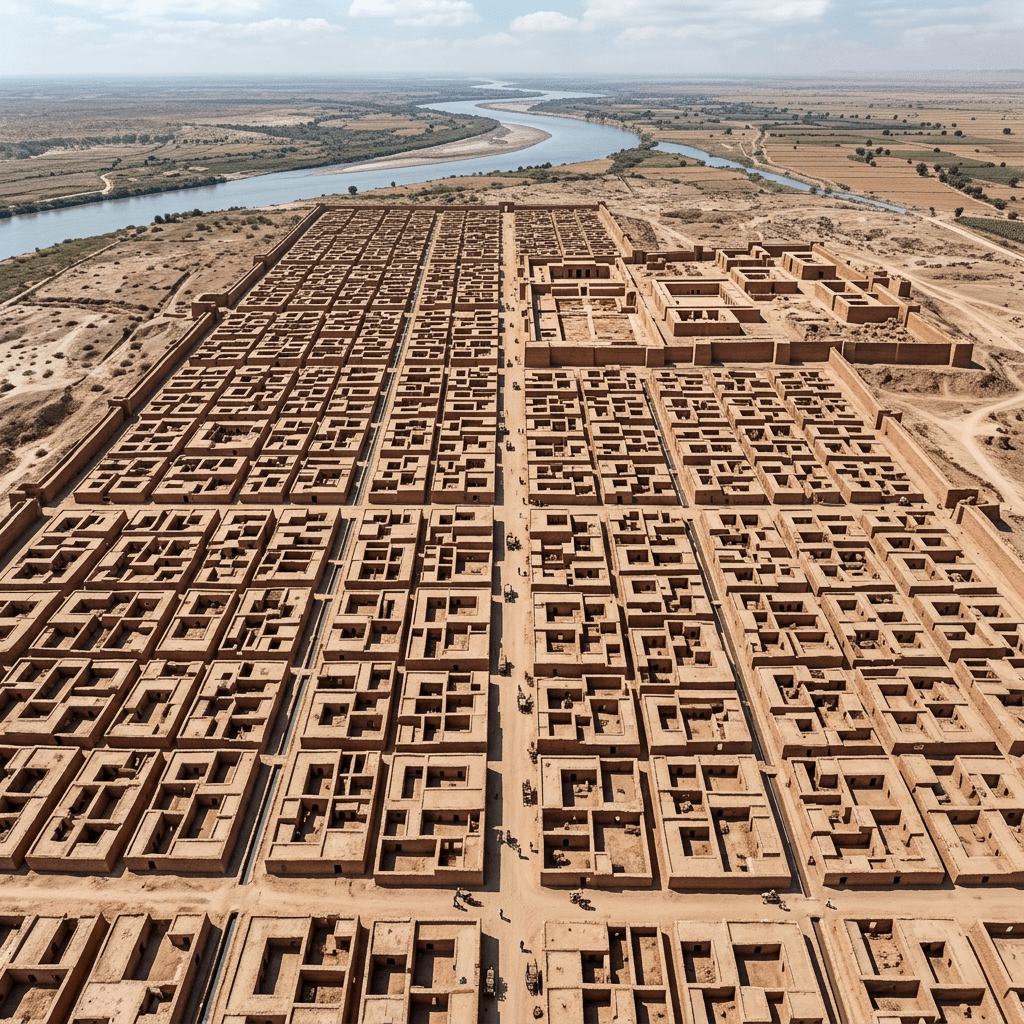
When archaeologists began excavating Mohenjo-Daro and Harappa in the 1920s, they expected to find what every great ancient civilization seemed bound to produce: palaces, temples, monuments to the glory of gods and kings. They found neither. This absence, long perceived as a mystery or a gap, may be the most important thing the Sapta Sindhu has to tell us.
Absence as message
In ancient Egypt, in Mesopotamia, in Shang China, in Olmec Mexico — wherever a complex civilization emerged, it left monumental traces of power. Pyramids, ziggurats, royal palaces are not merely buildings: they are political declarations carved in stone, affirmations of hierarchy designed to last millennia.
The Sapta Sindhu left nothing of the kind. Not a single building identifiable as a royal palace. Not a single monumental temple dedicated to a deity. Not a single statue of a ruler, not a single battle scene carved in stone.
This is not an accident of excavation. After a century of archaeological research across hundreds of sites, the finding is invariable. This civilization chose — consciously or culturally — not to build monuments to power.
What they built instead
What the excavations reveal is of an entirely different nature. At Mohenjo-Daro, the most imposing structure is the Great Bath — a carefully waterproofed brick pool, accessible to all, most likely linked to collective purification practices. Alongside it, large collective granaries stored and redistributed food reserves.
The houses of Mohenjo-Daro and Harappa are remarkably egalitarian in their dimensions. Streets are planned, and sophisticated drainage systems serve all neighborhoods — not only wealthy areas. The infrastructure is collective, utilitarian, oriented toward the common good.
This architectural choice is as powerful a political statement as any pyramid — but in the opposite direction. Where Egypt said behold the pharaoh, the Sapta Sindhu said behold the community.
Ṛta and architecture
In Vedic thought, ṛta — the cosmic order — is not embodied in a ruler or an institution. It is diffuse, present in every thing that fulfills its function correctly. A well-laid brick, a functioning drain, a well-managed granary: these are expressions of ṛta as much as a hymn to the sun.
This worldview renders the monument to power not only unnecessary, but perhaps philosophically incoherent. If order comes from the rightful participation of each person, what purpose is served by erecting a structure to celebrate a single man?
A civilization of use
One might say that the Sapta Sindhu produced an architecture of use rather than an architecture of prestige. Every building meets a real need: bathing, storing, dwelling, moving. Nothing is built to impress, to intimidate, to sacralize power.
This is a radical position in the history of civilizations. And it is a position that held for fifteen centuries — far longer than most empires that left their monuments in stone.
What this tells us today
Our own civilizations are obsessed with prestige architecture. The glass towers of business districts, the giant stadiums, the oversized airports, the presidential palaces: we continue to build monuments to economic and political power, as if the height of a building measured the worth of a society.
The Sapta Sindhu offers a different measure: the quality of ordinary life. The quality of water, the solidity of homes, the effectiveness of collective systems. A civilization may be judged less by its monuments than by what it offers to those who have none.
https://rigveda.blog/no-palace-no-temple-civilization-without-architectural-prestige
 Le Rig Veda
Laisser un commentaire