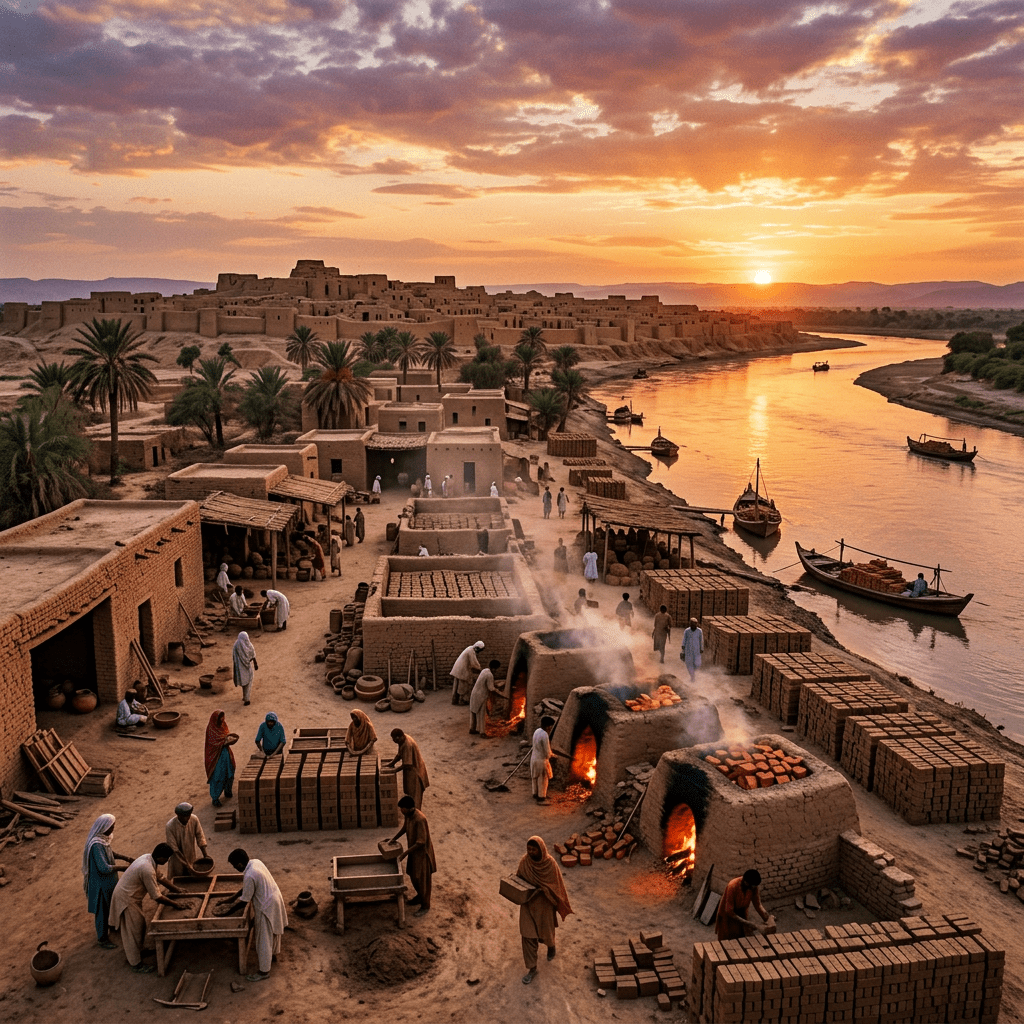
In the history of civilizations, the brick is rarely considered a philosophical object. Yet that is precisely what the archaeology of the Sapta Sindhu — the civilization of the Seven Rivers — reveals when we look closely at this seemingly ordinary material: a coherent vision, diffused over thousands of kilometers, without any central power ever needing to impose it.
A standard without an empire
The fired bricks of the Sapta Sindhu share a characteristic that long puzzled archaeologists: they everywhere conform to the same dimensional ratio, 1:2:4. Whether at Mohenjo-Daro in the Indus plain, at Harappa in the Punjab, at Dholavira in Gujarat, or at Rakhigarhi in Haryana, the bricks obey the same proportion. Not because a king had decreed it, not because a central administration controlled it — but because a shared understanding of the world circulated freely among communities.
This is not imposed uniformity. It is shared coherence.
What the ratio tells us
The 1:2:4 ratio is not arbitrary. It enables modular construction: bricks interlock, combine, and substitute for one another without the need to cut, adjust, or correct. It is an elegant solution to a practical problem — but it is also an implicit statement about the nature of the world: things can be at once distinct and compatible, individual and interchangeable, local and universal.
In Vedic thought, something familiar is recognizable here. The cosmos itself is built according to proportions — ṛta, the cosmic order, is not a law imposed from outside but a natural arrangement in which all things participate. The standard brick of the Sapta Sindhu may be the material translation of ṛta.
A civilization without a capital
What makes this standardization even more remarkable is the absence of any identifiable political center. No city of the Sapta Sindhu has yielded a royal palace, a treasury, or a monument glorifying a sovereign. Archaeological research has uncovered planned cities, sophisticated sanitation systems, collective granaries — but no monumental hierarchy, no pyramid of power carved in stone.
How then to explain that the same bricks, the same weights and measures, the same drainage systems appear from one city to another, sometimes separated by several hundred kilometers? The answer cannot be administrative. It is cultural, philosophical, perhaps spiritual.
Trade as a vehicle for thought
The trade routes of the Sapta Sindhu linked the Arabian Sea to the Himalayas, present-day Afghanistan to the coasts of Gujarat. Along these routes circulated not only goods — carnelian beads, copper objects, grains, cotton — but also practices, techniques, ways of building and organizing space. The merchant of the Sapta Sindhu was not merely a trader: he was a carrier of norms, a vector of cultural coherence.
The standardized brick made trade possible: one could build a warehouse at Lothal with materials from elsewhere, knowing they would fit together correctly. But trade, in turn, spread the standardized brick. A virtuous circle, with no central authority to oversee it.
What this tells us today
We live in a world obsessed with centralization. Our standards — technical, economic, sanitary — are imposed by international bodies, states, and multinationals. We believe that without a center there is no coherence; without power, no order.
The Sapta Sindhu shows us the opposite. A civilization can achieve remarkable coherence through culture, through exchange, through a shared vision of the world — without any master being necessary to maintain it. This may be its most precious lesson for the times to come: after the collapse of centers, coherence can be reborn from the ground up.
The fired brick of the Sapta Sindhu is not merely a building material. It is a lesson in social organization baked into clay.
rigveda.blog/fired-brick-philosophy-standardization-sapta-sindhuThe Rig Veda


Votre commentaire