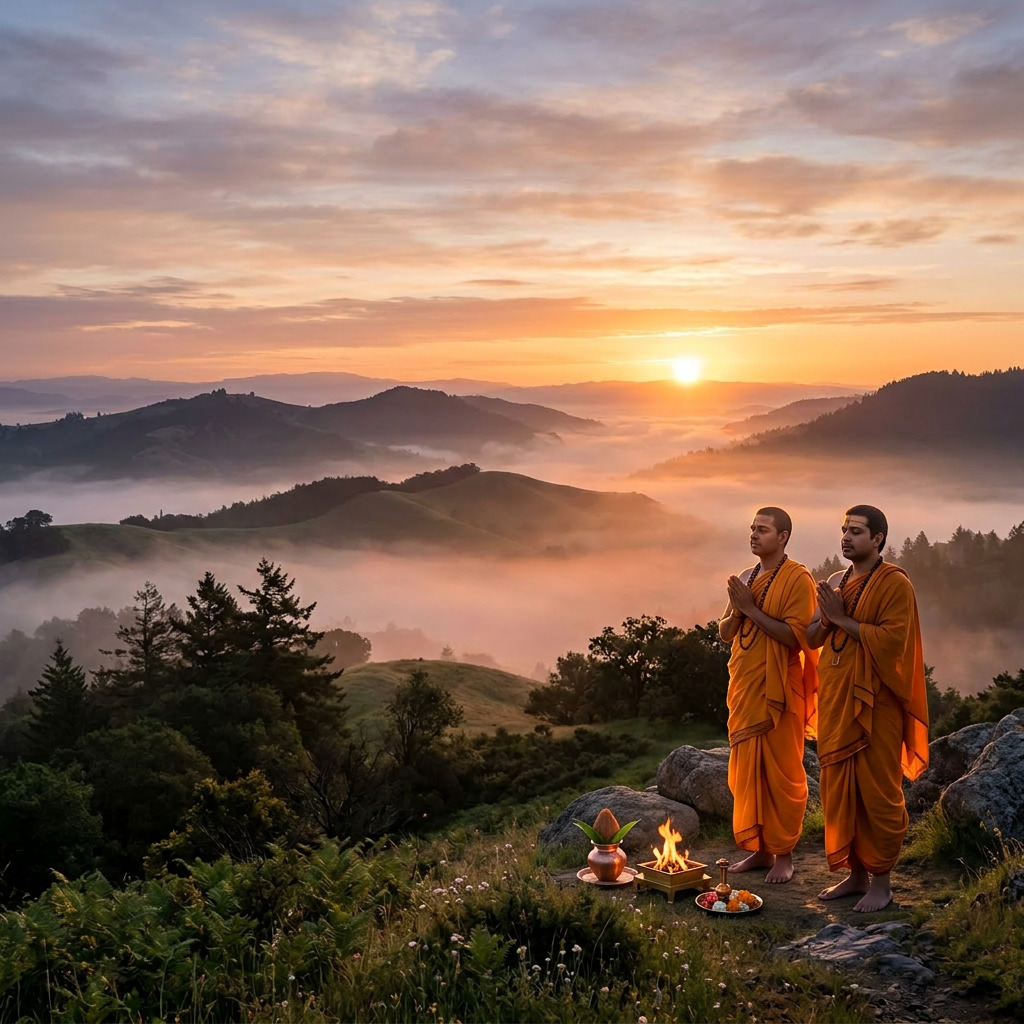
There is an apparent paradox in invoking the Vedic sacrifice to think about the ecological transition. The yajña, with its lit fires, its offerings poured into the flames, its animals sacrificed in certain contexts, seems at first glance to belong to a world so distant from our own that the comparison might seem forced. But this paradox dissolves as soon as one understands what the yajña truly was in the civilisation of the 7 Rivers: not a rite of propitiation of a capricious deity, but a technology for putting energy into circulation between the levels of reality. And this is precisely what the ecological transition must be if it is to succeed: not a simple technical substitution of one energy for another, but a restoration of the vital energy of a civilisation into a radically different relationship with the living world that supports it.
Let us recall what the yajña meant in its deepest conception. The root yaj designates not sacrifice in the sense of loss or deprivation, but offering, setting in motion, participation in the cycle of circulation of cosmic energy. What is poured into the fire does not disappear. It transforms, it rises, it nourishes the gods, it returns in another enriched form. The yajña is a cosmic pump, a mechanism that keeps in motion the circulation of what might otherwise stagnate and become corrupt. This is why the rishis said that without yajña, the cosmos itself would degrade: not because the gods would be hungry, but because the circulation of energy is the condition for maintaining all living order.
This vision of the yajña as circulation rather than sacrifice applies to the ecological transition with a precision that deserves to be examined seriously. The contemporary ecological crisis is fundamentally a crisis of circulation. We have built an economy that extracts without restoring, that takes without giving, that accumulates without circulating. The fossil fuels we burn were carbon sequestered over hundreds of millions of years: we release it in a few centuries without the cycle being able to close at the timescale relevant to us. The soils we exploit lose their fertility because we extract their nutrients without restoring them. The groundwater we pump empties because we consume it faster than it renews. Everywhere, the same logic: extraction without circulation, Vritra without Indra, the obstruction of the flow.
The yajña says something fundamental about how to correct this obstruction. It says that restoring circulation requires an offering, that is to say a gift that is also a consented loss. One cannot restore to circulation what one accumulates without releasing something. The ecological transition requires exactly this: the renunciation of certain forms of comfort, consumption and growth, to allow the natural cycles to close and the flows to resume. This renunciation, within the framework of the yajña, is not experienced as a painful deprivation but as an act of participation in something greater than oneself, a gesture that connects the one who offers to the cosmos that receives and gives in return.
This is perhaps the most important lesson the yajña offers to thinking about the ecological transition: the question of the state of mind in which the necessary changes are made. The ecological transition as it is generally presented in public discourse is a matter of constraints, regulations, carbon taxes, emission standards, prohibition timetables. These are necessary tools, but they are all conceived in the logic of the rule imposed from outside, the one we examined in the article on the Truth and contemporary normative chaos. They presuppose that economic actors and citizens will not spontaneously change their behaviour and must be compelled to do so by external sanctions. And this presupposition is largely justified, because in a society where direct contact with the Truth has been lost, behaviours do not transform through vision but only through constraint.
The yajña proposes a different path. Not constraint but transformation. Not the imposed rule but the offered gesture. Not the fear of sanction but the joy of participation. In the Vedic sacrifice, the one who offers is not losing something. He is aligning himself with something greater than himself, participating in a cosmic movement that surpasses him and that, in surpassing him, enriches him in a way that accumulation cannot produce. This quality of experience, this joy of the offering, this satisfaction of feeling that one is participating in something real and necessary, is exactly what is absent from the dominant discourse on the ecological transition, which speaks of sacrifices, restrictions and efforts, but rarely of the joy and meaning that can accompany these gestures when they are lived from the inside rather than imposed from the outside.
There is in the structure of the yajña another precious teaching for the ecological transition: its communal dimension. The Vedic sacrifice was not a solitary act. It was a collective ceremony, which mobilised the entire community, which created bonds between its members through the sharing of experience and intention. The ecological transition fails when it is presented as a series of individual consumption choices, because isolated individuals cannot produce the systemic transformations that are necessary. It needs to be lived as a collective yajña, a ceremony in which a community decides together to restore to circulation what it had accumulated, to participate together in the restoration of the flows that keep the world alive.
The most effective ecological movements have intuitively understood this. Transition communities, local initiatives for the relocalisation of food and energy, collectively managed natural commons: all these movements share a ceremonial dimension, a way of living change as a collective act charged with meaning rather than as an individual constraint. This is not a coincidence. It is because ecological transformation, to be lasting, must be lived as the yajña was lived: not as a sacrifice in the sense of deprivation, but as an offering in the sense of conscious and joyful participation in something that deserves to be given the best of what one has.
There is finally in the yajña a temporal dimension that is particularly relevant for thinking about the ecological transition. The Vedic sacrifice was not a one-off act. It was a regular practice, daily for the domestic puja, seasonal for the great public sacrifices. This regularity was essential: it kept alive the bond between the community and the cosmic forces on which it depended, it prevented forgetting, it created a rhythm that structured collective time around the relationship with the natural and spiritual world. The ecological transition needs this regularity. Not decennial plans and long-term objectives that remain abstract in the daily consciousness of the actors, but regular practices, repeated gestures, contemporary rituals that keep alive in the collective consciousness the reality of what is at stake and the beauty of what can be recovered.
The yajña cannot be repeated as such in our era. But its principle can be recovered: circulation rather than accumulation, offering rather than extraction, community rather than the isolated individual, regularity rather than punctual urgency, and above all joy rather than fear as the engine of transformation. This is perhaps the most original and most necessary contribution that the Vedic vision can make to thinking about the ecological transition: not technical solutions, but a way of inhabiting change that gives it the meaning and depth without which it cannot be lasting.


Laisser un commentaire