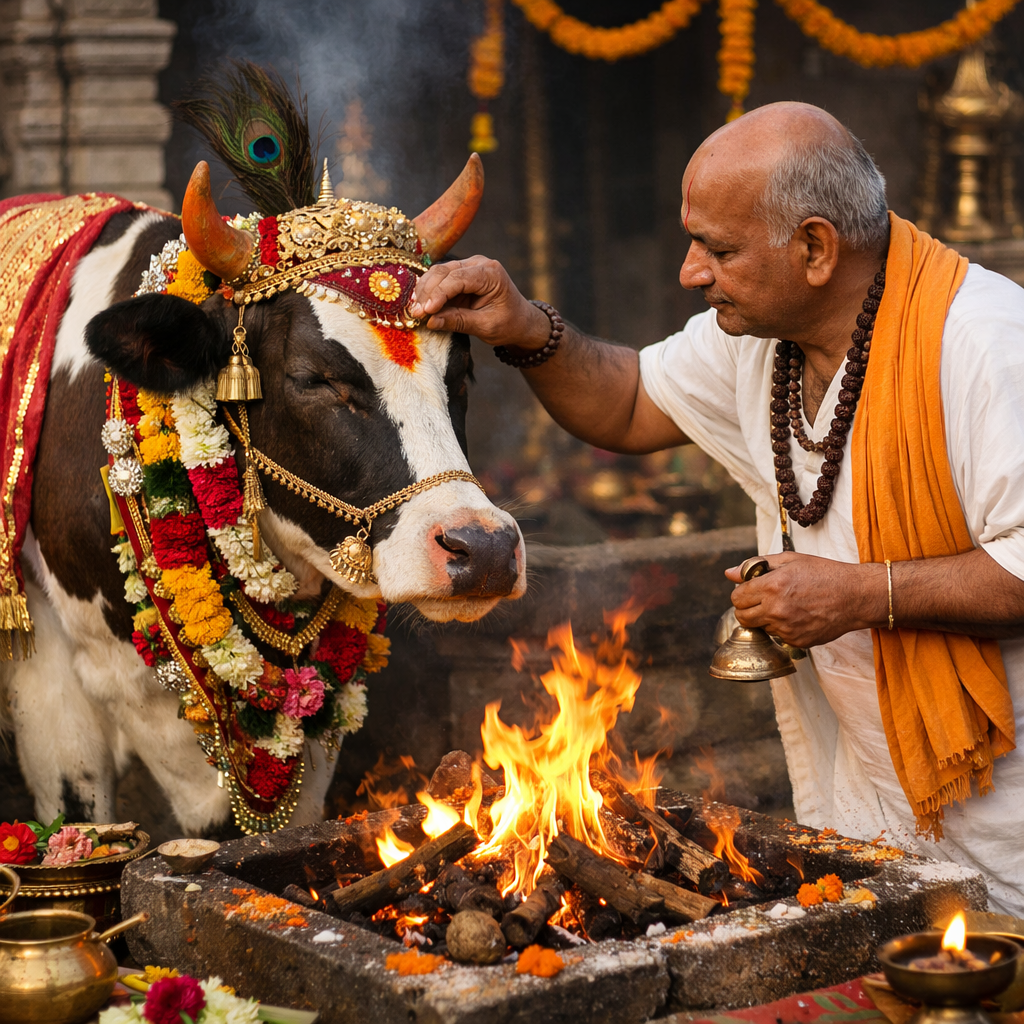
There is in the Rig Veda an animal presence so constant and so charged with meaning that it ends up forming a kind of living backdrop against which all the hymns stand out. Animals are not supporting characters, accessories of a pastoral setting that would make the text more picturesque. They are participants in the life of this civilisation in all its aspects, material and spiritual, and their presence in the hymns reflects a relationship with the animal world that is fundamentally different from the one that Western modernity has progressively installed as the norm.
The cow is without question the animal most present in the Rig Veda, and the density of her presence says something essential about the civilisation that produced this text. We touched in other articles on the symbolic dimension of the cow as a metaphor for Light and knowledge, the word go designating simultaneously the animal and the ray of sunlight. But one must also speak of the concrete cow, the real animal whose presence structured the daily life of Vedic civilisation in a way that we struggle to imagine today. The cow was wealth, the unit of measurement for exchanges, the milk that fed families, the clarified butter that fuelled the sacrificial fire. To ask the gods for cows was to ask for prosperity in its most concrete and most vital form. And this concrete request was simultaneously a spiritual request, because the cow and the Light were the same word.
What is remarkable about the way the Rig Veda speaks of cows is the genuine affection that shines through in certain hymns. They are not simply units of wealth to be counted. They are living presences with whom human beings maintain a relationship of proximity and reciprocity. The cows returning to the stable in the evening, the cows lowing for their calves, the cows whose milk is offered to the gods mixed with soma: all these images speak of a daily intimacy, a sharing of space and time that creates between human and animal something deeper than a simple relationship of utility.
The horse, about which we spoke at length in a dedicated article, is the second great domestic animal of the Rig Veda. But where the cow is the animal of subsistence and generosity, the horse is the animal of power and aspiration. He draws the chariots of gods and kings, he is the mount of warriors, he is the symbol of vital force and spiritual energy. His value in Vedic society was so high that he served as a standard for the most important exchanges: soma itself was exchanged for a cow at its full value, and certain sources mention that horses were among the most precious gifts one could offer. The relationship of the Vedic Indians with their horses had a dimension of respect and admiration that goes well beyond the utilitarian, as shown by the hymns of the first mandala that describe the sacrificial horse with a beauty and a tenderness that do not correspond to the way one speaks of a simple commodity.
The dog makes less frequent appearances in the hymns, but when he does appear, it is often with a precision and a familiarity that say something about his place in daily life. In Vedic mythology, dogs are the guardians of the gates of the underworld, a function attributed to them in many ancient traditions that says something about the way humans have perceived these animals: faithful, vigilant, capable of perceiving what humans cannot see. But in the more ordinary hymns, the dog is simply present as a companion, as an animal of the house and of the night, whose proximity to humans is close enough that he shares their living space.
The goat and the sheep have a double presence in the hymns: livestock whose wool and milk served daily life, and sacrificial animals whose ritualised killing in certain yajñas formed part of the cycle of offerings. We saw in the article on the yajña that this sacrificial dimension was less central in the Rig Veda than the first translators believed, but it existed, and it would be inaccurate to deny it. What is interesting is that even in this sacrificial context, the hymns accompanying the killing of the animal are not hymns of triumphant violence. They are hymns of recognition, of requests for forgiveness, of gratitude toward the animal that gives its life to nourish the cosmic cycle. A civilisation that asks forgiveness of the animal it sacrifices has a relationship with the living world that is not that of a civilisation that believes itself master and lord of nature.
The donkey, which one might have expected to be absent from a text so laden with cosmic symbolism, makes surprising appearances in the hymns, notably as the animal drawing the chariot of the Ashvins, those healer gods whose unusual mount says something about their nature: gods who do not move in the majesty of the war horse but in the humble and effective steadiness of the donkey, the animal that carries heavy loads without complaint and finds its way even in difficult terrain. There is in this image a wisdom about the nature of healing that the choice of the donkey as the mount of the divine physicians expresses with remarkable concision.
Birds occupy a particular place in the Vedic bestiary, on the border between domestic and wild animals. The eagle that brings soma from the celestial heights is without doubt the most celebrated, but there are also parrots, quails and partridges, some of whose hymns mention their presence in domestic or sacrificial contexts. Birds, through their capacity to move between earth and sky, are naturally associated in Vedic thought with the intermediate world, with that space between ordinary consciousness and Brahman where the most important spiritual experiences unfold. A bird singing at dawn is not simply a natural phenomenon in the Vedic vision. It is a messenger from the intermediate world, a voice announcing the passage from darkness to Light.
What unites all these animal presences in the Rig Veda is a fundamental vision that we have already encountered in other articles but that deserves to be repeated here in this specific context: animals are not inferior to humans in the hierarchy of existence. They are different, they occupy different functions in the cosmos, but they participate in the same fundamental reality, they are traversed by the same forces, they express in their own way the same powers as the gods and human beings. The cow that gives her milk, the horse that runs, the dog that watches, the eagle that rises: all these acts are manifestations of Brahman, all these animals are forms in which ultimate reality unfolds. To treat them with respect, to recognise their value beyond their utility, to attribute to them a symbolic and spiritual dimension is not a naive anthropomorphism. It is the logical consequence of a vision of the world in which everything that exists is sacred because everything that exists is an expression of the same Absolute.
This vision has practical consequences that we have not yet finished measuring. A civilisation that sees in animals participants in the cosmos rather than resources to be exploited does not treat them in the same way as a civilisation that has reduced them to their market value. It is not a coincidence that the protection of animals, which would in later Hinduism take on considerable importance with the principle of ahimsa, non-violence toward all living beings, finds its oldest roots in this relationship with the animal world that the Rig Veda documents with such precision and warmth.
 Le Rig Veda
Laisser un commentaire