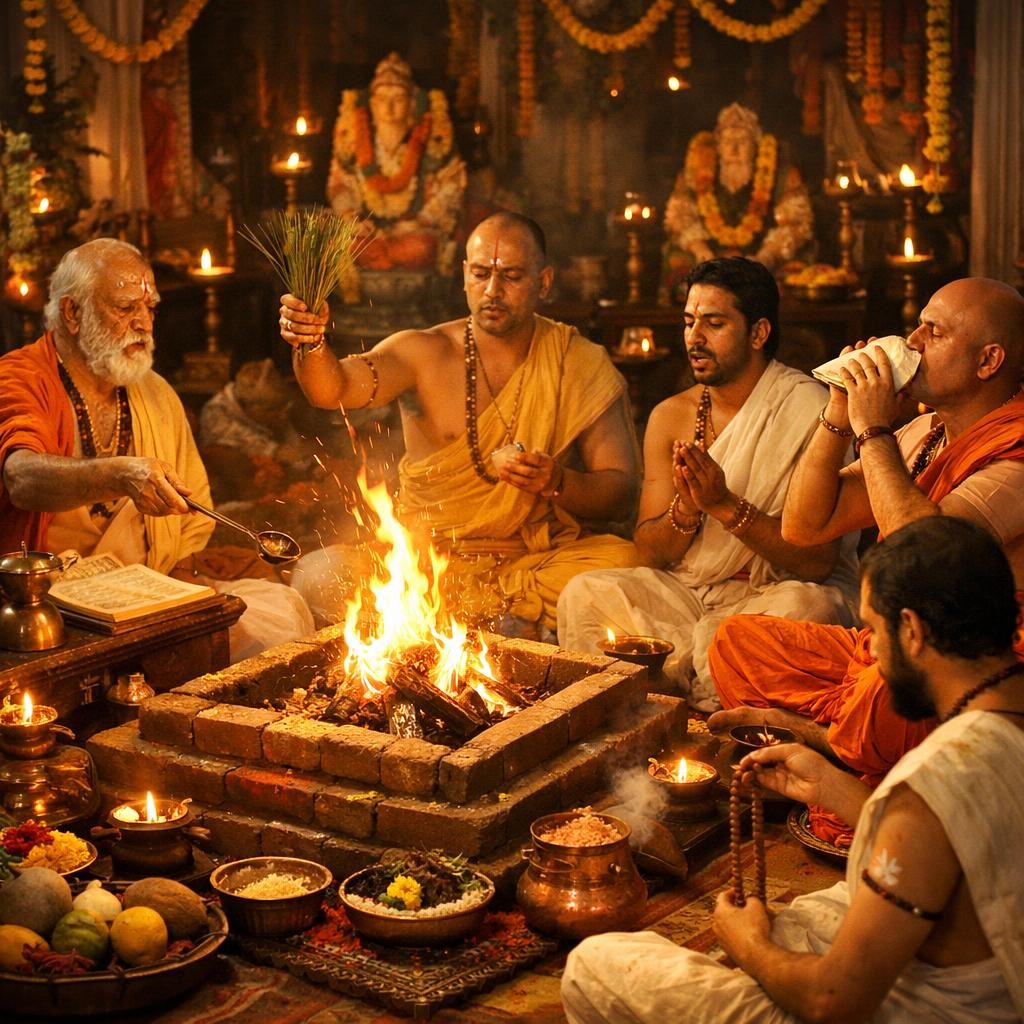
There is in the Vedic sacrifice a dimension that tends to be overlooked when one is primarily interested in its spiritual significance: its technical dimension. The yajña was not an improvised ceremony where everyone did as they wished in a collective surge of religious enthusiasm. It was an operation of extraordinary precision, orchestrated by specialists each of whom had a defined function, a specific corpus of texts to master, and a precise responsibility in the unfolding of the ceremony. These specialists were the priests of the sacrifice, and their organisation into distinct categories is one of the most remarkable characteristics of the Vedic tradition.
The oldest division distinguishes three principal functions, corresponding to the first three Vedas: the hotṛ recites the hymns of the Rig Veda, the adhvaryu performs the ritual acts while reciting the formulas of the Yajur Veda, and the udgātṛ sings the melodies of the Sama Veda. This tripartition is not administrative. It reflects a conception of the sacrifice as a total act, engaging simultaneously speech, gesture and song — the three dimensions of human presence in the ritual. Later, a fourth priest, the brahman, would be added to oversee the entire ceremony and correct any errors, but in the Rig Veda itself it is the original triad that dominates.
The hotṛ is the priest most directly connected to the Rig Veda. His name comes from the root hu, to pour, to offer, to invoke. He is the one who recites the invocation hymns, who calls the gods to the sacrifice, who asks them to come and take their share of the offerings. His function is fundamentally that of an intermediary between human beings and the gods, but an intermediary who acts through speech rather than through gesture. The quality of his recitation is essential: he must not only know the hymns in their different recitation modes, but pronounce them with the phonetic accuracy and spiritual intention that give them their effectiveness. A poorly recited hymn is not merely a technical error. It is a defective offering that may miss its target or produce undesirable effects.
What the hotṛ embodies in his function is the power of speech as a cosmic force. We saw in the article on Îla and on Vedic Sanskrit that the rishis did not conceive of words as arbitrary conventions. They were vibratory realities whose effects on the world were as real as the effects of fire or water. The hotṛ is the one who mobilises this power, who directs it toward the gods within the context of the sacrifice. His training lasted years, sometimes an entire lifetime, and it bore as much on inner mastery as on technical mastery of the texts. One did not become a hotṛ by learning hymns by heart. One became one by becoming someone whose speech carried sufficient spiritual weight to reach what it aimed at.
The adhvaryu is the priest of gestures. His name is linked to the adhvara, the sacrifice itself, and his function is the concrete realisation of all the ritual acts that constitute the yajña: lighting and tending the fire, preparing and pouring the offerings, pressing soma, constructing the altar according to prescribed measurements, performing the hundreds of precise gestures that make the sacrifice a physical reality. The Yajur Veda, his reference text, is precisely a manual of ritual instructions, a text that accompanies each gesture with an appropriate formula. The adhvaryu is in constant motion throughout the sacrifice, performing actions each of which must be correct in its form, its timing and its intention.
What is remarkable about the function of the adhvaryu is that it says something essential about the Vedic vision of action. In Vedism, the ritual gesture is inseparable from the consciousness that accompanies it. A correct gesture performed with a distracted or ego-polluted consciousness does not have the same value as a correct gesture performed in a state of presence and inner purity. The adhvaryu must therefore work simultaneously on the external precision of his acts and on the internal quality of his state of consciousness. This is a form of yoga of action, a prefiguration of what the Bhagavad-Gita would articulate centuries later under the name of karma yoga: the right act performed without ego, offered as a yajña.
The udgātṛ is the singer, the sacred musician of the sacrifice. His name comes from ud-ga, to sing upward, and this is perhaps the most accurate description of his function: he sings to carry the offerings upward toward the gods, to open a channel between the human world and the divine world through the power of musical sound. The Sama Veda, his reference text, is largely a musical adaptation of hymns from the Rig Veda: the same texts, or extracts from those texts, set to melody according to precise modes and sung during the sacrifice. These melodies, the Samans, are among the oldest musical compositions of which we have knowledge, and their transmission was the object of the same care as the transmission of the hymns themselves.
The function of the udgātṛ reveals a dimension of the Vedic sacrifice that purely textual reading cannot grasp: its sonic and musical dimension. The sacrifice was not only a recitation and a series of gestures. It was also an intense auditory experience, in which the melodies of the Sama Veda played a specific role in opening the consciousness of the participants. Contemporary research on the effects of music on the brain confirms what the Vedic Indians knew from the inside: certain melodic and rhythmic structures produce particular states of consciousness, facilitate the relaxation of egotistic defences, open spaces of receptivity that ordinary speech cannot reach. The udgātṛ was, in this sense, a sound therapist as much as a religious officiant.
These three priests worked together in perfect coordination, each in their own register, all in service of the same goal: to create the conditions in which the experience of Brahman could take place. The speech of the hotṛ invoked the divine forces. The gestures of the adhvaryu constructed and maintained the physical framework of the ritual. The chanting of the udgātṛ opened the consciousness of the participants. And soma, which the adhvaryu prepared and which all drank, did the rest. In this system, every element was necessary and none was sufficient alone. It is a vision of the sacred as a collective act, as a cooperation between different and complementary competencies, that contrasts deeply with the solitary and individualised vision of spirituality that modernity has progressively imposed.
There is in this sacerdotal organisation a lesson about the nature of excellence that deserves attention. In the Vedic tradition, specialisation was not fragmentation. The hotṛ who perfectly mastered his function of recitation did not for that reason ignore the functions of the other priests. He knew them, respected them, understood their place in the whole. Specialisation was in service of totality, not at its expense. It is an organisation that presupposes a common culture, a shared vision of the goal, a deep mutual understanding between specialists in different domains. It could only function in a civilisation in which all participants in the sacrifice, priests and sacrificers alike, had been formed in the same tradition and shared the same foundational experience: that of Brahman, accessible through soma and yajña, which gave all these technical specialisations their meaning and their value.
 Le Rig Veda
Laisser un commentaire