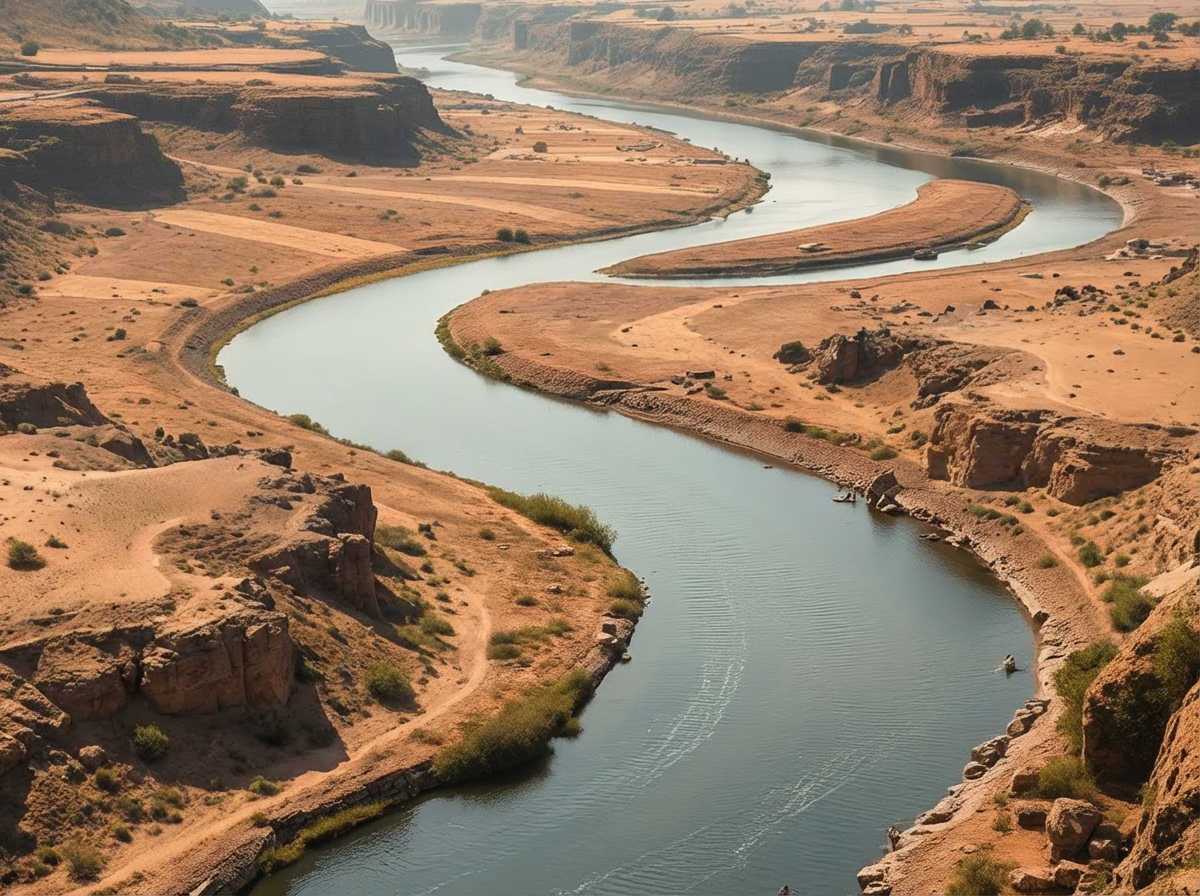
There is in the geography of the Rig Veda a reality that structures everything else, that gives the text its physical and spiritual dimension simultaneously, and without which neither Vedic civilisation nor its spirituality can be understood: the rivers. Not rivers as elements of the backdrop, nor rivers as simple sources of water for agriculture and navigation. Rivers as axes of the world, as living forces, as divinities, as paths toward Brahman. In the Vedic vision, a river is not a watercourse. It is a cosmic reality that manifests in liquid form.
Hymn 10.75, the hymn to the Indus, is one of the most geographically precise texts in all of ancient literature. It names the great rivers of the Vedic territory in an order moving from east to west: the Ganges, the Yamuna, the Sarasvati, the Shutudri, the Parushni, the Asikni, the Marudvridha, the Vitasta, the Kubha, the Gomati, the Krumu, and finally the Indus itself. This is not a neutral geographical list. It is an invocation, an act of recognition, a way of naming the forces that define and sustain the territory in which this civilisation lives and breathes. Every river named is a divine presence, and the list of their names is itself a mantra.
The Sarasvati occupies in this sacred geography a place that surpasses all the others. She is the greatest, the most powerful, the most celebrated of the Vedic rivers. She is described as surpassing all other rivers in her greatness, flowing from the mountains to the sea with an abundance that the hymns describe with an admiration that says something about the impression she must have made on those who depended on her. And this physical greatness is inseparable from her spiritual greatness: Sarasvati is simultaneously the river and the goddess, the flow of water and the flow of knowledge, the irrigation of fields and the illumination of minds. She is the axis of life in the most literal and most profound sense: without her, neither Vedic civilisation nor Vedic spirituality could have developed as they did.
What makes the deification of rivers in the Rig Veda particularly significant is that it is not a metaphor or a poetic convention. It is the direct consequence of a vision of the world in which nature and the divine are a single reality. A river is divine not because a god inhabits it or presides over it from outside, but because the cosmic force that manifests in the flow of water is the same force that manifests in the flow of consciousness toward Brahman. The river that descends from the mountains to the sea accomplishes the same movement as the consciousness that descends from the ego toward the Absolute: a movement of release, of growing fluidity, of surrender to a law greater than oneself. This is why the waters are sacred. This is why Indians have bathed in the Ganges for millennia. This is not superstition. It is the recognition of a deep homology between the movement of water and the movement of consciousness.
Rivers are axes of life in the most concrete sense of the term. All the great cities of the Indus-Sarasvati civilisation were built on the banks of these rivers or in their immediate proximity. Harappa on the Ravi, Mohenjo-daro on the Indus, dozens of other cities and villages on the banks of the Sarasvati and its tributaries. This was not a default choice dictated by the need for drinking water and irrigation. It was a way of inhabiting the world in accordance with its sacred structure, of building human civilisation along the axes that the gods themselves had traced. To live on the bank of a river was to live in permanent contact with a divine force, in a daily dialogue between the human and the cosmic.
The irrigation systems that this civilisation developed along these rivers are the technical translation of this sacred relationship. To channel the water of a sacred river to irrigate the fields is to participate in the circulation of divine energy in the world. It is not an exploitation of nature. It is a cooperation with it, a way of prolonging the gesture of the river, of carrying further what it brings, of distributing divine grace where it would not arrive on its own. The hydraulic engineers of the Indus-Sarasvati civilisation were, in this vision, participants in the cosmic yajña, sacrificers who offered their labour to keep in circulation the energy that nourishes the world.
The death of the Sarasvati is one of the most meaning-laden catastrophes in all of human history, not only because it provoked the collapse of a great civilisation, but because it broke a sacred axis that nothing could replace. When the river ceased to flow, following earthquakes and the great drought of 2200 to 2100 BCE, it was not only agriculture that was struck. It was the link between earth and sky, between the material and the spiritual, between daily life and sacred practice, that was severed. The populations that migrated eastward took with them their hymns, their rituals, their memories of the great river. But they could not take the river itself. And the goddess Sarasvati, deprived of her physical support, gradually became a purely spiritual goddess, goddess of speech and knowledge, with no longer any visible relationship to water. It is a poignant transformation: the river died, but the goddess survived, taking refuge in the inner space that water had once symbolised.
This movement, from the concrete river to the inner goddess, is emblematic of a broader shift observed in the transition from ancient Vedism to Hinduism. The sacred progressively interiorises as its outer supports disappear. When the rivers run dry, when soma is no longer available, when the great cities are abandoned, the path toward Brahman must be found within, in meditation, in yoga, in pranayama, rather than in the outer landscape that had once served as guide and support. It is a remarkable adaptation, and it produced some of the greatest achievements of human thought. But it also carries something melancholic: the loss of the sacred river as a visible and tangible axis of life, as a divine presence with which one could enter into contact simply by bathing in its cool waters at sunrise.
The rivers of the Rig Veda remind us that the sacred is not only interior. It is also exterior, embodied in the physical world, present in the forces of nature that surround and traverse us. The Vedic vision refuses the separation between inside and outside, between spirituality and geography, between the soul and the river. This is perhaps one of the most precious lessons that this six-thousand-year-old text can still offer us, in a world where we have so thoroughly interiorised the sacred that we have forgotten to look for it in the rivers that still flow.
 Le Rig Veda
Laisser un commentaire