There is a dimension of the Rig Veda that is easily overlooked when it is read as a unitary text, as if its 1028 hymns formed a homogeneous block emerging from a single tradition, a single place, a single moment. The reality is far richer and more complex. The Rig Veda is the product of a civilisation that extended across an immense territory, from the Ganges to the Indus and beyond, over nearly two millennia, and the different regions of that territory have left distinct traces in the hymns. These traces are perceptible in the vocabulary, in the images, in the gods that are favoured, in the way the sacrifice and the spiritual experience are conceived. To read the Rig Veda while taking these regional variations into account is to restore to it a human and geographical depth that a purely philosophical or spiritual reading tends to erase.
The Vedic territory was not uniform. It encompassed zones of alluvial plains along the great rivers, mountain foothills to the northwest, semi-arid zones to the east, regions of dense forest toward the south and east. These geographical differences produced different ways of life, different economies, different relationships with nature and its forces. A clan of rishis living in the foothills of the Himalayas or the Hindu Kush had a relationship with the natural world that was not the same as that of a clan established on the fertile plains of the Sarasvati. These differences are reflected in the hymns, discreetly but perceptibly, for those who know how to read them.
The hymns of the oldest mandalas, mandalas two through six, bear the marks of a pastoral and semi-nomadic culture, still close to its origins in the mountainous zones of the northwest. The dominant images are those of cattle, horses, flooding rivers, storms and battles. Indra is omnipresent, a warrior god whose power manifests in the most dramatic natural phenomena: lightning, storm, flood. This intense relationship with the most brutal and unpredictable natural forces is consistent with a culture of mountain and open plain, exposed to violent and unpredictable climatic events, dependent on rain and floods for its survival.
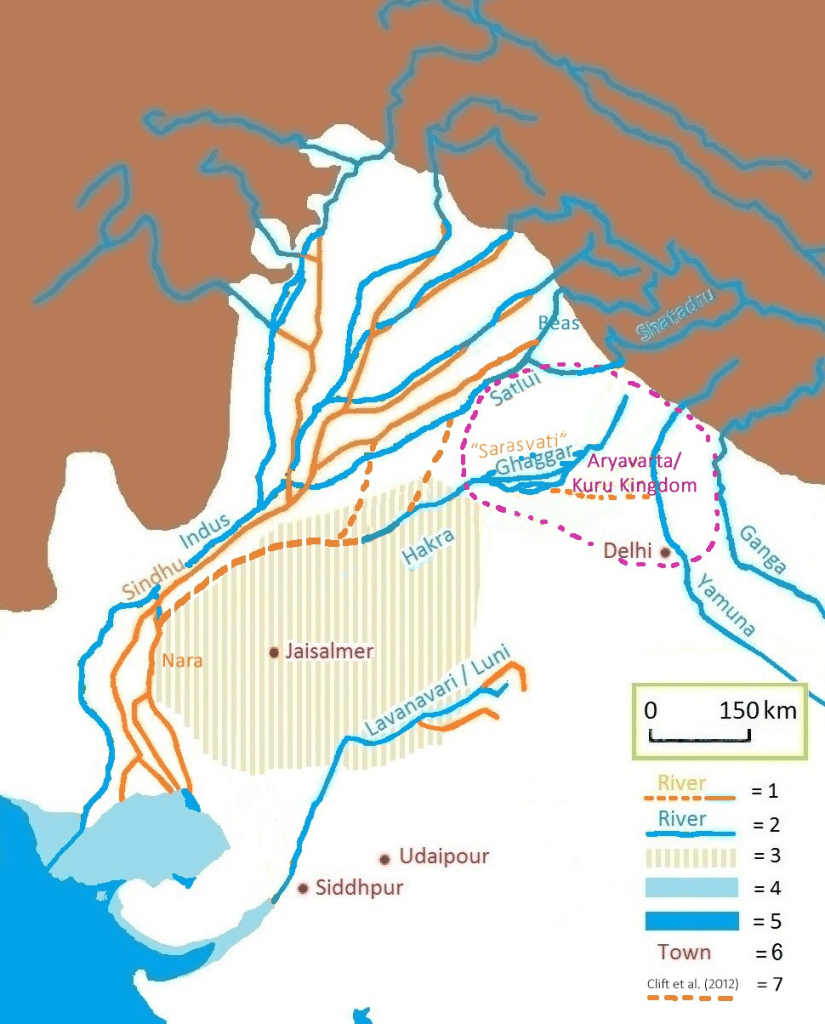
The rishi families of the northwest, those who lived closest to the mountains from which the great rivers descended, developed a particular sensitivity to water in all its forms. The hymns to rivers, the invocations to the waters, the descriptions of spring floods that fertilise the plains: all of this has a precision and an intensity that speak of direct familiarity with these phenomena. The Sarasvati, the deified river, is described with an abundance and a power that correspond to what that river must have been in its full period, seen from the regions that depended directly on its floods for their harvests. This is not an abstract description. It is a lived description, geographically situated, emotionally charged by generations of dependence on that water.
The intermediate mandalas, composed at a time when Vedic civilisation had fully developed its urban dimension, bear the marks of a more sedentary, more diversified culture, more in contact with different populations and traditions. The vocabulary expands, the metaphors grow more complex, the gods invoked diversify. In certain hymns one begins to see influences that seem to come from the east, from more forested and humid zones, with images of forests, wild animals, natural forces different from those of the semi-arid plains of the northwest. These influences are not always easy to identify with precision, but they contribute to the stylistic and symbolic richness of the mandalas of this period.
The question of external influences is particularly interesting. Vedic civilisation was not isolated. It was in commercial and cultural contact with the other great civilisations of its era: Mesopotamia, Egypt, the civilisations of Central Asia. Objects from the Indus have been found at Ur and Babylon. Mesopotamian influences are detectable in certain aspects of the craftsmanship of the Indus civilisation. And certain researchers have identified in some hymns of the Rig Veda echoes of mythologies that seem to have parallels in other traditions of the ancient Near East. These cross-influences do not diminish the originality of the Rig Veda. They place it back in the context of an ancient world that was far more interconnected than was once believed.
The relationship with the non-Vedic populations of the territory is another source of regional influences. The Dasyus, the Dasas, those peoples that the hymns describe as impious, as enemies of the gods and of the sacrifices, lived on the same territory as the Aryas and interacted with them continuously. These interactions have left traces in the text, in the form of references to different practices, to place names and personal names that are not of Indo-European origin, to elements of vocabulary whose origin seems Dravidian or proto-Dravidian. These traces say that Vedic civilisation was not a homogeneous ethnic and cultural bloc, but a composite civilisation, born from the contact and fusion of different traditions.
Iranian Zoroastrianism, which we have discussed in other articles as the sister tradition of Vedism, represents a particularly significant influence in the oldest hymns. The two traditions share a common foundation that goes back to a period prior to their geographical separation, but they subsequently evolved differently under the influence of their respective environments. In the Rig Veda, one can sometimes identify hymns or passages that seem closer to the Iranian sensibility than others, suggesting that they were composed in border zones between the two traditions, where exchanges were most intense. Present-day Afghanistan and Turkmenistan were precisely these contact zones, and archaeological excavations there have revealed civilisations that shared elements of both traditions.
The most recent mandalas, and in particular the tenth, bear the marks of a period of transition and displacement. The drought that caused the drying up of the Sarasvati forced entire populations to migrate east and south, into regions they did not know, with natural conditions different from those they had come from. These migrations produced contact with new populations, new traditions, new ways of conceiving the divine and the world. The tenth mandala is the most heterogeneous in the corpus precisely because it was composed in this context of mixing and transition, by rishis who found themselves in new environments and whose worldview was in the process of adapting, sometimes painfully, to this new reality.
What regional influences tell us about the Rig Veda is that it did not fall from the sky as a fixed and timeless revelation. It is the product of a concrete humanity, geographically situated, historically determined, in permanent contact with diverse natural environments and cultural traditions. This humanity produced something universal, but it did so by starting from the particular, the local, the lived. This is perhaps the most important lesson that regional influences offer us: universal truth is not expressed in the abstract. It is expressed from a place, from an experience, from a concrete relationship with the world. And it is precisely this rootedness in the concrete that gives the hymns of the Rig Veda their force and their durability.
 Le Rig Veda
Laisser un commentaire