There is a temptation, when reading the Rig Veda, to see only the great spiritual heights and to neglect the earth on which this entire civilisation rested. The hymns to Indra, to Agni, to soma capture the attention, and rightly so. But a civilisation does not live on mantras alone, and the Rig Veda, read carefully, reveals a society deeply rooted in a sophisticated agriculture, an agriculture that was not separated from its spirituality but was its inseparable material foundation.
The civilisation of the 7 Rivers, between 4000 and 1900 BCE, developed in one of the most fertile agricultural zones of the ancient world. The territory stretching from the Sarasvati to the Indus benefited from regular seasonal floods, a dense hydrographic network, and a rainfall that, before the great drought of 2200 to 2100 BCE, allowed for abundant harvests. Archaeology has confirmed what the text suggests: this civilisation fed considerable urban populations, in cities that sometimes numbered several tens of thousands of inhabitants, thanks to an agricultural organisation of remarkable effectiveness.
The main crops were wheat and barley. Barley in particular held an importance that went well beyond ordinary nutrition. It was the staple of everyday diet, of course, but it was also a central element of the sacrifice: barley cakes, baked and offered into the sacrificial fire, constituted one of the most frequent offerings of the yajña. This double function, nutritive and ritual, is characteristic of the way the Vedic Indians did not separate the material from the spiritual. The same grain that nourished the body participated in the ceremony that nourished the soul.
Wheat, less present than barley in the oldest parts of the text, becomes more important in the intermediate mandalas, which corresponds to an evolution of agricultural practices over the centuries. This evolution is consistent with what archaeology shows us: a progressive diversification of crops as the civilisation grew denser and nutritional needs became more complex. Legumes, sesame and various plants were also cultivated, some of which had medicinal and ritual uses.
Soma itself, whatever the exact botanical identity of the plant, required precise conditions of harvesting. The hymns of the ninth mandala, which are entirely devoted to it, describe the pressing and purification of the juice with a precision that presupposes real agronomic knowledge. It is known that the plant grew in the mountains, in particular conditions of humidity. Its harvesting was part of the expertise of the rishi families, transmitted with the same care as the hymns themselves.
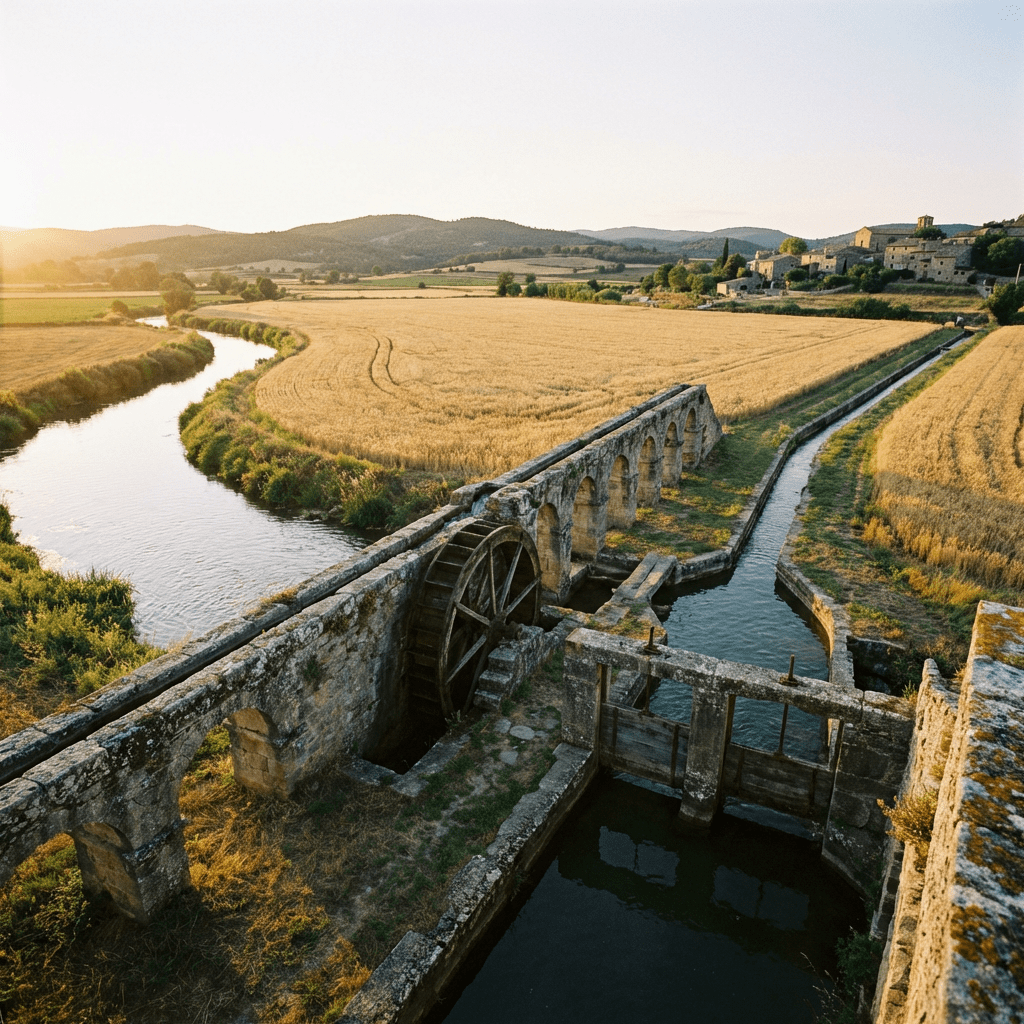
Irrigation was the technical pillar on which all this agriculture rested. In a zone where seasonal floods could be abundant but irregular, the capacity to channel, store and distribute water was the primary condition of food security. Archaeology has revealed irrigation systems of remarkable sophistication at the sites of the Indus-Sarasvati civilisation. Canals, retention basins, drainage systems: all of this testifies to a hydraulic engineering that has nothing to envy from the great river civilisations of Mesopotamia or Egypt, and that in certain respects surpasses them.
In the Rig Veda, water and irrigation are never presented as simple technical matters. They are enveloped in a sacred dimension that perfectly reflects the Vedic vision of the world. Rivers are goddesses. Waters are invoked as divine powers. To ask the gods for rain is to ask at once for agricultural survival and spiritual grace, because in Vedic thought these two dimensions are inseparable. The hymn to the waters of the tenth mandala is not a meteorological prayer disguised as religious poetry. It is a sincere recognition that water, at every level of existence, is the condition of life.
The collective management of water was probably one of the most important social functions of Vedic civilisation, and one of the reasons why a horizontal and communal organisation worked better than a vertical and authoritarian one. Large-scale irrigation works require extensive cooperation, long-term planning, and a capacity to subordinate immediate individual interests to durable collective needs. These qualities are precisely those that the regular practice of soma and yajña developed in participants: the dissolution of the immediate ego in favour of a broader vision, the capacity to see beyond one’s own interest, the sense of responsibility toward the entire community. Communal agriculture and communal spirituality reinforced each other.
The public granaries that archaeology has uncovered in the great cities of the Indus-Sarasvati civilisation are one of the most eloquent proofs of this collective organisation. Built outside the cities, accessible to all, not guarded as private treasures, these granaries say something essential about the way agricultural abundance was managed in this civilisation. Not accumulated by individuals or elites to consolidate their power, but stored collectively to guarantee the security of everyone in case of poor harvest. It is a form of social security before the term existed, made possible by an efficient agriculture and a social organisation that did not allow the individual ego to dictate the rules of sharing.
The great drought of 2200 to 2100 BCE struck this agriculture full force. The rivers that fed the irrigation systems fell, then ran dry. The Sarasvati, the greatest of them, progressively ceased to flow, following a series of earthquakes. Harvests diminished, cities were abandoned one after another, populations migrated east and south. This was not a catastrophe that unfolded over a few years. It was a slow decline, across several generations, that progressively transformed a prosperous and balanced civilisation into a collection of displaced populations in search of new arable land. The tenth mandala of the Rig Veda bears the traces of this new anxiety, of this awareness that something essential is being lost, that the world as it was known is changing in an irreversible way.
What the agricultural practices of Vedic civilisation tell us, in the end, is that material prosperity and spiritual depth are not contradictory objectives. This civilisation achieved both simultaneously, for nearly two millennia, by maintaining between them a relationship of interdependence rather than hierarchy. The earth nourished bodies, soma and yajña nourished consciousnesses, and the consciousnesses illuminated by soma cared for the earth with an attention and an intelligence that the civilisations that followed, deprived of this direct relationship with Truth, progressively lost.
 Le Rig Veda
Laisser un commentaire