There is something profoundly counter-intuitive, for a mind shaped by modern educational systems, about the way knowledge was transmitted in Vedic civilisation. We have built institutions, programmes, diplomas, hierarchies of competence certified by authorities external to the relationship between the one who knows and the one who learns. We have separated knowledge from the one who holds it, objectified it, standardised it, made it transmissible on a large scale and accessible to all regardless of context and relationship. We call this the progress of education. The Vedic Indians would have called it the impoverishment of knowledge.
For them, knowledge was not a commodity that can be stored, reproduced and distributed. It was a living reality that could only be transmitted within the framework of a living relationship, from person to person, in a proximity and over a duration that allowed not only the transmission of the outer forms of knowledge, but of the inner substance that gave it its value. This inner substance was direct experience. And direct experience is not transmitted through texts, lectures or examinations. It is transmitted by contagion, by immersion, by prolonged contact with someone who possesses it.
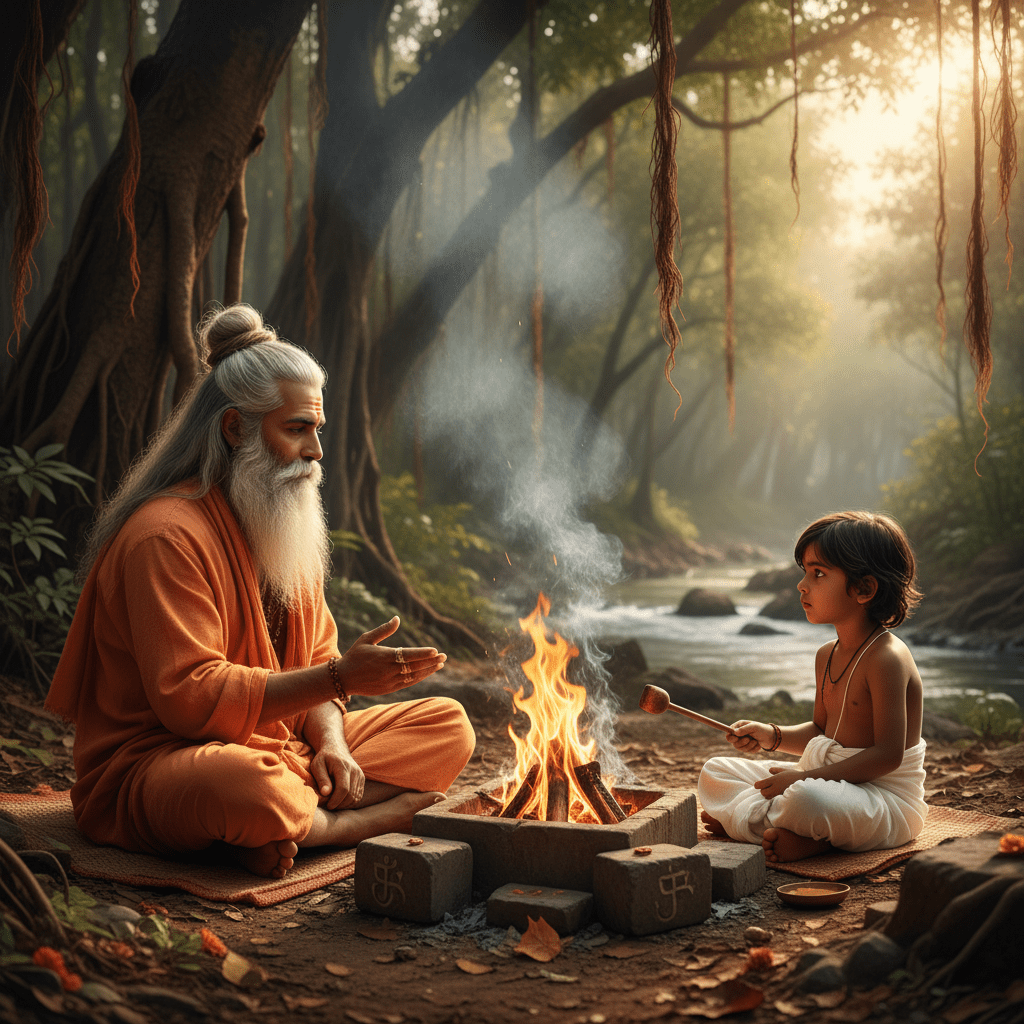
The Gurukula, the house of the master, was the fundamental educational institution of Vedic civilisation. Its name says everything: guru, the master, and kula, the family, the clan. The student did not go to a school. He entered a family. He lived with the master, shared his daily life, observed his way of being in all circumstances, participated in domestic tasks and spiritual practices, and within this framework of total immersion, received the teaching. This structure was not an organisational archaism. It was the logical consequence of a conception of knowledge that recognised that what is truly taught is not what one says, but what one is.
The first thing the student learned in the Gurukula was not a content. It was a disposition. A way of being present, of listening, of receiving. Vedic Sanskrit has a word to designate the student who deserves the teaching: shishya, the one who can be disciplined, shaped, moulded. Not in the sense of blind submission, but in the sense of an openness, a readiness to be transformed by what one receives. A student who arrives with pre-established certainties, who filters the teaching through what he already knows, who evaluates the master according to his own criteria, cannot truly learn. He can accumulate information, but not receive the substance. The first stage of Vedic education was therefore a work on receptivity, on the capacity to allow oneself to be reached by what one does not yet know.
The master, the guru, was not a teacher in the modern sense of the word. He had no programme to cover, no pedagogical objectives to meet, no timetable to respect. He was a presence, an example, a living incarnation of what he taught. The etymology of guru is revealing: gu designates darkness, ru designates the one who drives it away. The guru is the one who drives away darkness. Not through discourses about light, but through his own luminosity. In the Vedic tradition, a master who speaks of Truth without having lived it is more dangerous than useful, because he gives the illusion of knowledge without giving its substance. The primary qualification of the guru is not his knowledge of the texts. It is his direct experience of Brahman.
This requirement had important practical consequences. It meant that transmission could not be industrialised. A guru could have several students, but not hundreds. The relationship had to be close enough and long enough for real transmission to take place. It also meant that the choice of master was a fundamental decision, more important than any other educational decision, because the student was not merely going to acquire knowledge. He was going to be formed, in every sense of the word, by the presence and example of someone whose life he would share for years.
The content of the teaching was organised around the Vedas and the disciplines that accompanied them: phonetics, grammar, metrics, astronomy, ritual and philosophy. But this content was not taught as an accumulation of separate bodies of knowledge. It was taught as a coherent fabric in which each discipline illuminated the others, in which the phonetics of Sanskrit were inseparable from its cosmology, in which astronomy was inseparable from ritual, in which grammar was a way of entering the deep structure of reality. The Vedic Indians did not have disciplines in the modern sense — that is to say, domains of knowledge separated from one another by institutional boundaries. They had a single, multidimensional knowledge, whose different aspects illuminated one another.
Memorisation occupied in this system a place and a function radically different from those it occupies in modern education. We tend to regard memorisation as the lowest form of learning, inferior to understanding and application. For the Vedic Indians, memorising the hymns in all their recitation modes was to inhabit them, to carry them within oneself, to know them from the inside in a way that no reading, however deep, can reproduce. Someone who has memorised a Vedic hymn in all its recitation modes has a relationship to that text which is of a fundamentally different nature from that of someone who can look it up in a book. He does not consult it. He is it, in a sense. The text is part of his inner structure, of the way he thinks, perceives and enters into relationship with the world.
The spiritual dimension of Vedic education was not separated from its intellectual dimension. Learning the hymns and learning to live them were the same learning. The practices of the sacrifice, the consumption of soma within this ritualised framework, the work on breath and posture that accompanied recitation: all of this was integrated into the formation of the student as an inseparable dimension of the acquisition of knowledge. One could not truly understand the Rig Veda without having had the inner experience of it, without having personally traversed what the hymns describe. This is why the rishis did not consider themselves authors but receivers: a student who had truly learned could in turn receive, and what he received was of the same nature as what his masters had received before him.
This educational model disappeared with the civilisation that had produced it. The Upanishads still retain something of it: the earliest Upanishads are dialogues between masters and students, in which the relationship between the two is as important as what is said. But progressively, with the institutionalisation of religion and the formalisation of castes, direct and living transmission gave way to textual and ritual transmission, more reproducible but less alive. This movement is universal: every spiritual tradition knows it, and every attempt at spiritual revitalisation in human history has begun with a return to direct transmission, from master to student, as the primary condition of any renewal.
What Vedic education tells us about what we have lost is uncomfortable. We have educational systems extraordinarily effective at transmitting information, techniques and professional competencies. We are far less effective at transmitting wisdom, the capacity to inhabit one’s own life with depth and presence, the self-knowledge that is the condition of all other knowledge. The Vedic Indians knew that this kind of knowledge cannot be transmitted in a classroom. It is transmitted in a relationship, over time, through example and immersion. And they had built their entire civilisation around that conviction.
 Le Rig Veda
Laisser un commentaire