There is a way of reading the Rig Veda that reduces it to a catalogue of primitive beliefs, naive anthropomorphisms and meteorological metaphors. This is the way a large part of nineteenth-century Western Indology read it, and its effects are still felt in certain contemporary academic presentations. In this reading, Indra is the god of the storm because his thunderbolt resembles lightning, Agni is the god of fire because people needed to explain fire, and the cows that the hymns ask the gods for are simply cows, because people needed cattle. This reading is internally consistent, but it misses entirely what makes the text great and deep. It confuses the vehicle with the destination.
The Rig Veda is a poetic text in the strongest and most technical sense of the word. Its authors were masters of figurative language, and the images they used were not rhetorical ornaments designed to make thought more agreeable. They were instruments of thought, ways of saying something that ordinary conceptual language cannot say, bridges between the visible and the invisible, between concrete experience and the spiritual reality that underlies it. To understand the metaphors of the Rig Veda is to understand the Rig Veda itself, because in this text form and content are inseparable in a way that few literatures in the world have achieved.
The central metaphor, the one that recurs most often and that structures a large part of the text’s symbolism, is that of Light and darkness. The Light is Brahman, ultimate reality, the expanded state of consciousness, enlightenment. Darkness is Maya, illusion, ignorance, the ordinary state of consciousness in which the perception of separation reigns. This opposition is not a banal metaphor found in every tradition. In the Rig Veda it is lived, concrete, daily: every sunrise is a victory of Light over darkness, every lighting of the sacrificial fire is a recreation of this primordial movement, every experience of soma is a personal crossing from darkness into Light. The cosmic and the intimate overlap in the same image with a naturalness that is one of the most characteristic traits of the Vedic genius.
Cows are one of the densest and most misunderstood images in the text. In the double reading that the hymns invite one to practise, the cow simultaneously designates the concrete animal and the rays of light, clarity, knowledge. When Indra frees the cows held captive in the cave of Vala, he liberates at once the cattle that an enemy had stolen and the Light that Vritra was holding prisoner in the darkness. These two readings do not exclude each other. They coexist in the same image, and it is precisely this coexistence that makes the image so rich. A sacrifice to obtain cows is simultaneously a subsistence practice and a spiritual practice. The concrete and the transcendent are the same gesture, seen from two different levels of consciousness.
The horse, as we saw in another article, is the image of vital force, of spiritual energy, of the power that allows consciousness to advance. But it is also, in certain contexts, the image of the breath, of prana, that vital force which pranayama seeks to master. The chariot that Indra drives is the mind in motion, consciousness advancing toward the Light carried by its own energy. The two horses that draw this chariot are the two complementary aspects of that energy: momentum and direction, enthusiasm and discipline. This image of the chariot and its driver would run through all of Indian thought: it reappears in the Katha Upanishad, then in the Bhagavad-Gita, where Krishna himself is the driver of Arjuna’s chariot. The source of this metaphor is in the Rig Veda.
Water is the image of intuitive knowledge, of the flow of receptive consciousness, of the fluidity that is the condition of enlightenment. We developed this in another article, but it is worth underlining here the way this image functions in the poetic text itself. The waters that flow, that descend from the mountains, that meet in rivers, that move toward the ocean: this image of downward and converging movement is the image of consciousness that, in releasing the resistances of the ego, flows naturally toward Brahman as water flows naturally toward the sea. The ocean, Varuna, is the final destination, the oldest image of Brahman himself, that infinite space in which all waters ultimately dissolve.
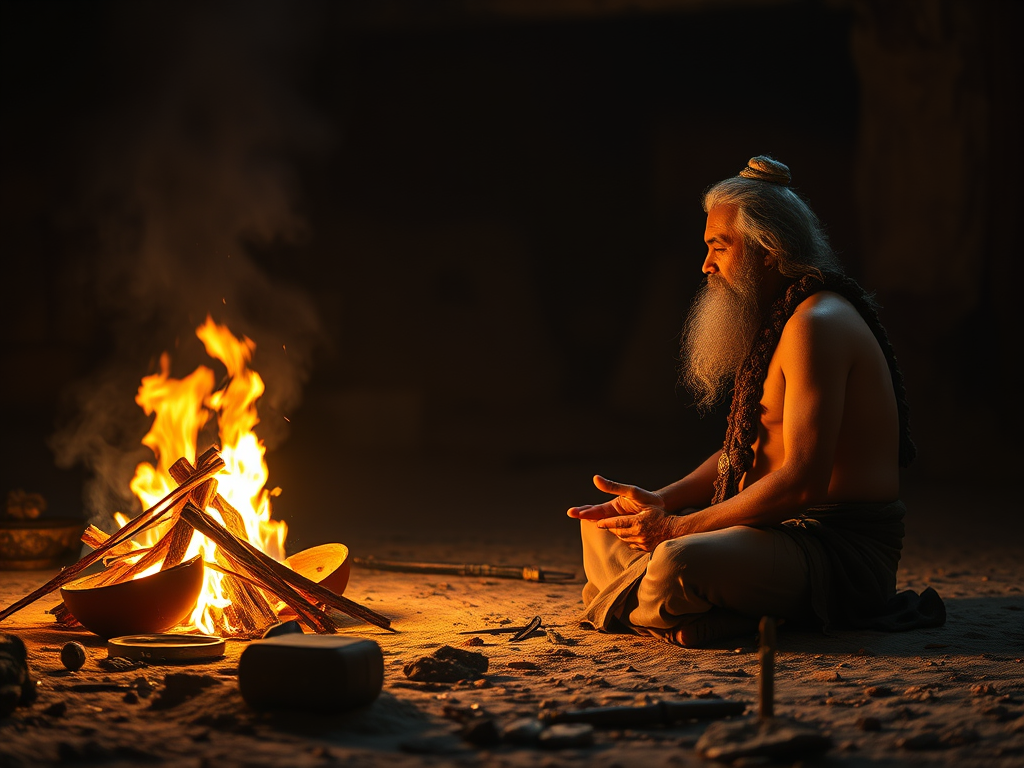
The fire of Agni is perhaps the richest and most complex image in the entire text. Agni is the fire of the domestic hearth, the fire of the sacrifice, the fire of digestion within the human body, the fire of the consciousness that transforms, and the fire of the final enlightenment that consumes whatever darkness remains. This multiplicity is not confusion. It is the recognition that the same principle of transformation through heat operates at every level of existence, from the most physical to the most spiritual. The fire that cooks food and the fire that illuminates consciousness are manifestations of the same Agni, the same transformative force that is at the heart of every process of change. This is why Agni is the messenger: he transforms the concrete offering into smoke that rises toward the sky, exactly as the inner yajña transforms egotistic resistances into spiritual energy that rises toward Brahman.
The dawn, Ushas, is the image of the moment of transition between darkness and Light, between the ordinary state of consciousness and awakening. But in the hymns devoted to her, she is described with a sensual precision and a tenderness that make her something more than a simple metaphor. She is a young woman awakening, unfolding her luminous veils, arriving without noise and without violence. This gentleness of the image says something important about the nature of spiritual awakening in the Vedic vision: it is not a brutal rupture, a shock, a shattering revelation. It is a gentle, gradual transition, like the day that rises imperceptibly until the moment one realises that the darkness has gone.
The eagle that brings soma from the celestial heights is one of the most beautiful and most suggestive images in the text. The bird that rises higher than all others, that sees from above what earthbound creatures cannot see, and that descends to bring humanity the substance of enlightenment: this image condenses into a single figure the entire movement of the Vedic spiritual path. The summit of the sky where the soma plants grow is the image of Brahman, inaccessible to the ordinary state of consciousness. The eagle is spiritual aspiration, consciousness rising. And the soma it brings back is the fruit of that ascent, made accessible to those who cannot yet rise so high by their own means.
What unites all these images, what makes them a coherent system rather than a collection of disparate metaphors, is the worldview that underlies them: a vision in which every visible reality is the reflection of an invisible reality, in which the physical cosmos and the spiritual cosmos are structured according to the same principles, in which the same Truth manifests at every level of existence. The rishis had no need to invent their metaphors. They read in the visible world the signs of a reality they knew from the inside, and the hymns are the account of this double reading, simultaneous and inexhaustible, of the world and of consciousness.
 Le Rig Veda
Laisser un commentaire