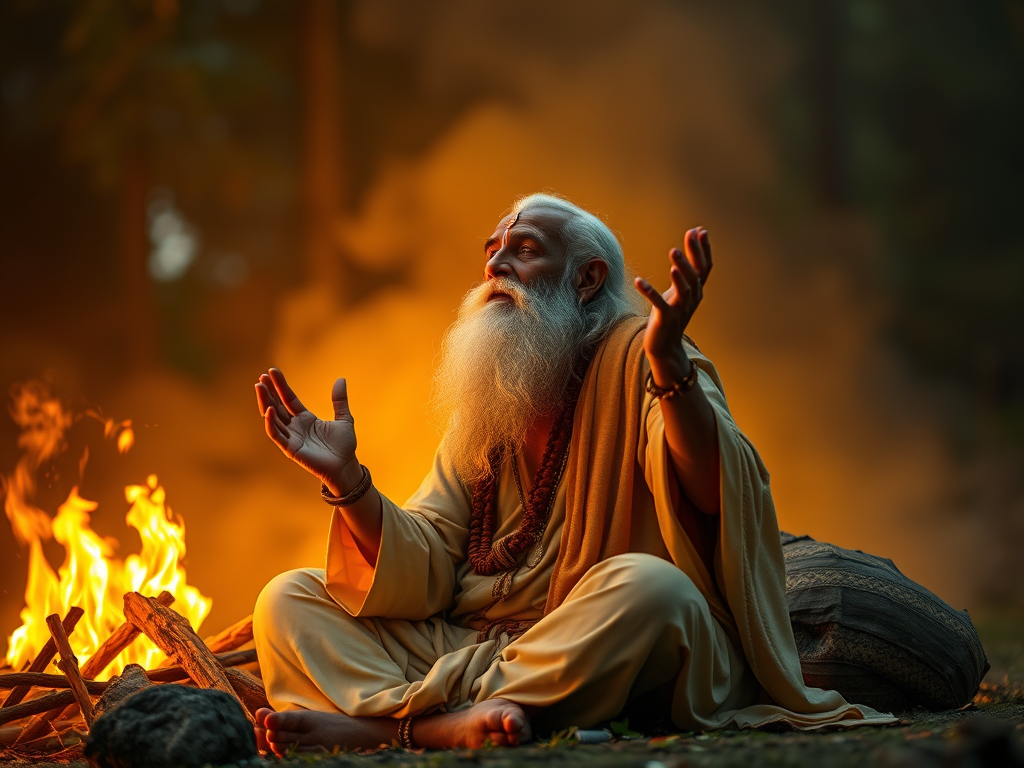
There is something rather troubling about the way Western translators of the Rig Veda have generally approached the question of soma. Most of them, trapped in their academic certainties or their own uneasy relationship with altered states of consciousness, have carefully sidestepped the subject, or buried it under ritual and botanical considerations that allowed them to avoid the essential point. The essential point is that soma was a powerful psychotropic substance, that everyone in Vedic civilisation knew this, and that the Rig Veda speaks about it without the slightest ambiguity — for anyone willing to read the text without blinkers.
Let us begin with what the plant actually was. The ninth mandala is entirely dedicated to it. It is the only god to whom an entire mandala is devoted. Its descriptions never mention leaves, seeds, fruits or flowers, only fibres. That detail matters. In 2009, Russian archaeologists unearthed in Mongolia a tapestry dating from the first century of the common era, woven in Palestine or Syria and embroidered in the cities of the Indus. The motif depicts Zoroastrian priests venerating a mushroom identified as an Indian variety of psilocybe — that is, a mushroom containing psilocybin. Zoroastrianism is the direct descendant of Vedism, and its priests used the same drink, called haoma in Iranian, soma in Sanskrit. The conclusion is hard to avoid: soma contained a tryptamine, from the same family as dimethyltryptamine, which our brains produce naturally and which is activated, among other means, by yoga, deep meditation and above all pranayama.
Stanislav Grof spent more than ten years treating patients with serious psychological disorders using LSD, with remarkable results. When campaigns orchestrated by American fundamentalist groups made the practice administratively impossible, he developed, with the help of yogis, holotropic breathing. Identical results. This is not an anecdotal detail. It means that the Vedic rishis, drinking soma within a precise ritual framework, were living the same experiences that contemporary research now documents: expansion of consciousness, temporary dissolution of the ego, a sense of unity with the universe, experiences of transcendence beyond the ordinary limits of perception.
The hymns say this in plain terms, and this is where the text becomes extraordinarily precise. In the eighth mandala, hymn 48, verse 3, we read: « We have drunk the soma. We have become immortal. We have entered the Light, we have found the gods there. » This is not a Sunday poet’s metaphor. It is an experiential report. Someone drank the plant, went through something intense, and described what they lived through in direct terms: immortality, Light, divine presence. In the second mandala, hymn 41, verse 4: « Mitra and Varuna, this juice of soma allows one to reach the Truth. » Not an abstract philosophical truth. The Truth, capitalised, which in Vedism designates the Brahman, the Absolute — what Hindus today still call enlightenment or Liberation.
It is important to understand what the word « Light » means in these hymns, because it appears hundreds of times and it has nothing to do with the sun rising. The Light is enlightenment in the strict sense. It is the state in which the intellect finally falls silent, where Maya — the illusion constructed by our limited senses — dissolves, and where Brahman appears. Soma opened that door. That is why the ninth mandala is the only one dedicated to a single being, and why Soma is deified: not because the Vedic people were kindly poets with a touch of superstition, but because they had understood that this plant gave access to something that nothing else allowed one to reach so directly.
Hymn 79 of the eighth mandala is particularly striking in this regard. We read there that soma « covers the one who is naked, heals all those who are sick, makes the blind see and the lame walk. » These formulations have scandalised more than one scholar, who saw in them mythological exaggerations. In reality, anyone with personal experience of tryptamines recognises immediately what is being described. The blind who see, the lame who walk: these are descriptions of inner states. Soma dissolved psychic blockages, unresolved pain, perceptions distorted by ego and fear. It gave access to a dimension of being that ordinary states of consciousness cannot reach. It was a spiritual therapy, and the rishis knew this perfectly well.
What makes Vedic civilisation unique — and what archaeology now confirms clearly — is that these experiences were not reserved for a reclusive elite of mystics. All leaders, all those responsible for the running of society, took part in the sacrifices and drank soma regularly. Rajas, priests, heads of household, and women too — the texts state this without any ambiguity. An entire civilisation whose decision-makers regularly lived through the dissolution of the ego, the experience of unity and the disappearance of aggression. Archaeology confirms this in its own way: no palaces, no prestige temples, no army, no slavery, no display of wealth, and a system of wastewater management that other civilisations of the era would not equal for centuries. This is not a coincidence.
The shortage of soma, linked to a widespread drought between 2200 and 2100 BCE, changed everything. Soma gradually disappeared. Other plants were substituted: ephedra mixed with cannabis, blue lotus. Plants with entirely different effects. The tenth mandala, the most recent, bears the mark of this rupture. In it we see the appearance of castes, morality, prohibitions, and several hymns that quietly but clearly indicate that soma is becoming scarce and that some people no longer have access to it. Egos return. Violence too. Spirituality gradually gives way to religion — that is, to ritual emptied of its direct content. What the priests of subsequent centuries made of sacrifice, without the plant that was its heart, resembles what the Mass would become if its mystical meaning were removed: a ceremony.
For anyone who was twenty years old in 1967, all of this is blindingly clear. The rishis of the Rig Veda had no need of Griffiths or Carhart-Harris to know what happened when soma was drunk in a ritual setting, in good company, with chanting and a fire. They knew it from the inside. And they wrote it down with a precision and an honesty that their translators have not always had the courage to acknowledge.
 Le Rig Veda
Laisser un commentaire