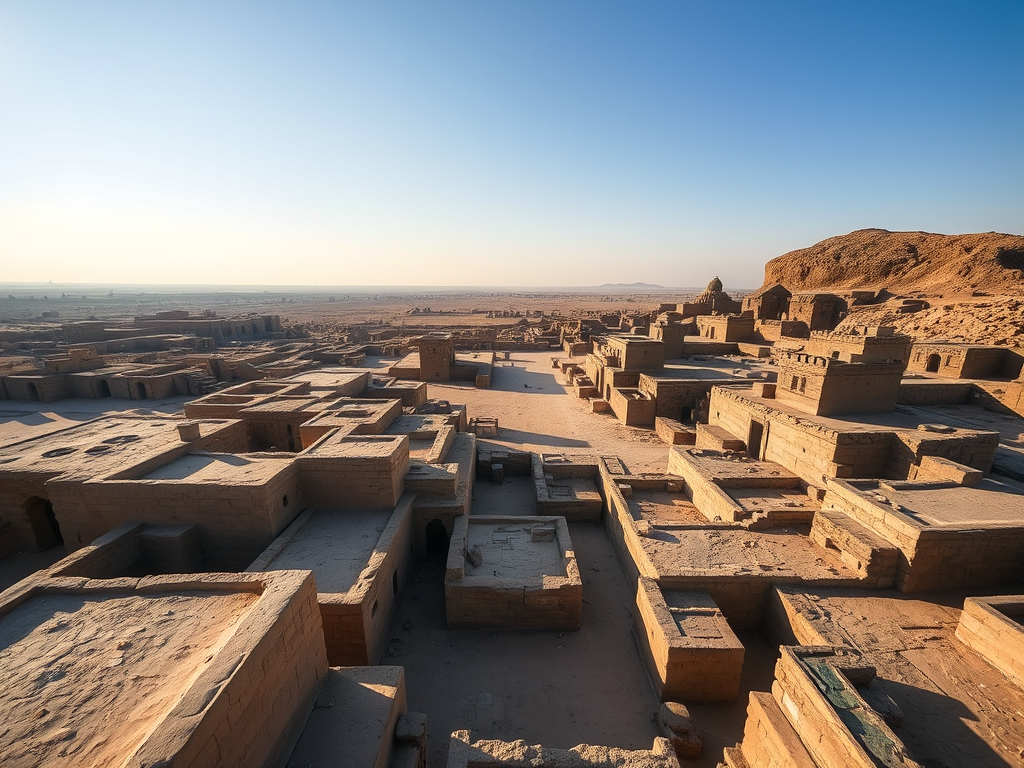
There exist, in the depths of human history, civilisations that achieved such remarkable urban and social perfection that they remain, millennia after their disappearance, an inexhaustible source of questioning for archaeologists, linguists and historians. The Indus civilisation, also known as the Indus-Sarasvati civilisation in reference to the river that irrigated its eastern margins, constitutes one of the major enigmas of Antiquity. Long eclipsed by the fascination that Mesopotamian and Egyptian civilisations have exercised over Western minds, it now asserts itself as one of the vastest and most complex that humanity has ever produced. Three of its sites deserve particular attention: Rakhigarhi, Kalibangan and Bhirrana. These three cities, located on the territory of the present-day Indian subcontinent, each reveal in their own way the sophistication of a society whose roots plunge far more deeply into time than classical historiography had supposed.
The Indus civilisation developed in a region that corresponds today to Pakistan and north-western India, stretching from Balochistan to the plains of the Ganges, and covering at its peak a surface area greater than that of ancient Egypt and Mesopotamia combined. It is generally divided into several chronological phases. The pre-Harappan or proto-Harappan period dates back to around 7000 BCE, according to the most recent datings from the excavations at Bhirrana. The so-called mature phase, that of the great planned metropolises, extends approximately from 2600 to 1900 BCE. Finally, the late period sees a gradual decline stretching until around 1300 BCE. This chronology, long debated, is today being refined thanks to advances in radiocarbon dating methods and the multiplication of systematic excavations.
The question of applying the term « Vedic » to this civilisation remains one of the most controversial in contemporary Indology. For some researchers, particularly those who defend the thesis of India’s cultural continuity, the Indus-Sarasvati civilisation would in reality be the archaeological manifestation of the society described in the Vedic hymns, thereby challenging the hypothesis of a massive Aryan invasion or migration in the second millennium BCE. For others, more attached to the migration theory, the Harappan populations constituted a distinct cultural entity, absorbed or supplanted by groups of Indo-European language speakers coming from Central Asia. The excavations at Rakhigarhi, and in particular the genomic analysis carried out in 2019 on skeletons exhumed from the site, have relaunched this debate with renewed vigour, without however bringing it to a definitive close.
Rakhigarhi is perhaps the most important site of the entire Harappan civilisation, judging by its surface area. Located in the Hisar district of the state of Haryana in India, the site extends over approximately 350 hectares, possibly more according to recent estimates that incorporate peripheral zones previously overlooked. It surpasses in area the two better-known metropolises of Mohenjo-daro and Harappa, whose names long served to designate the civilisation as a whole. Excavations carried out at Rakhigarhi since the 1960s have uncovered a complex stratigraphy bearing witness to continuous occupation over several millennia. The architectural structures reveal the existence of organised residential quarters, streets laid out according to a rigorous orthogonal plan, sophisticated drainage systems and monumental granaries intended for the storage of grain. The city was evidently a major economic and perhaps administrative centre.
One of the most spectacular discoveries made at Rakhigarhi is the uncovering of a cemetery containing remarkably well-preserved skeletons, whose analysis opened an exceptional window onto the biology and genetics of the Harappan populations. The study published in 2019 by an international team led by Vasant Shinde and David Reich showed that these individuals did not carry the genetic markers associated with migrations from the Pontic steppes, thereby contradicting a view that made steppe nomads the exclusive vectors of Indo-European languages into India. These results lent weight to the thesis that the Indus-Sarasvati civilisation constituted an indigenous cultural hearth, without any major rupture linked to an external invasion. However, the researchers themselves emphasise the complexity of human migrations and the need to multiply analyses in order to reach robust conclusions.
Kalibangan, whose name means « black bangles » in Hindi, is an archaeological site located in the Hanumangarh district of Rajasthan. It lies on the left bank of the ancient course of the Ghaggar river, which many specialists identify with the Vedic Sarasvati, the mighty river whose disappearance is attested in ancient texts and confirmed by contemporary palaeohydrological studies. Kalibangan has the distinctive feature of having yielded remains belonging to both the pre-Harappan and the mature Harappan phases, making it a privileged observatory for understanding the continuity or ruptures between these two cultural periods. Excavations conducted by the Archaeological Survey of India between 1960 and 1969 uncovered two distinct mounds: one corresponding to a citadel and the other to the lower city, following the urban pattern characteristic of the great Harappan cities.
Among the most remarkable discoveries at Kalibangan is what archaeologists have interpreted as the oldest known ploughed furrow in the history of humanity. This field, dated to around 2800 BCE, testifies to an already well-organised agriculture, practising irrigation and cross-cultivation in a regular pattern that evokes a thorough knowledge of agricultural techniques. The site also yielded fire altars, arranged according to a precise orientation that led researchers to see in them the expression of a ritual comparable to the Vedic sacrifices described in the sacred texts. These sacrificial structures, composed of rectangular pits containing ash and animal remains, constitute a powerful argument for those who support the continuity between Harappan civilisation and the Vedic tradition.
The pottery of Kalibangan also deserves particular mention. The sherds found in the oldest layers display forms and decorations that gradually evolve towards the standards of mature Harappan pottery, illustrating a slow and endogenous cultural transformation rather than a brutal rupture. This continuity in the ceramic tradition is often invoked to challenge the hypothesis of a major population discontinuity between the successive phases of the civilisation. Furthermore, Kalibangan has yielded examples of the Indus script, that as yet undeciphered graphic system which constitutes one of the great mysteries of world archaeology. More than four thousand brief texts have been catalogued across all Harappan sites, but no decipherment key has yet been unanimously accepted, leaving in the shadows a considerable portion of what these populations thought, believed and organised.
Bhirrana, sometimes spelled Birhana or Bhirana, is a site in the Fatehabad district of Haryana that has been the subject of intensive excavations in the early twenty-first century. It is to this site that we owe one of the most radical challenges to the traditional chronology of the Harappan civilisation. Radiocarbon datings carried out on organic materials taken from the deepest layers have yielded dates going back as far as 7570 BCE, an antiquity that pushes the origins of the civilisation considerably further back in time. Bhirrana may be one of the oldest known sites of permanent occupation in South Asia, predating Mehrgarh, which had until then been considered the cradle of sedentarisation in the region. These results have naturally sparked methodological debates about the reliability of the samples and the interpretation of complex stratigraphies.
The excavations at Bhirrana have made it possible to trace an almost uninterrupted cultural sequence, from the most archaic phases of prehistory through to the mature Harappan period. The oldest remains include rammed-earth dwellings, storage pits and ceramic assemblages that represent the first milestones of a craft tradition destined to develop over millennia. As one moves forward in time, the structures become more elaborate, the pottery more refined, and the traces of commercial activity more numerous. This site illustrates better than any other the way in which the Harappan civilisation did not arise ex nihilo but resulted from a long cultural maturation whose roots reach into a past that we are only just beginning to glimpse.
One of the most striking characteristics of all Harappan sites, and Bhirrana is no exception, is the extraordinary cultural homogeneity that prevails across a geographical area of considerable extent. Standardised weights and measures, identical ceramic forms, urban plans obeying the same principles, drainage systems of similar design: everything suggests the existence of a network of exchanges and cultural norms sufficiently powerful to maintain remarkable coherence across hundreds of kilometres. This uniformity contrasts with the apparent absence of palaces, temples and representations of rulers, which has led researchers to propose models of governance very different from those that prevailed in Mesopotamia or Egypt, founded on a form of elite consensus or on the authority of prosperous merchants.
The question of the decline of the Indus-Sarasvati civilisation is intimately linked to the physical geography of the region. The progressive drying up of the Ghaggar-Hakra river system, which many identify with the Sarasvati of the Vedic texts, played a determining role in the collapse of the great metropolises. Recent palaeoclimatic studies suggest that a prolonged period of drought, between 2200 and 1900 BCE, would have considerably weakened the agricultural foundations of this hydraulic civilisation. Populations would then have migrated eastward and southward, towards the Indo-Gangetic plains, carrying their cultural traditions with them and thus contributing to the genesis of the subcontinent’s later civilisations. This thesis of eastward migration is supported by the proliferation of late sites in previously sparsely occupied regions, notably Gujarat and eastern Punjab.
It would be reductive to approach these civilisations only through the lens of their decline. What strikes the historian more forcefully is the vitality and ingenuity of these societies at their peak. The irrigation systems put in place enabled intensive agriculture capable of feeding urban populations of several tens of thousands of individuals. Maritime and overland trade extended as far as Mesopotamia, as attested by Harappan seals found at Ur and other sites in the ancient Near East. Craftspeople mastered bronze metallurgy, the cutting of lapis lazuli, the manufacture of beads in steatite and carnelian, as well as numerous other techniques requiring both sophisticated know-how and supply networks for raw materials covering considerable distances.
The debate over the Vedic or non-Vedic nature of the Indus-Sarasvati civilisation must not obscure the intrinsic richness of this heritage. Whether or not one accepts the identification with the society described in the hymns of the Rigveda, it remains the case that Rakhigarhi, Kalibangan and Bhirrana bear witness to a collective intelligence and an organisational capacity that commands admiration. These cities managed for centuries to maintain a balance between urban development and the exploitation of natural resources, between cultural homogeneity and adaptation to local conditions, between trade open to the world and remarkable internal coherence. They represent a fundamental chapter in human history, a chapter that archaeologists are rewriting before our eyes, as excavations progress and analytical methods improve.
The legacy of the Indus-Sarasvati civilisation is difficult to measure precisely, but it is undeniable. Some researchers see in contemporary Indian practices — the veneration of sacred trees, certain forms of yoga, the reverence accorded to cattle, the use of certain symbols such as the swastika — survivals of Harappan traditions. Others are more cautious and recall that formal convergences do not prove direct filiation. What is certain, however, is that the Indus civilisation constituted an exceptional human laboratory, where original solutions were found to the universal challenges of life in society: how to feed a dense population, how to organise cohabitation in urban space, how to regulate commercial exchanges, how to maintain a cultural identity across an immense territory.
Research currently under way at Rakhigarhi, Kalibangan and Bhirrana, as well as at dozens of other sites still largely unexplored, promises to profoundly renew our understanding of this civilisation. New technologies — drone aerial photography, geophysical prospecting, genomic analysis, computational modelling of ancient river systems — open up perspectives that the pioneers of Indus archaeology, at the beginning of the twentieth century, would not have dared imagine. Each excavation season brings its share of surprises and obliges researchers to revise their certainties. This is one of the great virtues of archaeology: it reminds us that the past is never definitively closed, that civilisations buried beneath the sediments continue to speak to us, and that the history of humanity is infinitely richer and more complex than our usual narratives lead us to believe.
 Le Rig Veda
Laisser un commentaire