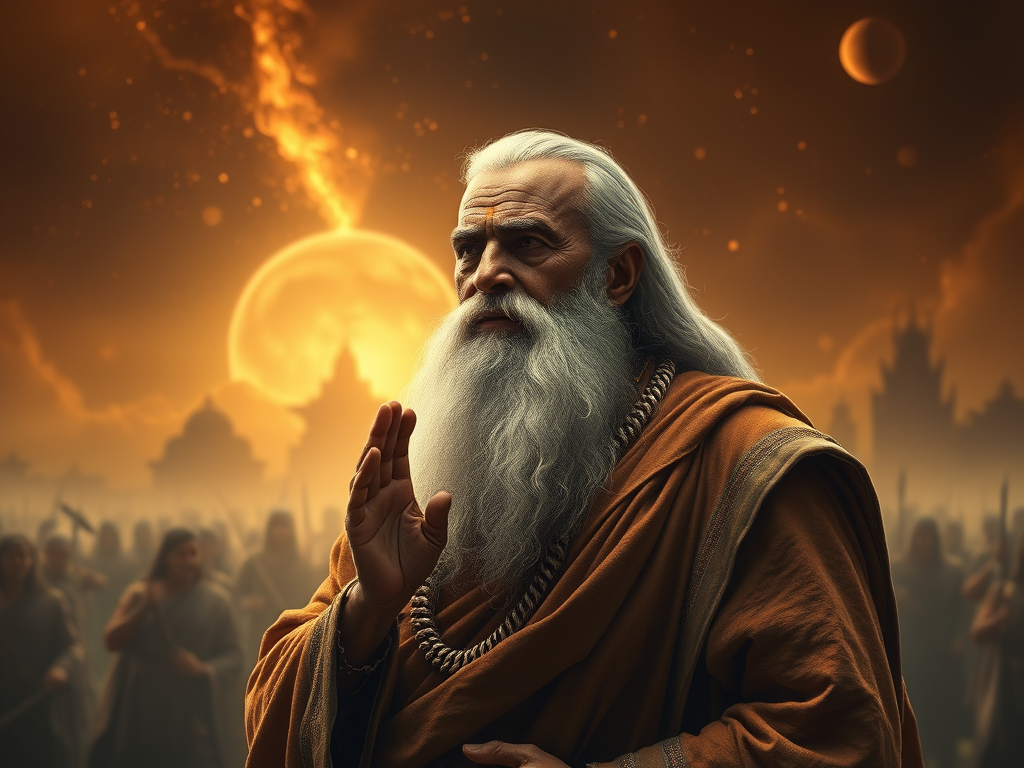
There are words that carry an entire civilization within them. Mitra is one of those. In the oldest Indo-European languages, this word designates both the friend and the contract, friendship and alliance, as if the ancients had understood, long before our philosophers, that every true relationship is a commitment, and that every sincere commitment is already a form of love.
In archaic Vedism, Mitra is a solar deity, but of a particular sun: not the midday sun that burns and blinds, but the gentle morning light that reconciles night with day. He reigns over agreements between people, over promises kept, over that subtle form of fidelity that does not proclaim itself but holds communities upright when everything wavers. Beside Varuna, his inseparable companion, who watches over the cosmic order with vigilance, Mitra embodies the gentleness of that order, its kindly face, its human warmth.
Gentleness. The word deserves a pause, for our era regards it with suspicion. We readily confuse gentleness with weakness, kindness with naivety, stability with stagnation. Yet the gentleness of Mitra has nothing passive about it. It is a force that chooses not to crush. It is a power that decides to take care. The stability he embodies is not that of inert stone, but that of the tree whose deep roots allow its branches to sway without fear in the storm.
It is here that the name Vishvamitra takes on its full density. Vishva means the whole, the entire universe, the world in its infinite unfolding. Mitra, the friend. The one who is everyone’s friend, or whom everyone loves, as one prefers to read it. Both translations are simultaneously true, for authentic friendship possesses that miraculous property of being identical in both directions: one cannot truly love without being, in some sense, lovable.
Vishvamitra is one of the most fascinating and most tormented rishis of the Vedic tradition. His entire life is a living contradiction of his name. He was first a warrior king, Kaushika, ambitious and violent, whose encounter with the sage Vasishtha ignited in him a desire for spiritual transcendence so ardent that it burned everything in its path, including his own inner peace, across millennia according to mythic time. He sought to conquer wisdom as one takes a fortress, through will, through the most extreme asceticism, through a determination that sometimes bordered on madness.
The war of ten kings, the Dasharâja, in which he played a central role, illustrates well this constitutive tension in his being. That Homeric conflict of Vedic literature saw him provoke, compose, curse, and bless, with an intensity that belongs only to those who suffer from not yet being what they sense they must become. He composed the Gayatri mantra, the most recited prayer in the Hindu world for millennia, a hymn to the light that illuminates intelligence. The friend of the entire universe reached that title only after having traversed the darkest forms of himself.
There is a lesson here that Mitra teaches silently: true friendship, true gentleness, true stability are not points of departure. They are destinations. One is not born a friend of the universe. One becomes it, slowly, painfully at times, by learning to untie the knots of the ego that constrict the heart and shrink the world to the measure of our fears.
The stability that Mitra offers is therefore not the comfort of one who has never been shaken. It is the rediscovered equilibrium of one who has passed through the movement and who, on the other side of the whirlpool, has discovered that the depths of things are peaceful. That peace, the Vedas call shanti, and they repeat it three times in their invocations, as if to indicate that it must penetrate the three planes of existence: body, speech, and mind.
Mitra invites us to consider that relationship is the very fabric of reality. The world is not composed of isolated things that relations come to connect after the fact. It is originally composed of relations, alliances, correspondences, echoes. Each being is what it is because it stands in relation to everything else. Friendship is therefore not one sentiment among others: it is the recognition of this deep structure of the real. To love, in this sense, is simply to see what is.
Vishvamitra, despite his inner storms and outer wars, carried this name as a program, as a destiny to be accomplished rather than a nature already acquired. And perhaps it is so for each of us: our names, our aspirations, our highest ideals do not describe what we are, but what we move toward, the fixed star that orients our walk through the darkness.
The gentleness of Mitra is a star of that kind. It does not judge the distance that separates us from it. It shines, simply, with that constancy proper to things that are true, and it waits.
 Le Rig Veda
Laisser un commentaire