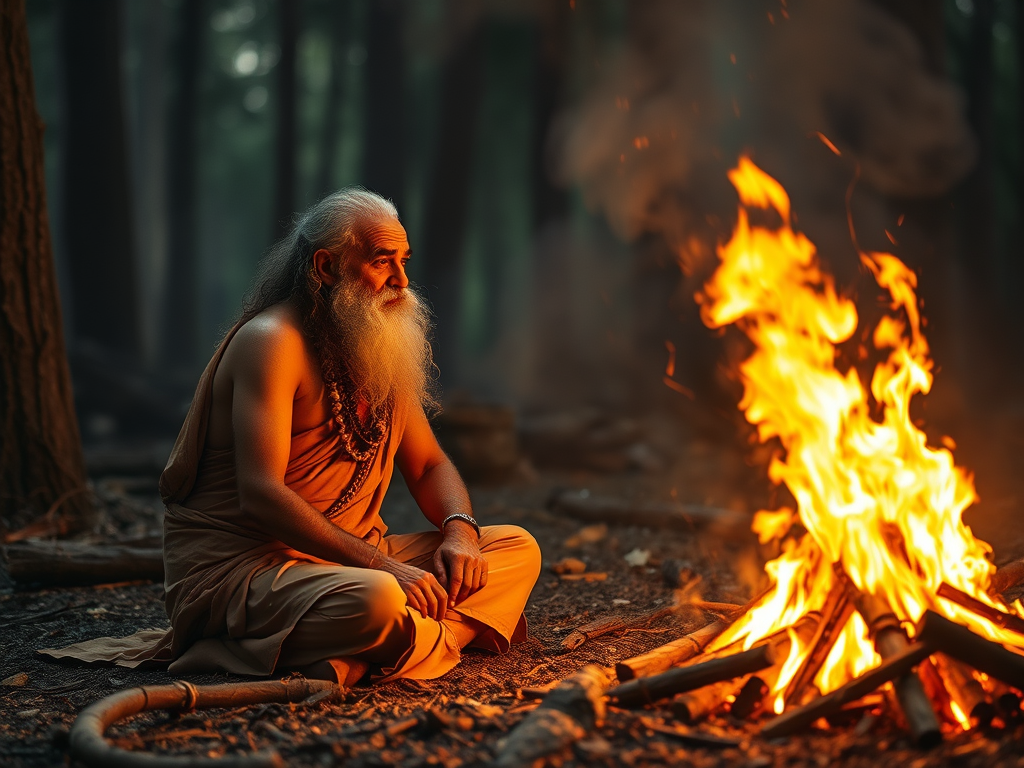
Of all the figures in the Rig Veda, Agni is undoubtedly the one most directly connected to the daily lives of the people who composed these hymns. His name simply means « fire, » and therein lies his power: he is not a distant abstraction, but is present in every hearth, in every flame lit at daybreak, in every sacrificial pyre from which smoke rises to the heavens. The Vedic poets dedicated a considerable number of hymns to him, and this abundance is no accident. Agni is everywhere there is heat and light, and in a world without electricity, without gas, without the conveniences we take for granted, fire was quite simply the boundary between life and death.
What is striking when one reads carefully the hymns dedicated to him is the tenderness with which the poets speak to him. Agni is not addressed as one would a fearsome god who must be appeased. He is spoken to as a friend, as a guest received each morning, as a familiar being whose character is known. He is « the one who licks the wood, » the one whose tongues of flame seem to advance as if to greedily devour what is offered to him. He is also called « the immortal among mortals, » which says much about how these men perceived him. Fire dies, yes, if it is not tended. But it is reborn. It can always be reborn. And it is precisely this capacity to die and return to life that makes it something that transcends mere matter.
But Agni is not just a cooking fire or a campfire. Above all, he is the fire of sacrifice, and it is here that his role becomes truly central in Vedic thought. In the civilization of the seven rivers, sacrificial rites were the beating heart of religious and social life. Sacrifice consisted of offering food, clarified butter, milk, herbs, sometimes animals, by throwing them into the fire. And Agni, by consuming these offerings, transformed them, elevated them, and carried them to the other gods. It is here that he becomes something unique: he is the messenger between the world of men and the world of the gods. He is the one who takes what men give and transmits it to the heavens, to where men cannot go themselves.
This mediating function is absolutely fundamental. In other religious traditions, this role is often filled by angels, prophets, or priests who intercede. In the Rig Veda, it is fire itself that plays this role. And this completely changes how we understand the relationship between humans and the divine in this civilization. There is no need for a human intermediary with special power or authority. There is fire, which anyone can light, which anyone can tend, and through it, anyone can, in a certain way, speak to the gods. There is something remarkably direct about this, almost democratic in the deepest sense of the word.
The hymns emphasize that Agni « knows » the gods, that he associates with them, that he is at home with them as well as with humans. He navigates between the two worlds with an ease that no other possesses. He is sometimes called « the messenger of the gods to humans » and « the messenger of humans to the gods, » which clearly shows that this movement is reciprocal. The gods also communicate with humans through him. The flame that descends from the sky in lightning, the fire of the sun that warms the earth, the fire contained within plants and wood before being extracted by friction: all these manifestations of fire are forms of Agni, ways in which he reveals himself in different places and under different guises.
This idea that fire is present everywhere in a latent state is very beautiful and profound. In wood, in plants, in dry grass, in lightning, in the sun, there is always fire waiting to be unleashed. The Vedic poets had observed this with great attention. They knew that rubbing two pieces of wood together would eventually produce a flame. For them, this was not simply a technique; it was a revelation. Fire was there, hidden, and the human gesture brought it forth. They told a story about it: Agni is born from two pieces of wood that are rubbed together, like a child is born from the union of two beings. It emerges, it cries out, it grows rapidly, it devours everything it is given.
What is also striking is that the poets of the Rig Veda attribute to it intelligence, memory, and will. Agni « knows » which offerings please the gods. Agni « guards » homes and protects people during the night. Agni « sees » everything that happens, because no darkness can withstand the light. These qualities are not mere poems or figures of speech. They reflect a way of being in the world where the boundary between what is living and what is not is not drawn where we draw it today. For these people who lived on the banks of these seven great rivers several millennia ago, fire was alive. Not metaphorically. Truly.
It is crucial to understand that all of this takes place within a very specific geographical and historical context, one that nineteenth-century Indologists did not always fully grasp. These hymns were not composed in the abstract. They were composed by real men and women, living in real conditions, in a region of the world that archaeology and hydrology now allow us to better identify. The civilization of the seven rivers, that of Sapta Sindhu, had its own climatic, agricultural, and pastoral realities. Fire served concrete functions: heating, cooking, warding off wild animals, signaling one’s presence, and celebrating important moments in community life. And it is from these very concrete realities that the figure of Agni was conceived, sung, and celebrated.
Agni is also linked to the concept of truth, what the Rig Veda calls Rita, the just order of the world. Fire does not lie. It burns what must burn, it transforms what must be transformed. It does not pretend. It is what it is with complete honesty. This association between fire and truth is not unique to the Rig Veda; it is found in many human traditions, but in the Vedic hymns it is expressed with particular clarity and beauty. Those who offer fire are those who seek to align themselves with this order of the world, to enter into the just flow of things. Agni is the witness to this process and the guarantor of its sincerity.
Finally, there is something moving in the fact that this Agni, so powerful, so central, is also vulnerable. It must be nurtured. It must be fed. If it is abandoned, it dies out. And then everything dies with it: the connection with the gods, the warmth, the light, even the possibility of sacrifice. Poets sometimes ask it not to drift away, to stay, to continue to shine. In these appeals, there is a very human anxiety, the fear of losing what connects us to something greater than ourselves. And in this anxiety, we recognize something that does not age, something that still speaks to every human being, regardless of the century in which they live.
 Le Rig Veda
Laisser un commentaire