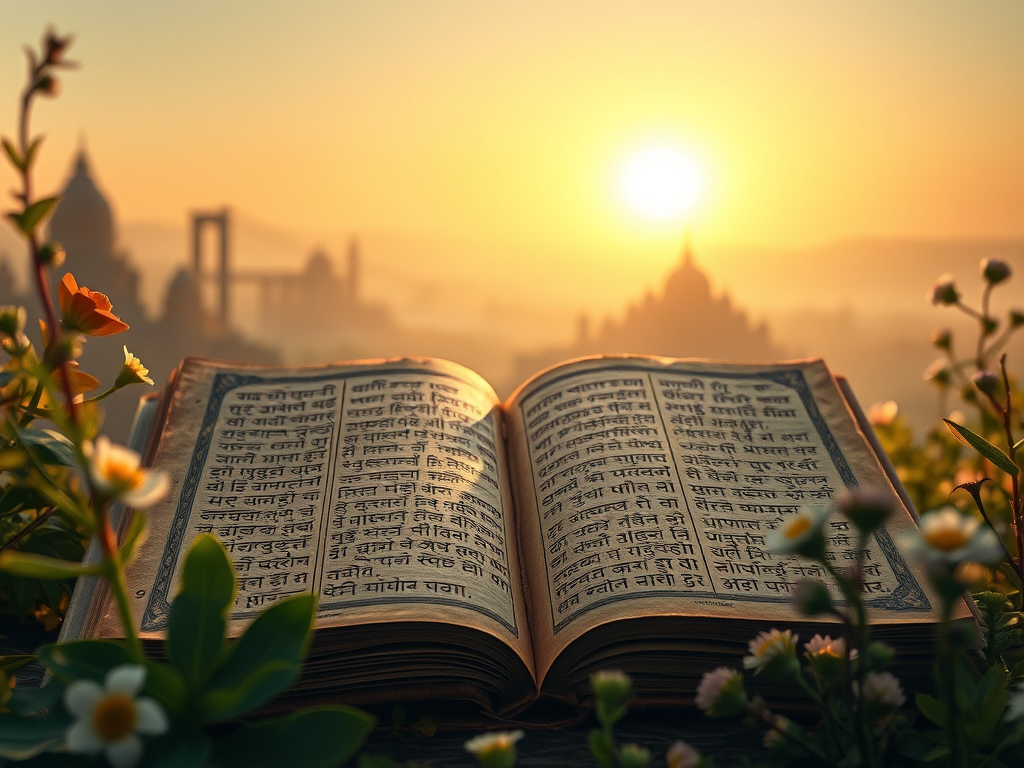
Imagine a book so ancient that writing did not yet exist when it was composed. Imagine men and women who, in the valley of great rivers in what is now northwestern India, perhaps three thousand five hundred years ago, lifted their eyes to the sky at dawn and found words to express their wonder. These words they entrusted not to paper or stone, but to the living memory of their children, who passed them on to their own children, and so on, by word of mouth, from generation to generation, for millennia, without losing a single syllable. That book is the Rig Veda.
The word itself says much. Veda comes from the Sanskrit root vid, meaning to know, to understand, to see. It is the same root as the Latin videre, the French voir, the English wit. Rig, or more precisely Ric, denotes the verse, the sung hymn, the carefully crafted word. The Rig Veda is therefore, in its simplest translation, the knowledge of hymns, or understanding through song.
It is composed of one thousand and twenty-eight hymns, grouped into ten books called Mandalas, meaning circles or cycles. These hymns address forces that the Vedic poets call gods, but which it would be reductive to imagine as human-shaped figures sitting on clouds. Agni is fire, but also the principle of transformation that allows all things to pass from one state to another. He symbolises light, the light of Illumination. Indra is the thunderbolt, but also the force that breaks through obstacles and releases pent-up waters, slaying whatever prevents us from reaching the Light. Varuna is the night sky, or the Ocean, but also the silent guardian of the order of the universe. These figures are not mere primitive superstitions. They are attempts, of breathtaking depth, to name the powers that govern the visible and invisible world, both inner and outer.
What strikes the modern reader approaching the Rig Veda for the first time is both its distance and its proximity. The distance is real. The language is difficult, archaic, dense, full of wordplay and allusions that presuppose a familiarity with a vanished world. Translators themselves have been disputing the meaning of certain passages for centuries. Vedic Sanskrit is not the classical Sanskrit of Kalidasa or the Bhagavad-Gita. It is an older, rougher language, closer to and more ancient than the Indo-European languages, from Greek to Latin, from Persian to Celtic.
But the proximity is there too, and it is overwhelming. A father asking the gods to protect his son. A woman singing her love at sunrise. A sage who, in the night, wonders what existed before creation, before even the gods came to be. This vertigo before the origin of things, this tenderness for loved ones, this gratitude for the morning light, all of it still speaks to us, directly, without intermediary.
But above all, it is the search for Illumination through the consumption of Soma, an entheogenic plant, that shines through right up to the ninth Mandala, which is devoted entirely to the god Soma.
The Rig Veda is not the Bible. It is not the Quran. Nor is it a philosophical text in the Greek sense of the term. It is something prior to all these categories. It is poetry in the most radical sense of the word, that is to say a way of bringing the world into existence by naming it. The Rishi, the poet-seers who composed these hymns, did not separate the beautiful from the true, nor song from thought, nor prayer from knowledge. For them, seeing clearly and speaking beautifully were one and the same thing.
The Rig Veda has long been regarded as one document among many on the religions of Antiquity, to be filed somewhere between the Sumerian tablets and the Upanishads. That reading is insufficient. The Rig Veda is a window onto a way of inhabiting the world that we have almost entirely lost, a way in which man did not position himself as master of nature but as its interlocutor, in which the cosmos was not a silent backdrop but a living partner, in which the well-spoken word had the power to sustain the order of the universe.
This is what the Vedic people called Rita, the Truth or Reality of this world. An idea found, under different names, in almost every great ancient civilisation, as though humanity, in its beginnings, had known something it has since forgotten.
 Le Rig Veda
Laisser un commentaire