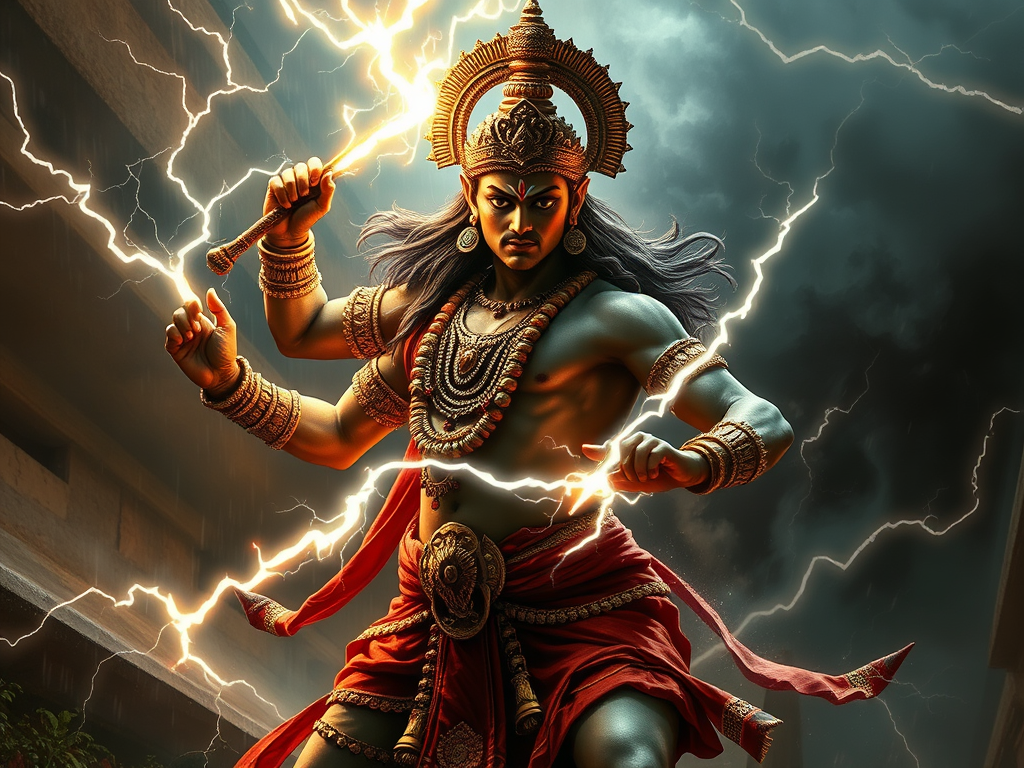
In the Rig Veda, Indra is the most invoked deity. More than 250 hymns are dedicated to him. This alone reveals his importance: Indra is not a marginal figure. He is the dynamic force of the Vedic world.
First, he is the god of the storm.
He wields the vajra, the thunderbolt.
He defeats Vritra, the serpent who withholds the waters.
When Vritra falls, the rivers flow again, and life returns.
But this cosmic battle also mirrors an inner reality.
1. Outwardly: the power of the storm
Indra represents nature’s explosive energy.
A storm destroys, yet it also purifies. It breaks oppressive heat, releases rain, renews the earth.
In the hymns, Indra is called:
- Breaker of obstacles
- Liberator of the waters
- Protector of men
- Unconquerable warrior
Nature is not static. It moves through tension and release. Indra embodies that release.
2. Inwardly: transformative energy
The term shakti does not yet appear in the Rig Veda. Yet the concept is already present.
Indra is transformative force within the human being.
He breaks psychological resistance.
He destroys fear.
He opens awareness.
In this interpretation, Vritra becomes:
- inertia
- fear
- doubt
- ignorance
When Indra acts, something shifts. A blockage dissolves. A new clarity emerges.
3. Indra and Soma: awakened energy
Indra is the great drinker of Soma.
Many hymns insist that his power grows after drinking it.
Soma is not merely ritual drink. It represents heightened consciousness.
Thus:
- Soma expands perception
- Indra turns expansion into decisive action
Without Indra, illumination remains passive.
Without Soma, energy lacks direction.
4. A universal principle
Indra embodies a timeless psychological law:
Transformation requires rupture.
- A crisis.
- A shock.
- A decisive act.
The inner storm precedes clarity.
Indra is not merely an ancient war god.
He is the principle of transformative energy.
Conclusion
Indra is the force that strikes and liberates.
Outwardly, he is thunder and lightning.
Inwardly, he is the power that transforms consciousness.
He is movement itself.
In the civilization of the Seven Rivers, this force was not abstract. It was experienced, sung, invoked — a living energy linking nature and awareness.
 Le Rig Veda
Laisser un commentaire