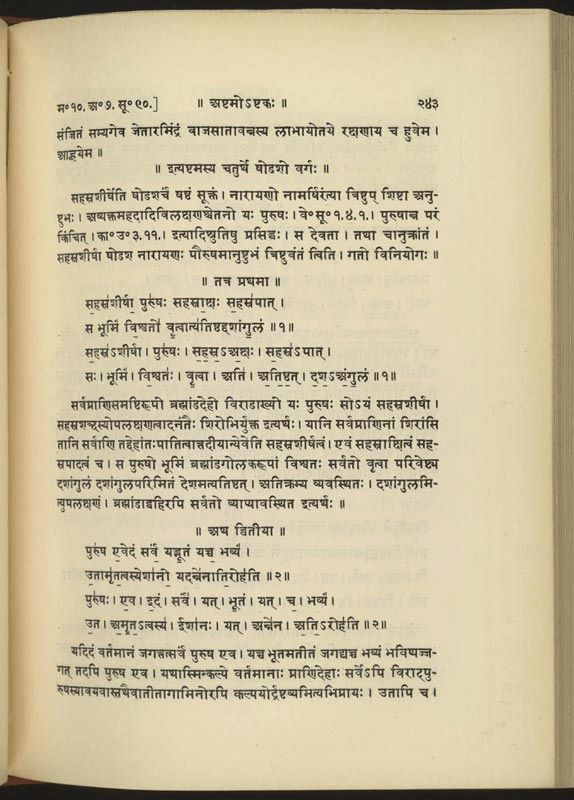
The Purusha Sukta (10.90) of the Rig Veda is one of the most discussed — and controversial — hymns in Vedic literature.
Why?
Because it describes the creation of the universe through the sacrifice of the primordial Cosmic Being — the Purusha — and mentions the origin of the four varnas.
For modern Western readers, this can appear as the theological foundation of the caste system.
But is it really?
1. A Cosmic Myth
The hymn describes a vast Being:
“The Purusha has a thousand heads, a thousand eyes, a thousand feet…”
He transcends the earth and pervades the cosmos.
The gods sacrifice him, and from this primordial act emerge:
- the Moon (from his mind),
- the Sun (from his eyes),
- Indra and Agni (from his mouth),
- the sky, air, and earth.
This is symbolic language.
The sacrifice represents transformation: unity becoming multiplicity.
2. The Four Varnas
The sensitive passage states:
- From his mouth came the brahmanas
- From his arms, the rajanyas
- From his thighs, the vaishyas
- From his feet, the shudras
Later history turned this verse into a justification for rigid social stratification.
But the hymn itself does not speak of racial purity, inherited superiority, or social immobility.
It describes a social body.
3. An Organic Metaphor
A body functions through cooperation:
- Mouth → speech, knowledge → brahmanas (thinkers, teachers, spiritual guides)
- Arms → protection, governance → rajanyas (leaders, administrators)
- Thighs → support, production → vaishyas (entrepreneurs, farmers, independent workers)
- Feet → foundation, movement → shudras (employees, skilled laborers)
Each part is indispensable.
Without feet, the body collapses.
Without arms, it cannot act.
Without the mouth, it cannot communicate.
The hymn presents society as an interdependent organism.
4. Varna vs Caste
The term used in the Rig Veda is varna, meaning “color,” “aspect,” or “functional appearance.”
It does not yet refer to the later system of hereditary jatis.
Nothing in the hymn states that individuals are permanently locked into one function.
Nothing establishes moral hierarchy.
The text speaks of roles — not privileges.
5. A Universal Structure?
Applied to modern societies:
- Intellectual and spiritual leaders → brahmanic function
- Political leaders and managers → rajanya function
- Entrepreneurs and producers → vaishya function
- Wage workers → shudra function
Every complex society contains these structural roles.
The real issue is not whether such functions exist —
but whether they are organized with justice, mobility, and dignity.
Final Reflection
The Purusha Sukta is not a political doctrine.
It is a cosmological vision.
It affirms unity behind diversity.
It presents society as an expression of cosmic order.
Its historical misuse should not obscure its symbolic depth.
Myth — yes.
Metaphor — certainly.
Oppression — only when frozen by history.
 Le Rig Veda
Laisser un commentaire