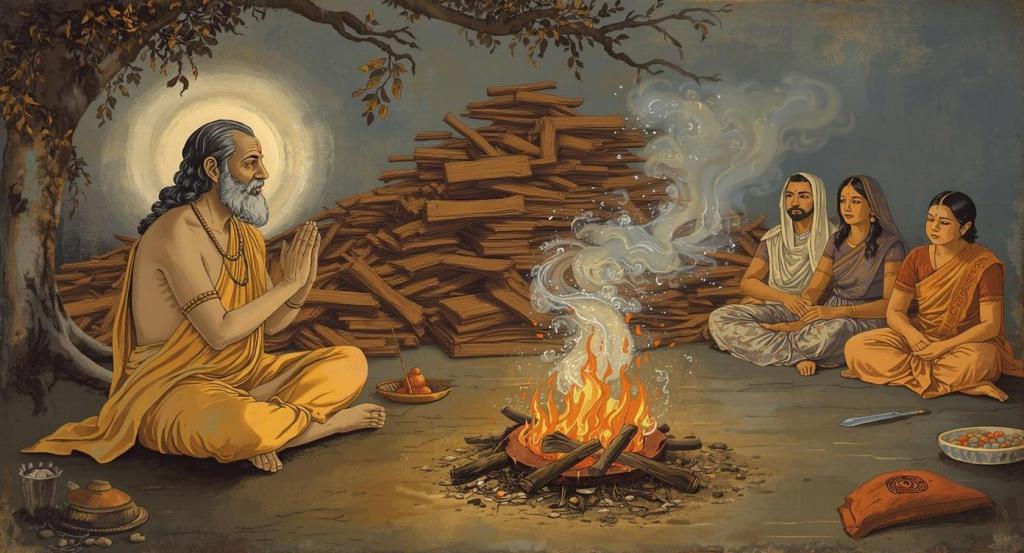
- 1. Death in the Vedic world
In the Rig Veda , death is not presented as an absolute rupture, but as a passage.
The funeral hymns—particularly in the tenth mandala (RV 10.14–18)—show a structured and peaceful vision of the afterlife.
Death is not a punishment. It is part of the cosmic order, ṛta , which governs both the movement of the stars and human respiration.
Man dies, but he does not disappear.
- 2. Yama: first to die, king of the ancestors
The central figure in funeral hymns is Yama .
In the Rig Veda, Yama is the first to die. He opened the way. He reigns over the world of ancestors ( pitṛs ).
He is not a terrifying judge as in some later traditions.
He is a guide. A peaceful king who welcomes the deceased into a luminous abode.
The anthems ask for:
« Go to Yama, to the ancient fathers,
where the righteous dwell, in the light. »
The Vedic afterlife is described as a place of clarity, joy, and continuity.
- 3. The Agni fire: a bridge between worlds
Another key player is Agni , the sacred fire.
Agni consumes the body during cremation. He transports the soul to the world of the gods and serves as an intermediary between the living and the ancestors.
Fire does not destroy: it transforms.
In the hymns, Agni is asked not to harm the deceased, to gently lead him to the fathers and to purify him.
Cremation is not annihilation, but transmutation.
- 4. A luminous vision of the afterlife
The Vedic afterlife is not yet structured into heaven and hell as in later traditions.
It contains neither eternal damnation nor a detailed moral judgment. Nor does it contain an elaborate karmic system (which will appear later).
The deceased joins the ancestors who are in a celestial sphere. It is also a space of light.
Some hymns even evoke the possibility of a return, suggesting the first intuitions of reincarnation, although the doctrine was not yet formalized.
- 5. Continuity rather than the end
What is striking about these hymns is their serenity.
Death is a temporary separation. It is a transformation, a change of state.
The community of the living remains connected to the ancestors through ritual.
Memory is active.
The dead are not erased: they become an invisible presence.
- 6. A design consistent with the civilization of the Seven Rivers
Within the framework of a civilization centered on balance and consciousness — this vision of the afterlife makes sense.
It is a society without punitive obsession, without permanent fear of punishment and without eternal hell.
Death is integrated into the cosmic cycle.
It does not terrorize.
It places humanity within a larger order.
 Le Rig Veda
Laisser un commentaire