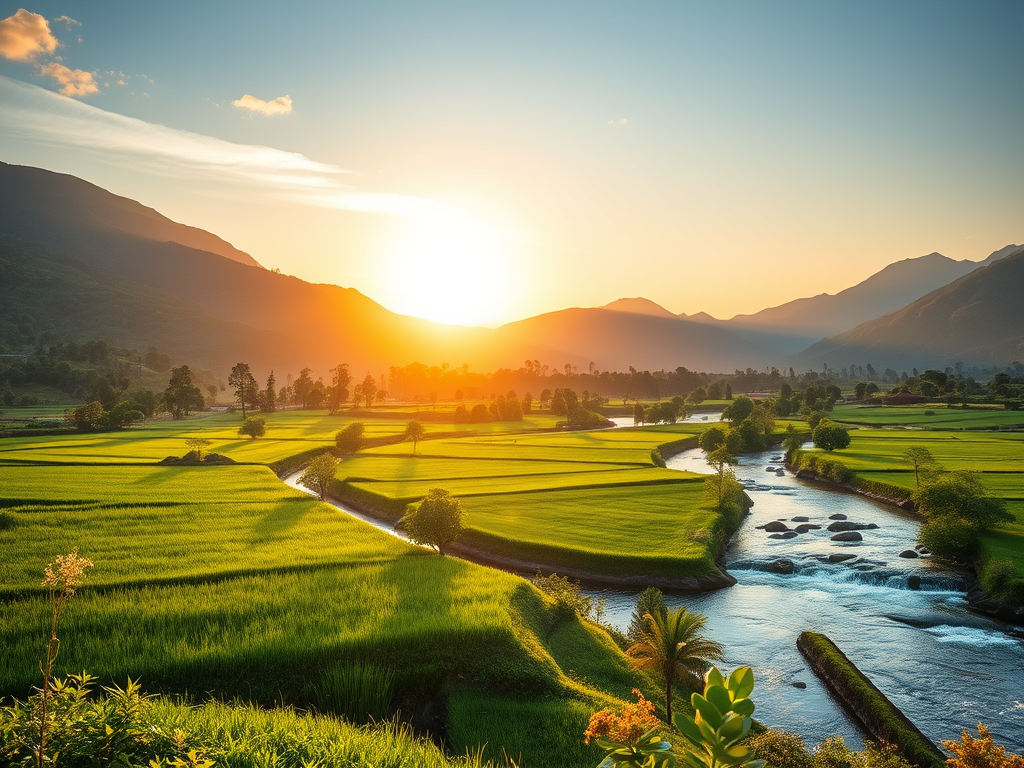
1. A Living, Never Inert Nature
In the Rig Veda, nature is never just scenery.
It is alive, conscious, active.
Fire (Agni), Dawn (Ushas), Storm (Indra), River (Sarasvatī), Wind (Vāyu) are not merely physical events. They are active forces, intelligent powers, manifestations of a greater order.
Vedic poetry does not say: “it rains.”
It says: a power acts.
Nature is therefore:
- Dynamic
- Relational
- Meaningful
2. Nature as Expression of Ṛta (Truth)
The hymns describe a world structured by a fundamental principle: Ṛta, which you translate as “Truth.”
It is not a written law.
It is the natural order of reality.
The rising of the sun.
The cycle of seasons.
The flow of rivers.
The rhythm of breath.
All belong to Ṛta.
Vedic poetry observes these phenomena carefully but places them within a coherent whole. Nature is not chaotic; it follows harmony.
3. Precise and Concrete Observation
Vedic poetry is not abstract.
It describes:
- Lightning splitting the sky
- Cows leaving the enclosure at dawn
- Fire crackling and transforming wood
- Rivers flowing with strength
These images are rural, concrete, close to daily life.
We sense a civilization deeply rooted in its natural environment — what you call the Civilization of the Seven Rivers.
4. Nature as a Mirror of Consciousness
Nature is not only external.
It mirrors inner states:
- Dawn (Ushas) = inner awakening
- Fire (Agni) = light of intelligence
- Storm (Indra) = force breaking obstacles
- River (Sarasvatī) = flow of speech and intuition
Vedic poetry works through correspondences.
The visible world and the inner world reflect one another.
5. A Non-Dominating Vision
Nature is not something to conquer or exploit.
There is no radical separation between human beings and the world.
Humans participate in the same cosmic order.
They do not stand outside it.
This vision helps explain the balance often attributed to the Sapta Sindhu civilization: integration rather than domination.
6. A Poetry of Movement
Nature in the Rig Veda is always in motion:
- The sun travels
- Rivers advance
- Wind blows
- Fire rises
The world is never static.
It is energy.
And that energy is celebrated, invoked, sung.
Conclusion
Vedic poetry presents nature as:
- Living
- Intelligent
- Ordered by Truth (Ṛta)
- Resonant with human consciousness
- Sacred in its dynamism
It is not landscape description.
It is a worldview.
 Le Rig Veda
Laisser un commentaire