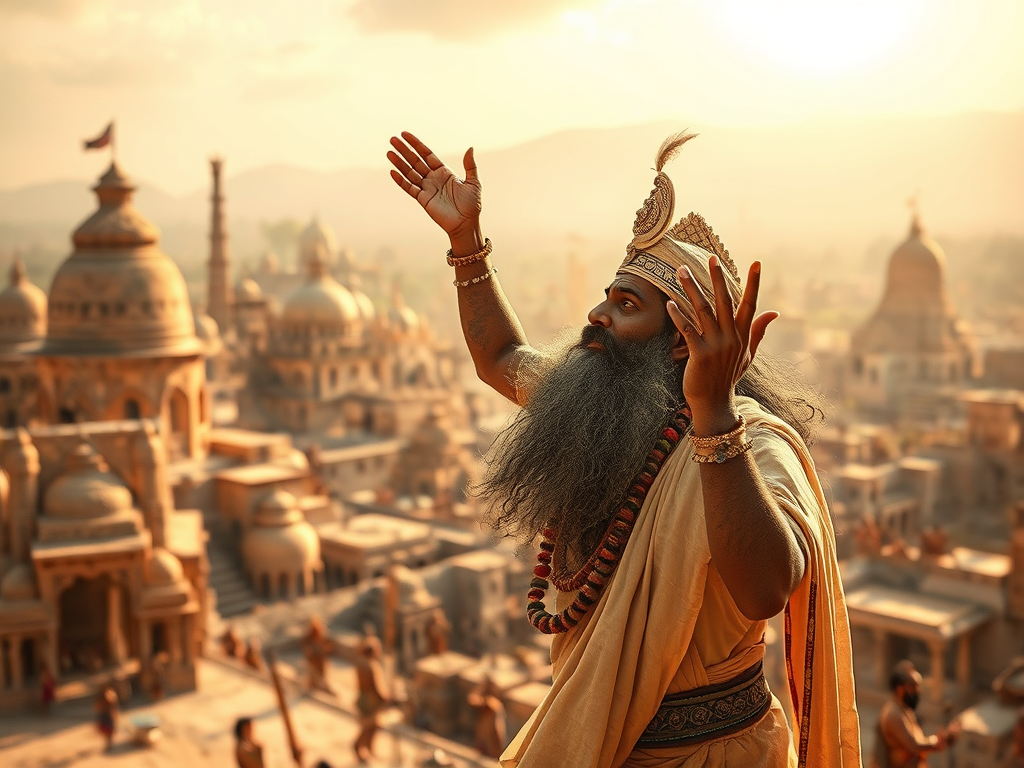
The Civilization of the Seven Rivers — the Sapta Sindhu — lived in a world where poetry, nature, and inner life were deeply connected. The hymns, which later formed the Rig Veda, played a central role in daily life. They were not “religious texts” in the modern sense, but living chants carried by a peaceful society without violence, armies, or oppressive hierarchy. For them, hymns were memory, knowledge, philosophy, and a way to stay aligned with the natural and inner world.
1. A living oral tradition
In this civilization, people did not read: they listened and recited.
The hymns were transmitted orally, generation after generation, within families and clans. Each verse had to be learned by heart, with perfect accuracy.
This was not only a feat of memory; it was a sacred act. A mispronounced hymn was believed to lose its force, like a fire that has not been tended properly.
The hymns united the community. They reminded everyone who they were, where their ancestors came from, and how they were connected to the world’s order.
2. A direct relationship with nature
The people of the Seven Rivers lived in harmony with their environment.
The hymns were a way to communicate with the forces of nature:
- the dawn (Ushas),
- the fire (Agni),
- strength and vital energy (Indra),
- the sacred river (Sarasvatî).
These were not “gods” in the later sense, but living forces that shaped the world.
Reciting a hymn meant awakening an energy: lighting the inner fire with Agni, opening consciousness through the dawn, or flowing into knowledge with Sarasvatî.
3. Soma: an inner experience
Hymns also played a central role in the preparation and drinking of Soma, the entheogenic plant that helped dissolve the ego and bring clarity.
The entire Mandala 9 of the Rig Veda is dedicated to Soma, showing its importance.
The hymns were sung during the preparation of the drink, as a way to align the mind with the experience.
Rhythm, vibration, and repetition created a state of openness and understanding.
4. A philosophy of peace
The hymns show a society without war, domination, or institutional violence.
Unlike later epics, they do not glorify battles.
Instead, they reflect a civilization seeking inner light, truth, and balance.
Hymns served as a moral guide.
By reciting them each morning, people reminded themselves that life is not a struggle against others, but a path toward clarity.
5. Building a shared identity
The Sapta Sindhu was not an empire but a network of towns and villages connected by ritual, culture, and hymns.
Through these chants, a common identity endured for more than a thousand years.
The hymns were the backbone of society:
- they transmitted values,
- preserved ancestral memory,
- explained the structure of the cosmos,
- and gave meaning to daily life.
Without writing, they were library, school, philosophy, and social connection all at once.
6. A refined poetic art
The hymns were not only spiritual texts but also beautiful works of poetry.
Rhythms, meters, images, and subtle sound patterns show a high level of artistic mastery.
Each rishi was both a poet and an inner explorer.
Poetry was a tool for diving into consciousness, especially during Soma experiences.
7. A legacy for future ages
What is remarkable is that the hymns survived across millennia.
Even the drying up of the Sarasvatî, even migrations and social changes, could not break this line of transmission.
This is why we have the Rig Veda today: the oldest book of humanity, born from a civilization that chose peace, clarity, and harmony as its foundation.
 Le Rig Veda
Laisser un commentaire