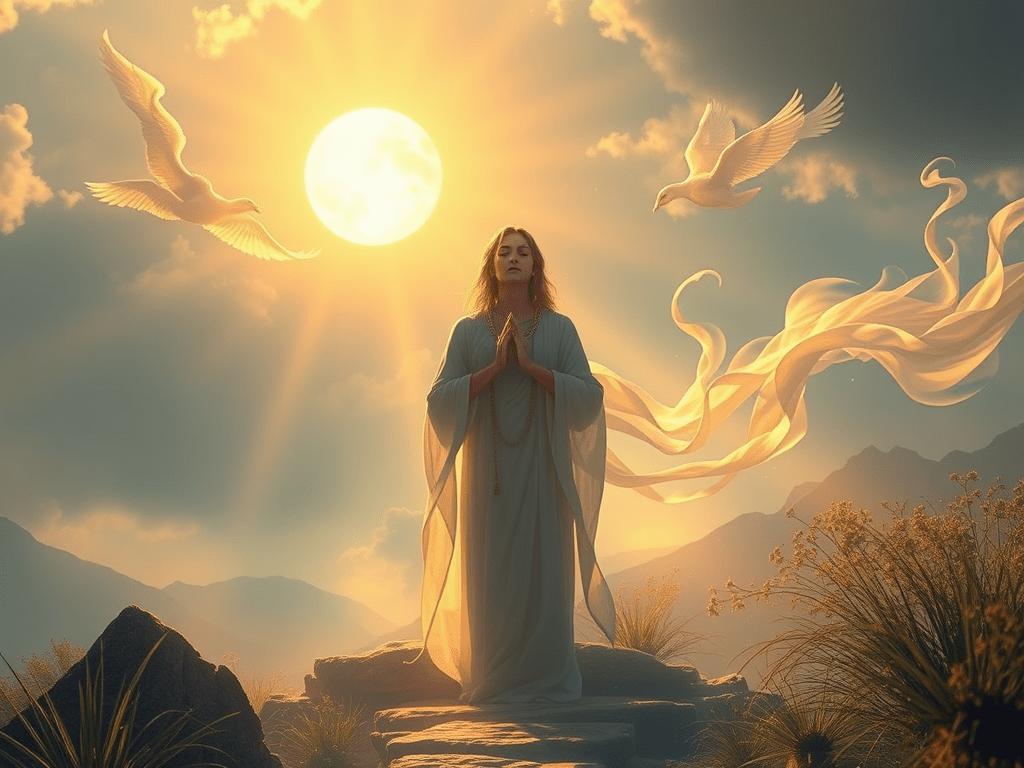
The Rig Veda is a chant. Not a book to be read while sitting in an armchair, but a set of mantras recited aloud during sacrifices. Each verse is a vibration. Each mantra is a call, a praise, an opening of the mind to the inner Light .
The mantra is not a word
In the Rig Veda, a mantra is not a magic formula or a poem. It is the Word , what the text calls vāc , the vibrant force that connects the human to the divine. This word is not a human invention. It comes from Brahman , the ultimate ground of everything. It is transmitted by the rishis , inspired seers, who see these sounds, not who invent them.
The mantra is therefore a sacred sound , carrying energy. It acts on consciousness. It purifies , illuminates , elevates .
The Gayatri Mantra
This is one of the best known (RV 3.62.10):
10 – May we obtain this luminous splendor, so desired, from the god Savitri who stimulates our thought.
So this is not wishful thinking, but a direct action on the mind . This mantra calls on Savitr, the inner solar force, to elevate our thoughts. It is a mantra of elevation , not submissive prayer.
Each mantra is a breath
To recite a mantra is to breathe with it. In the Rig Veda, breath is central. Vāyu , the wind, is also the vital breath. Chanting is ritual breathing . It sets the rhythm of the sacrifice. It supports the inner effort of the sacrificer.
When we chant a mantra, we align ourselves with the forces of the world: Fire ( Agni ), the Sun ( Savitr ), Light ( Ushas ), Wind ( Vāyu ), Waters ( Apas )… These are not gods in the religious sense. They are natural and internal forces , which the mantra sets in motion within us.
Recitation transforms
The Rig Veda often says that soma acts with speech. For example:
“Indra, come, led by thought, invoked by the enlightened sacrificers, drink the juice of soma, which is the Word of the sacrificer.” (RV 1.3.5)
Or again:
“Sarasvatî, who purifies us, who sings the Force with Energy, promotes rich meditation during sacrifice.” (RV 1.3.10)
The word is not external. It guides meditation , it purifies , it carries strength . It is the creative Word , the one that brings about the inner Real.
A precise, oral and sacred transmission
The mantras were not written down. They were completely memorized , with perfect rhythm, tone, and pronunciation. Because any change would have altered the vibration .
This rigorous recitation was a path of inner transformation. The reciter was not simply reciting a text. He was aligning himself with Brahman.
The goal: Enlightenment
All mantras have an ultimate goal: enlightenment , Truth , Light . Not faith, nor obedience, nor an imposed morality. The important thing is not the moral content, but the spiritual effect .
The text says:
“We drank the soma. We became immortal. We entered the Light, we found the gods.” (RV 8.48.3)
But also :
“ Mitra and Varuna, this soma juice enables one to attain the Truth. Listen here to my invocation.”(RV 2.41.4)
And again:
“The recitation of the invocation […] gives us a powerful ecstasy through the juice of soma and through friendship.” (RV 1.10.5)
Conclusion
In the Rig Veda tradition, the mantra is a vibrational key . It opens a passage between the human and the divine. It is not used to believe, but to live an inner experience . The Vedic mantra is a tool to unite the human spirit with the Light .
The right words, sung in the right way, in the right ritual, raise awareness . They don’t talk about enlightenment. They make it possible.
 Le Rig Veda
Laisser un commentaire