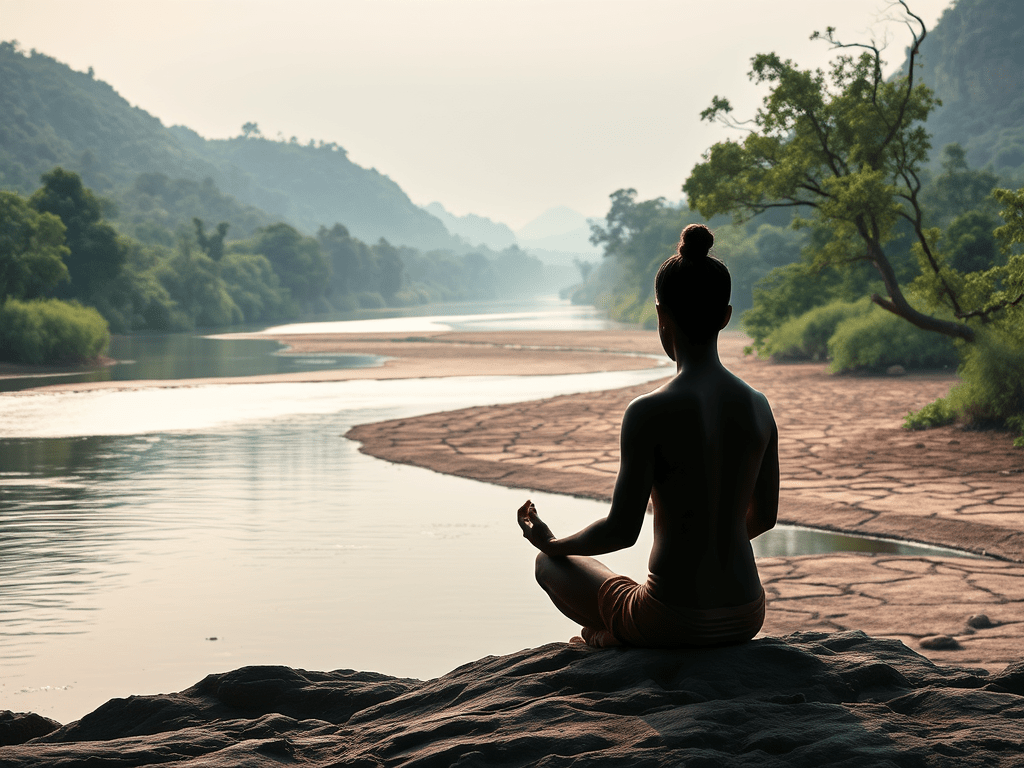
Around 2200 BCE, a major turning point marked the Seven Rivers Civilization. Soma, the sacred plant used in spiritual rites to awaken consciousness, began to disappear during the great drought. The Sarasvati River, the central axis of this civilization, was gradually drying up. This climate change made soma increasingly scarce, eventually causing a real shortage.
Faced with this situation, two paths emerged among the inhabitants of this civilization. Two different ways of continuing to seek the connection with the divine.
The ritualist movement: keeping the form of the rite
The first movement chose to remain faithful to the ancient rituals. Since the real soma plant was no longer available, the priests decided that the most important thing was no longer the plant itself, but the proper conduct of the sacrifice.
Everything had to be perfectly organized: every gesture, every word of the chant, every offering. A specialized priest, called the Brahman , did not participate directly in the sacrifice. He remained in the background to observe, listen, and correct the slightest error. This role shows how precision had become more important than the inner experience itself.
This movement emphasized the external form of the rite, keeping alive a thousand-year-old tradition, even without the sacred plant.
The Inner Current: Rediscovering the Effect of Soma Through Other Paths
But another current took a very different direction. For them, the disappearance of soma was not an end. It was a call to search within oneself for what soma once allowed one to feel.
They asked themselves: How could they regain the ecstasy, clarity, and peace that soma provided? Their answer: through meditation, breathing, silence, and self-knowledge.
This movement gave birth to the Upanishads , very profound texts, born of inner research. In these writings, we discover that true soma is not a plant. It is an experience that can be born in each of us, through listening, presence, breathing, and awareness. The goal was no longer to make the external sacrifice well, but to discover the inner fire , this living link between the human being and the universe.
Birth of Inner Hinduism
These two currents have influenced the entire spiritual history of India. The first laid the foundations for Vedic rituals. The second paved the way for what is now called inner Hinduism , centered on direct experience, meditation, and the search for unity with the Whole.
Thus, the shortage of soma sparked a movement back to the essentials. The disappearance of a plant pushed some to seek another way to awaken. This inner quest is still at the heart of many spiritual practices in India and elsewhere today.
 Le Rig Veda
Laisser un commentaire