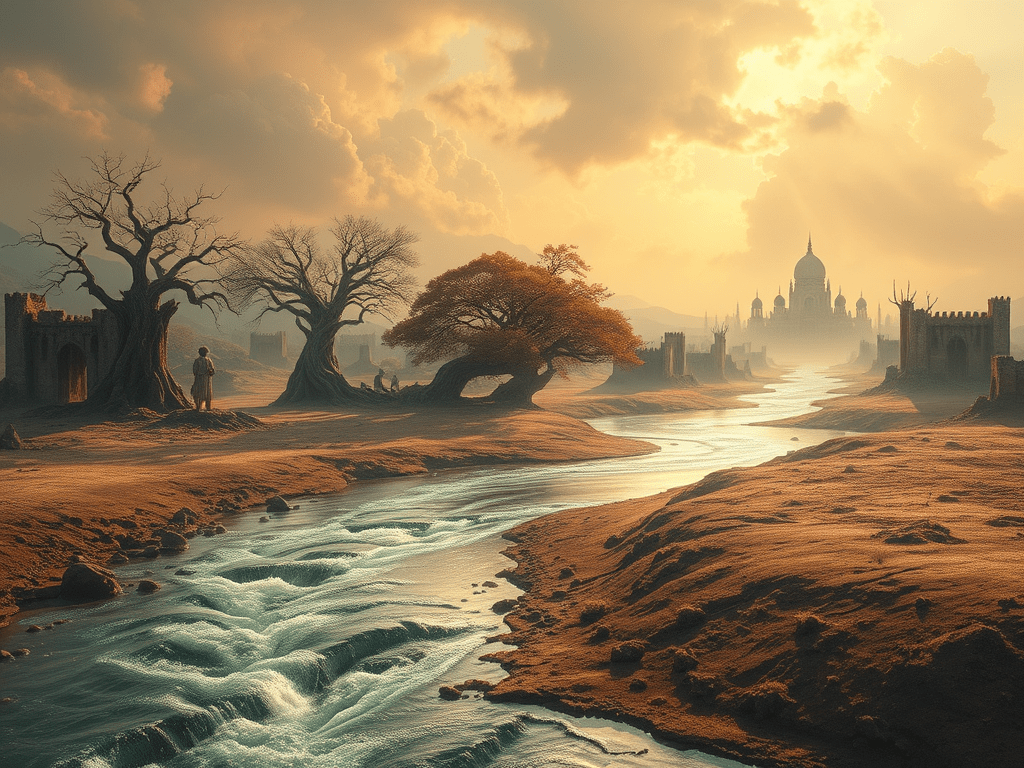
The Rig Veda is an ancient collection of sacred chants. It tells us of a bygone world, that of the civilization of the seven rivers, a society without armies or slavery, with well-organized cities, comfortable homes, waterways, and a deep respect for nature. The tenth Mandala, the last book of the Rig Veda, seems to have been added at the end of this great era.
Why is this mandala so different from the others? Several clues show us that it reflects a period of transition, perhaps even the final moments of a civilization that felt its end approaching.
1. The Sarasvati still flows, but the Drishadvati has disappeared
In Hymn 10.75, the Sarasvati River is still mentioned as powerful, but one detail is striking: the Drishadvati, one of its major tributaries, is no longer mentioned. This absence is strange. In the third mandala, which was ancient, the Drishadvati occupied an important place. Its silence in this Mandala could show that this river has dried up, or that it has changed its course, probably due to a major geological upheaval, such as an earthquake.
The Sarasvati itself, once wide and powerful, now appears to be weaker. This is consistent with recent research, which shows that the river gradually disappeared between 2000 and 1900 BC, due to the diversion of its main tributaries.
2. Rishis from unknown families
In the other Mandalas, the rishis (poet-wise men) belong to known families, sometimes for several generations. But in the tenth Mandala, many of these sages come from unidentified families. This suggests that the transmission has been interrupted, or that new poets have taken over in a changing society.
What we see here is an image of an era that no longer follows the old rules, perhaps because those rules no longer worked in a rapidly changing world.
3. The Soma has disappeared, the old chants too
In the ancient mandalas, the hymns are full of energy. They sing of the forces of nature: light, fire, rivers, and especially Soma, the sacred plant without flowers or seeds, which opened the doors to enlightenment.
But in the tenth Mandala, the true Soma seems to have disappeared. The songs are more social, more human. They speak of marriage, death, the origins of the world, and social organization. They are no longer the cries of joy of a society in full swing, but the reflections of a people who feel their world is changing.
4. A society still organized, but already in decline
Hymn 10.90, known as Purusha Sukta , depicts a society that is still highly structured. It discusses the various roles of society: teachers, leaders, traders, farmers. This poem celebrates unity in diversity. But it also marks a form of withdrawal: society is being organized to stand as its natural foundations (such as rivers) begin to fail.
It is probably around the year 2000 BC, when the Sarasvati River lost its tributaries, large cities began to be abandoned, and the climate became drier.
5. One last message: the anthem of the union
The tenth Mandala ends with a powerful hymn: a call to unity. It invites all men to think alike, to walk together, to speak with one voice. This hymn seems to have been placed there as a farewell message. As if the compiler wanted to keep a record of what this civilization of the seven rivers was: a society of peace, harmony, and wisdom.
This final anthem is like a cry from the heart. It says: “Remember who we were. A united people, living with nature, inspired by the light.” There is in these verses the awareness that everything could disappear. It is not just a religious text, it is a human call.
A lesson for our time
Today, our modern world faces its own crises: global warming, divisions, and a loss of meaning. Reading the tenth Mandala, one senses that the ancients understood something. They knew that a civilization does not last forever. But they wanted to leave one last song. A song of unity, of memory, and perhaps of hope.
Perhaps this is why this Mandala exists: to remember. To tell future generations that a great civilization existed there, between the Sarasvati and the Drishadvati. A civilization of the seven rivers, free, without war, and focused on awakening.
 Le Rig Veda
Laisser un commentaire