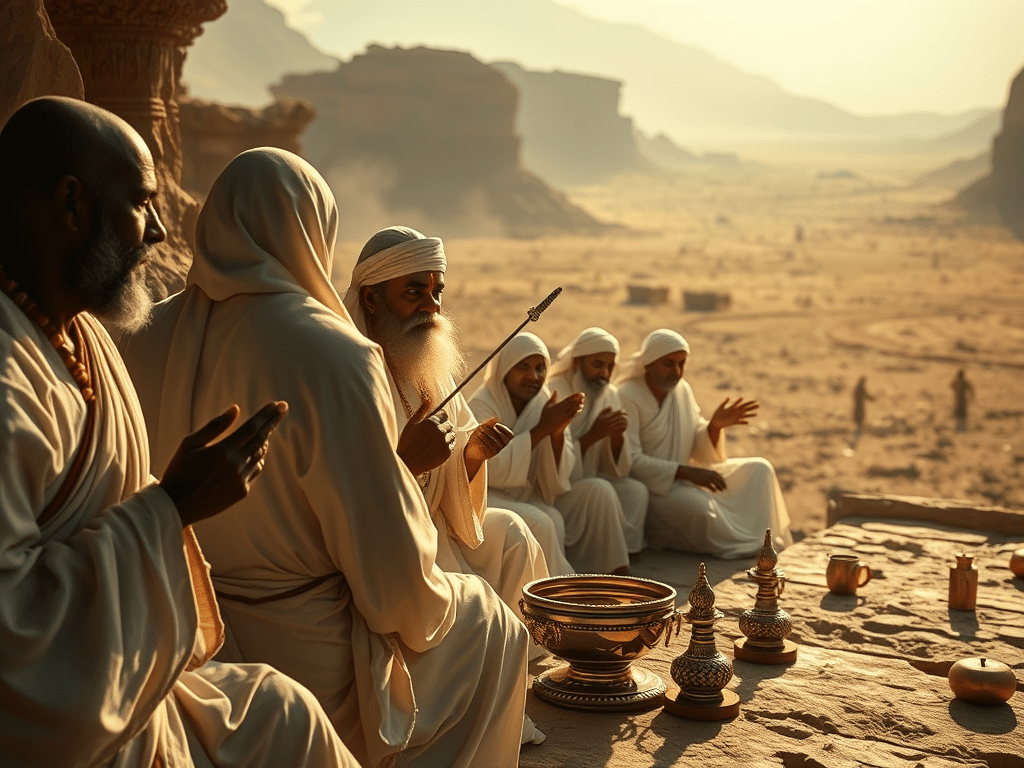
The civilization of the 7 rivers, which extended along the Sarasvati and the Indus, was a prosperous and balanced society. For a long time, it was marked by strong cohesion and an absence of marked inequalities. However, a major climatic event upset this balance: a great drought that occurred around 2200 BCE.
The rarefaction of soma
Soma, the sacred plant used in Vedic rituals, played a central role in the spirituality of the Seven Rivers civilization. Consumed by all members of the society during ceremonies, it was believed to bring a clear vision of the world and a connection with the divine.
But the drought that struck the region led to a scarcity of soma. The plant, which depended on a humid climate to grow, became increasingly difficult to find. Faced with this shortage, the priests decided to limit access to this sacred drink. (10.85.3)
The exclusion of shudras
Initially, the priests reserved the soma for the upper castes, gradually excluding the shudras, who formed the basis of society. This decision marked a break in the ancient traditions where the soma was shared by all. This change is evoked in the tenth mandala of the Rig Veda, which testifies to a significant social transformation. (10.90.4)
This process of exclusion contributed to the emergence of inequalities. Society, once more egalitarian, began to structure itself around privileged access to the sacred. Priests became the sole holders of the soma, thus reinforcing their power and influence.
The disappearance of soma and its consequences
Over the centuries, soma became increasingly rare. Around 4100 BCE, it disappeared completely, probably due to climate change and the progressive desertification of certain regions.
Without soma, Vedic spirituality evolved. The rituals continued, but the drink was replaced by other psychoactive plants, but which did not give the same results. This change further strengthened the authority of the priests, who remained the guardians of sacred knowledge.
The disappearance of the soma thus marked a turning point in the history of the civilization of the 7 rivers. What was once a society based on sharing and harmony gradually slid towards a system where inequalities were reinforced.
Conclusion
The great drought of 2200 BCE caused much more than just an ecological crisis. It was the cause of a major social upheaval in the civilization of the 7 rivers. The gradual disappearance of the soma allowed the priests to increase their power and exclude the lower classes from sacred rites. This process marked the beginning of a more hierarchical society, where access to the divine was no longer a universal right, but a privilege reserved for an elite.
 Le Rig Veda
Laisser un commentaire