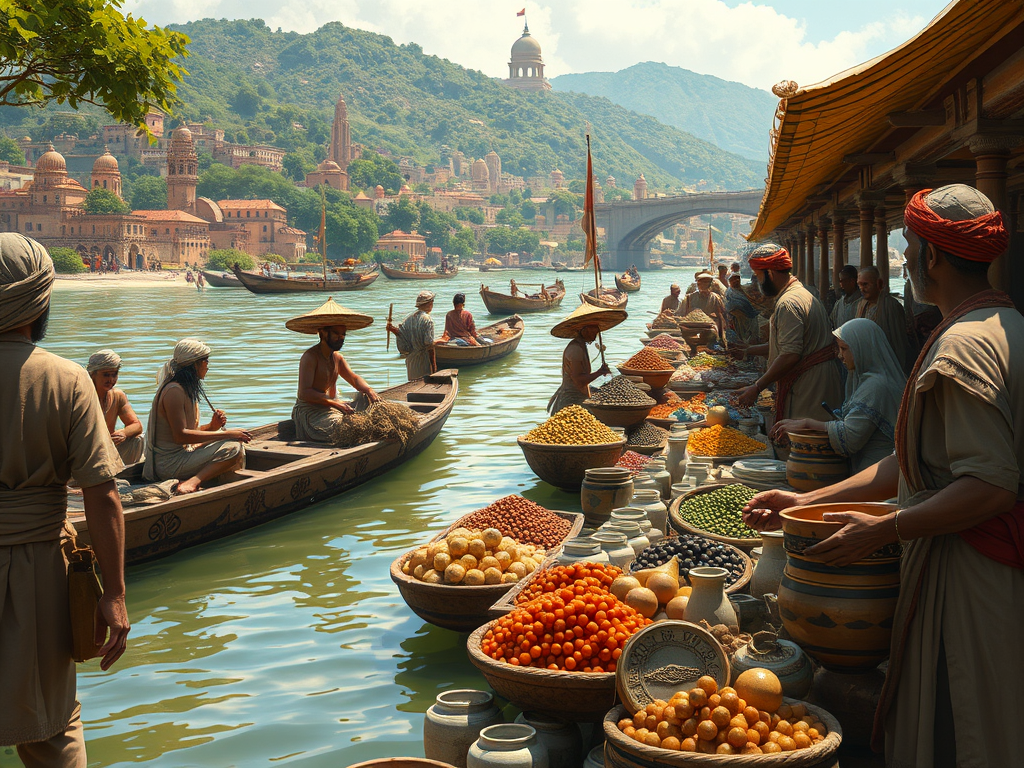
The Seven Rivers Civilization, which developed in the Indus Valley and along the Sarasvati, maintained trade links with many regions, including the Persian Gulf. These exchanges allowed the circulation of raw materials, crafts and know-how between these two areas, promoting their prosperity.
Trade routes and products traded
The merchants of the cities of Sarasvati mainly used river and land routes to transport their goods to the ports located at the mouth of the Indus. Lothal, which was not a port but a shipyard, is a good example of this. A large port, now under the sea, must have been located not far from Bet-Dwarka. From there, ships sailed to the cities of the Persian Gulf, notably Dilmun (Bahrain), Magan (Oman) and sometimes as far as Mesopotamia.
The objects found on these sites show an active trade. Among the products exported by the civilization of the 7 rivers, we find:
- Carnelian beads and jewelry , highly prized in Mesopotamia and the Gulf.
- Copper and bronze , which were used to make tools and weapons.
- Ceramics and engraved seals , bearing inscriptions that show a form of accounting.
- Agricultural products , such as grain and cotton, which were probably traded for other commodities.
In return, the merchants of Sarasvati imported:
- Copper from Oman , used to make metal objects.
- Lapis lazuli and other precious stones , coming from Afghanistan and passing through the Persian Gulf.
- Precious woods and resins , used for construction and religious rituals.
Cultural and commercial links
The engraved seals of the Seven Rivers civilization found at sites in the Persian Gulf show that exchanges went beyond simple trade. Objects bearing similar symbols and inscriptions suggest regular contact and perhaps even the presence of merchants established on site.
In addition, certain craft techniques, such as carnelian work, seem to have influenced the Gulf artisans. The use of flat-bottomed boats for maritime transport was also common to both regions, a sign of shared know-how.
A thriving exchange network
Thanks to these economic relations, the cities of the Sarasvati were able to prosper for centuries. This trade strengthened their infrastructures and allowed the circulation of ideas and innovations. The gradual collapse of this economy around 1900 BCE, due to the drying up of the Sarasvati and climate change, marked the end of this flourishing period.
The connections between the Seven Rivers Civilization and the Persian Gulf illustrate a well-organized trade network, linking India, Arabia, and Mesopotamia. They also show that these ancient societies were much more connected than is often imagined.
 Le Rig Veda
Laisser un commentaire