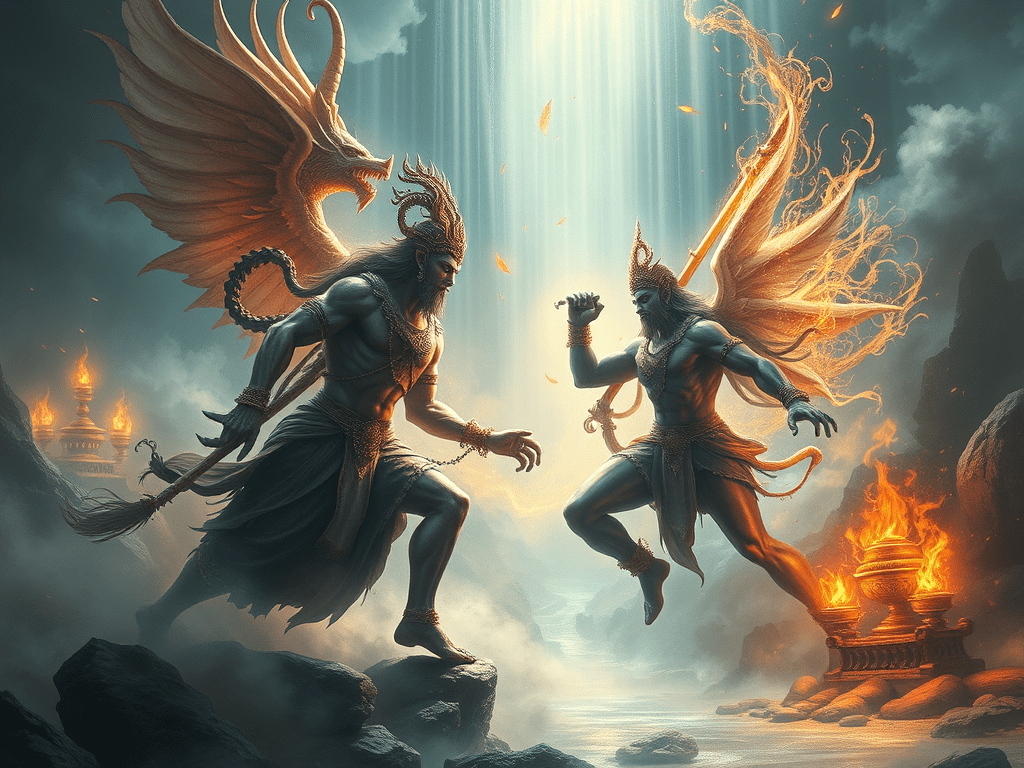
In the Vedic texts, an eternal struggle opposes the gods (Deva) and the demons (Asura, and other demons). This conflict, often described as a cosmic war, takes place in a setting where rituals and sacrifices play a central role. But behind these spectacular battles, we must see symbolic metaphors linked to spiritual experiences and significant historical events.
A spiritual fight within the framework of sacrifice
In the civilization of the 7 rivers, Vedic rituals involved the consumption of Soma, an entheogenic plant with visionary effects. In this altered state of consciousness, priests and initiates lived intense inner experiences, later translated into the form of epic stories. These battles should therefore not be understood literally: they reflect symbolic visions, inner struggles and cosmic dynamics perceived through the experience of the ritual.
The Deva, forces of light and harmony, confront the Asura, often associated with illusion, greed, and chaos. This conflict represents the struggle between clarity and obscuration of consciousness, a tension found in many spiritual traditions.
A reflection of ancient events
While these stories are primarily metaphors, they can also retain the memory of real events that occurred long before they were written down. A striking example is the story of the Panis, which means: greedy or miserly. According to the Rig Veda, they steal the cows of the Vedic people and hide them, which leads to the intervention of Indra, god of strength and storm, who frees them.
This scene can be interpreted as a memory of a solar eclipse that occurred on February 19, 3929 BCE. In Vedic astronomy, cows are often associated with light. The idea of a cow theft could therefore symbolize an obscuration of the sun by the moon, which the ancient priests would have transcribed in the form of a myth.
Cosmic war as a key to reading the world
The confrontation between the Devas and the Asuras in the Vedic hymns is not a simple story of battles between deities. It illustrates fundamental principles: the need to combat ignorance, resistance to forces that hinder spiritual elevation, and the maintenance of a just order. In this framework, the Soma plays a central role in providing access to visions where these realities are perceived in a poetic and powerful form.
By combining mystical experiences and astronomical events, the Seven Rivers civilization has passed on a legacy that allows us to better understand the relationship between myth, ritual and historical reality. These stories are neither mere legends nor pure descriptions of past battles, but keys to exploring profound truths about man and the universe.
 Le Rig Veda
Laisser un commentaire