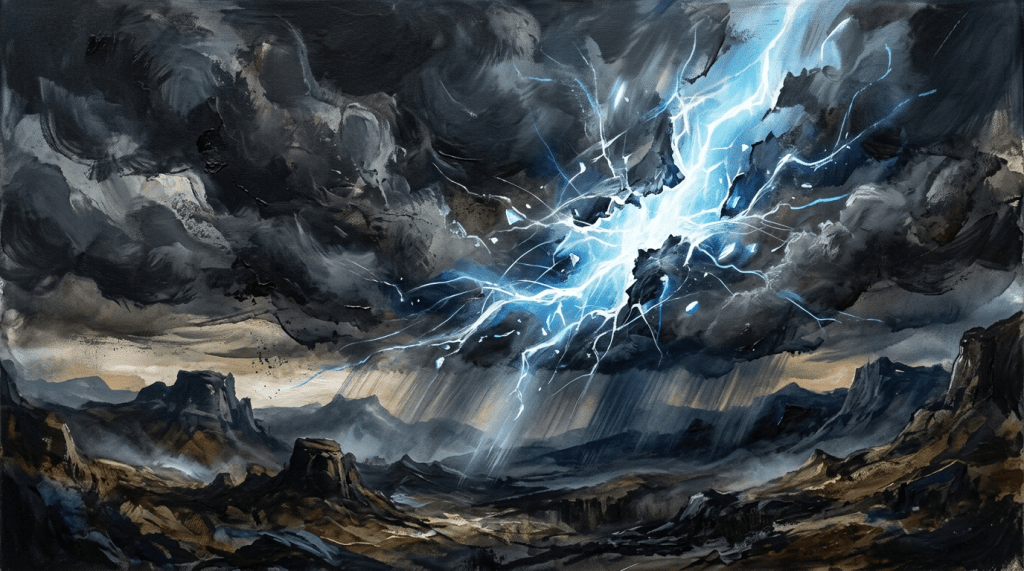
Indra is often misread. Because he carries the thunderbolt, because he slays Vritra, because he is called a “warrior god”, one imagines him on a war chariot in literal, heroic violence. This is the most common misreading of the Rig Veda. In my translation, it became clear very quickly that Indra’s battles are not wars in the ordinary sense — they are metaphors for consciousness. And this rereading opens an unexpected path toward a philosophy of non-violent resistance.
Indra means “he who is powerful.” He is the god of intellect, of storm, of the light that breaks through clouds. His weapon, the thunderbolt, is explicitly described in my Rig Veda glossary as “the weapon that kills ignorance to make room for Light.” Vritra, his supreme enemy, means “he who covers, who obstructs” — darkness, gloom, the one who prevents man from reaching illumination. Indra’s victory over Vritra is not a military victory: it is the victory of clear consciousness over ignorance, of light over what blocks it.
This symbolic framework changes everything. When the Rig Veda says that Indra is “invoked in battles” and that we must ask him to “vanquish evil thoughts” and “overcome aggressiveness”, it is not a prayer to win a physical battle. It is an invocation of inner power — that lucid intelligence that makes it possible to resist what crushes us without submitting to it and without becoming what oppresses us. This is a remarkably precise definition of what the non-violent tradition would call, millennia later, resistance through truth.
What I take from Indra is that he conquers for mankind “wealth, which is Brahman; Light, symbolized by the cow; and strength, symbolized by the Horse.” These are not material goods: they are states of consciousness. Vedic wealth is the awareness of reality. Vedic strength is the capacity to act from this place of consciousness without being swept away by anger or fear. This kind of strength does not need violence to express itself. It expresses itself precisely as resistance to whatever extinguishes the light.
The civilization of the 7 Rivers, which practiced this spirituality daily, did not wage wars of conquest. Conflicts existed — the War of the Ten Kings being one — but the general culture was not oriented toward military expansion. Its leaders regularly drank soma, a substance that dissolves the ego and expands consciousness. Such a state does not predispose one to domination. It predisposes to precisely the opposite: the perception of the other as part of oneself. This is the philosophical root of non-violence.
Gandhi — who grew up in a culture steeped in this tradition — put modern political words on something the Rig Veda already contained: resistance that draws its strength not from the capacity to destroy the enemy but from the capacity to maintain, under pressure, clarity of consciousness. Satyagraha, the “force of truth”, is the political translation of a worldview where Indra — luminous intelligence — is more powerful than any violence. Vritra, who “covers and obstructs”, bears a striking resemblance to all systems that block the circulation of the common good: oligarchies, censorship, state apparatuses that interpose themselves between human beings and their own light.
What the Rig Veda proposes, read this way, is an ethics of resistance founded not on hatred of the adversary but on the conviction that light is stronger than darkness — and that our work is to be on the side of the light, with the thunderbolt of Indra as our only weapon: intelligence, the right word, the hymn that names what is. In a world that lacks models of non-destructive resistance, this figure has something to say.


Votre commentaire