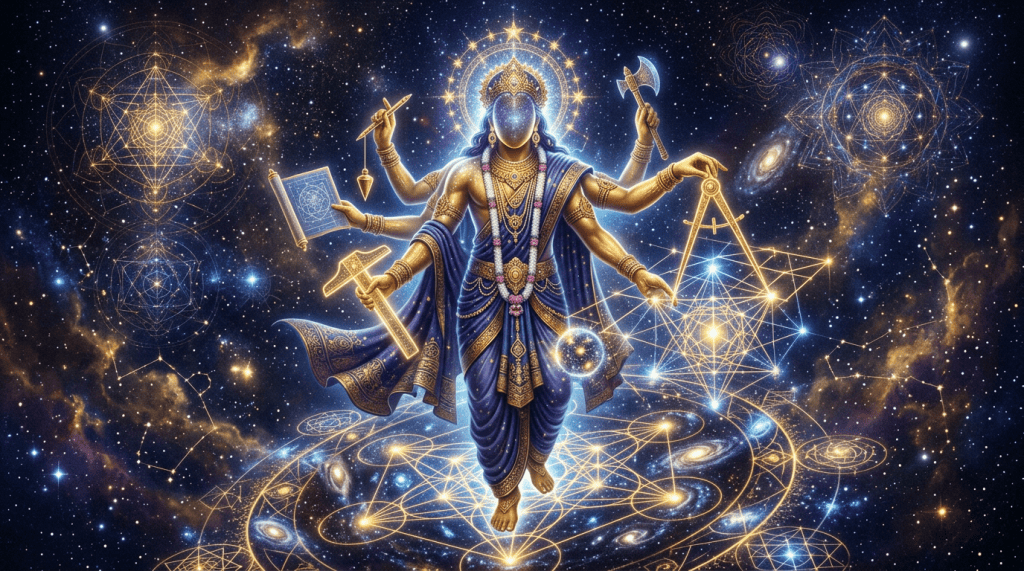
In the Vedic pantheon, every cosmic force is deified — fire, water, wind, dawn, speech. But there is one god who stands apart from all the others by his function: not a natural force, but an activity — the most fundamental of all. The act of creating, conceiving, building, giving form to what had none.
This god is Viśvakarman — literally « he whose acts are universal, » « the craftsman of everything. » And the two hymns the Rig Veda devotes to him — 10.81 and 10.82 — are among the most philosophically dense texts in the entire Vedic corpus.
The architect who names himself
The extraordinary particularity of hymn 10.81 is that its rishi — its author — is Viśvakarman Bhāuvana, that is, Viśvakarman himself. The architect of the cosmos is also the poet who sings his own nature. Like Vāc in hymn 10.125, Viśvakarman speaks in the first person about the reality he embodies.
10.81.1 — All creatures have called the rishi, the invoker, our father, sitting below, ardently asking for the Riches, he enters into the first as into the last.
« Our father » — Viśvakarman is the father of all creatures because he gave them form. « He enters into the first as into the last » — he is present in the first instant of creation as in the last manifested beings. He is the creative intelligence that precedes all and traverses all.
10.81.3 — He who sees on all sides, whose face is turned on all sides, whose arms and feet are on all sides, welds with his arms, with his wings, completely, Heaven and Earth — he, the one god.
« Whose face is turned on all sides » — Viśvakarman is omniscient because his gaze encompasses all directions simultaneously. He has no particular point of view — he sees from the centre of everything. And it is from this total vision that he « welds Heaven and Earth » — that he maintains the cohesion of manifested space.
The enigma of the material
Hymn 10.81 poses a question that is not rhetorical — it is a genuine philosophical question, vertiginous in scope:
10.81.4 — Who, in truth, was the forest? What is that tree from which they fashioned Heaven and Earth?
What is the cosmos made of? What material did the architect use? The « forest » and the « tree » are not naive metaphors. They are pointers toward a reality that ordinary words cannot say directly: the primary substrate of all manifestation, what the later Vedic tradition will name prakṛti — primordial Nature, the raw material of the universe.
10.81.2 — Who, in reality, approached the place of grasping? How did he do it? How did Viśvakarman generate the Earth? How did the one who sees all choose Heaven, by his greatness?
These cascading questions — « how? », « by what means? », « from which place? » — are not questions the text answers directly. They are the sacrifice itself. To pose the question of creation with sufficient precision is already to approach the answer. This is the same approach as the Nāsadīya Sūkta — the philosophical question as a spiritual act.
Hymn 10.82: the first germ
If hymn 10.81 questions the how of creation, hymn 10.82 ventures toward the what — the first origin, the germ from which all emerged.
10.82.1 — The Father of the eye, through his wise mind, generated the clarified butter and the two that go up and down. When the ancient limits were fixed, then Heaven and Earth extended.
« The Father of the eye » — Viśvakarman is the consciousness that makes vision possible. Before the eye, there is the one who gives the eye. Before perception, there is the one who makes perception possible.
10.82.3 — This one is our father, the progenitor, he knows the domains and all creatures. He gave the name of the gods.
« He gave the name of the gods » — Viśvakarman precedes the gods themselves. He is the intelligence that named Agni, Indra, Varuṇa, Vāc. The gods are not primary — they are aspects of reality that the architect of the cosmos differentiated and named.
10.82.5 — Was it beyond Heaven, beyond Earth, beyond the gods and the Asuras? What first germ did the waters receive?
10.82.6 — This first germ was brought to the waters, where all the gods gathered. They inserted one into the navel in which all creatures stood.
The « first germ » — prathamam garbham — is the central concept of hymn 10.82. It is the Vedic equivalent of what contemporary cosmology calls the initial singularity — the infinitely dense point from which everything emerged. But in the Vedic vision, this germ is not purely physical: it is deposited in the Waters by the consciousness of Viśvakarman. Intention precedes matter.
Viśvakarman and the artisans of the 7 Rivers civilization
10.81.7 — Today, we call the master of speech, Viśvakarman, for help, for energy, for quickness of mind.
« The master of speech » — Viśvakarman is also the master of the mantra, the just formula, the speech that creates. Physical creation and verbal creation are, in the Vedic vision, one and the same fundamental activity: giving form to what had none. The architect who draws a plan and the rishi who composes a hymn make the same fundamental gesture.
Today, in contemporary India, Viśvakarman is the patron of craftsmen, engineers, and architects. His festival — Viśvakarma Jayantī — is celebrated on September 17th in workshops, factories, shipyards and laboratories. Tools, machines and instruments are decorated with flowers and blessed. The intelligence that creates honours its own source.
Four thousand years of continuity — from hymns 10.81-82 to the workshops of Mumbai and Chennai.


Laisser un commentaire